
via TechRadar - All the latest technology news https://ift.tt/tLgKOBS
The most recent iPhone is the iPhone 14, launched last September – but it all started way back in 2007, and the very first Apple-made smartphones that were launched in that year are now worth rather more than their initial $499 asking price.
An original, unopened iPhone 1 is now up for auction (via AppleInsider), and is expected to fetch as much as $50,000 (that's about £41,480 / AU$72,235 at today's exchange rate). That's not a bad return on an investment after 16 years.
This is "one of the most important and ubiquitous inventions of our lifetime" according to the auction listing, a device that "forever changed the smartphone industry" and which is now "widely regarded as a blue-chip asset amongst high-end collectors".
The auctioneers make reference to two earlier auctions for similar items that have come close to the $40,000 mark, and it would appear that the price is likely to go up over the years. As we're writing this, the top bid for the item stands at over $11,000, with the auction running until next Thursday.
It's clearly one of the most important gadgets of the century – perhaps the gadget of the century – but it doesn't hold up as a phone today: the screen is a tiny 3.5 inches from corner to corner (with a 480 x 320 pixel resolution), and the storage maxes out at 16GB. There's a single 2MP camera on the rear.
Our review of the first iPhone is still available to read online, and while we liked the intuitive interface and the "dazzling screen", we were disappointed by the lack of 3G connectivity (remember that?) and the fixed focus camera.
Seeing the price of an Apple iPhone 1 rocket up a hundred fold over the course of 16 years shows just how iconic this particular smartphone is – so while it's worth checking your drawers at home for old and vintage tech, don't expect to make a fortune from your Google Pixel 2, for example.
It's not just the age but the manufacturer that's important, and the place that a device has in history, when it comes to making valuations on older tech. Collectors seem to love Apple, and you might remember that an Apple-1 computer built by Steve Jobs and Steve Wozniak fetched a handsome $400,000 back in 2021.
Condition is crucial as well – you're not going to get anywhere near as much for your classic devices if you've been using them for a couple of years before stuffing them back in their box. Should you be planning to get into the long-term tech investment game, keep your electronics sealed in their original packaging.
It's hard to predict what might be the next must-have piece of collectable tech, but gaming machines and Apple devices are likely to be good bets – if you can afford it, it might be worth keeping an Apple AR/VR headset or a Nintendo Switch 2 stashed away somewhere, if and when they eventually launch.

Each time I play a new video game I find myself trying to capture that feeling I had playing them when I was younger. That feeling where you find yourself staring up at the screen and nothing else around you matters.
After years of trying to recapture that magic, I finally found it when I picked up Disney's Dreamlight Valley.
Growing up, I was an only child who lived with a single parent who worked full-time, this made me very familiar with feeling lonely. I often found myself looking to the media around me for some form of comfort and as it was the 1990s, that media had something to do with Disney. Disney was everywhere at the time, from the Saturday morning cartoons I watched, the clothes I’d wear, the film’s I’d go see in the cinema, and the video games I played.
One of my earliest gaming memories is of playing Capcom’s Aladdin on the SNES. The film the game was adapted from was the first movie I ever saw in a cinema. I was obsessed, down to the Genie backpack I’d proudly take to school every day.
This obsession led to the video game becoming my favorite at the time alongside being my main source of comfort. I would spend hours upon hours hurling apples at foes and swinging from platform to platform as Aladdin while listening to the lovely 16-bit renditions of the film’s catchy musical numbers.
During the summer, while my school friends would visit Mickey Mouse and friends in person at Disneyland, I spent my holidays visiting my favorite characters through the video games I’d play.
I’d stay with my Grandparents every summer, and be fixated on my Grandad’s Packard Bell PC, playing games like Disney’s Magic Artist and Disney’s Storybook: 101 Dalmatians. Again, I could sit there for hours, staring up at the PC monitor, finding comfort with the characters I knew so well.

Eventually, I lost the ability to fully immerse myself in video games. I still played them, but the older I got, the more responsibilities and realities of the world around me would get in the way of how I experienced the media I once admired. I also began to notice that I was no longer the target demographic for a lot of Disney content.
Sometimes you just have to accept that Disney Princess: Enchanted Journey for the Nintendo Wii isn’t for you, and that’s okay. There were games like Kingdom Hearts, which I was, and still am adamantly a fan of, but the feeling I had interacting with my favorite characters wasn’t the same now that the realities of being an adult had begun to set in.
Then, years later, Disney’s Dreamlight Valley happened.
“..yearning for a pause from life’s responsibilities, you arrive at a familiar place”, the opening narrator states as you start a new game. It's almost like the developers at Gameloft knew exactly what gaming experience I was looking for.
Disney’s Dreamlight Valley is a mixture of a life and farming simulator, think that of Animal Crossing but with a Disney coat of paint. When you begin to play, you have your own little house, which you can decorate with Disney-themed items, allowing me to make a space that looks not too dissimilar to my own bedroom when I was younger.
The main objective is to help the Disney characters get their memories back, as they’ve been inflicted with a curse. The more I helped the characters remember, the more I remembered that wonderful feeling of playing Disney games on my Grandad’s PC. Although the PC I was now using was a lot more advanced, the feeling of staring up at the monitor was all too similar.

What sets Dreamlight Valley apart from the Disney games I played when I was younger, is that now I get to play as myself. Instead of playing as my favorite Disney hero or villain, I get to hang out with them, as myself. I can start up conversations with Mickey Mouse, take Goofy fishing, or just hang out with my favorite fellow Scot, Scrooge McDuck.
As I took control of the game's version of myself, the immersion I was missing came back with each step I took into the valley. Dreamlight Valley also allowed me to embrace my childhood in other ways. Since playing the game for the first time, I’ve begun to re-buy a lot of Disney toys I used to own when I was younger. From a Snow White bubble bath figure to Pride Rock playsets, down to the exact Aladdin backpack I took to primary school all those years ago. In my home office, there now sits a shelf where all my Disney memorabilia goes.
Where once I was afraid to still like the things I did when I was little, Dreamlight Valley has allowed me to embrace the things which make me happy. My relationship with Disney media has definitely still changed. Since becoming an adult, I’m more aware of their past, and as I like to consume media through a critical lens, I can’t consume their media with the ignorant bliss I had when I was younger.
However, playing Disney’s Dreamlight Valley has brought back a feeling that was missing from my life. That feeling where nothing else matters apart from you and the game you’re playing. Whenever I visit the Valley, I’m reminded of all the days spent staring up at my Grandad’s PC, and for those hours, I’m able to feel like a kid again.
If you watched Samsung Unpacked 2023 earlier this week, you'll know that the company announced a new initiative in the field of Extended Reality, or XR. What we didn't get were any details of an actual physical product – which is where a new leak comes in.
As spotted by GalaxyClub (via SamMobile), a battery that has just passed through regulatory certification in South Korea matches up with a particular model number that the rumor mill associated with an upcoming Samsung device last year.
That device, with the model number SM-I120, was thought to be some kind of AR/VR wearable. Add in the announcement at Samsung Unpacked, and the appearance of this battery module, and it looks likely that this hardware product is on the way.
We can't glean all that much information from this battery leak – we don't know the capacity, for example – but it points to a standalone device that can work independently, without a connection to a computer or a smartphone.
That makes it different from the Samsung Gear VR series, devices which you had to slot a phone into. We can expect a pretty clean break from the virtual reality hardware that Samsung has pushed out in the past.
It's worth remembering that this might not be the product Samsung was referring to at Unpacked, in partnership with Qualcomm and Google – in fact it might only be a prototype. But it's an interesting peek into what's coming in the future.
Terms like virtual reality and extended reality can be difficult to keep on top of – especially when companies use them in different ways. A label attached to something by one manufacturer might not mean the same thing as a label applied by another manufacturer.
What most people agree on is that virtual reality (VR) refers to completely enclosed digital worlds (see the Oculus Quest 2, for example). Augmented reality (AR) refers to putting digital overlays on top of the physical world, and this is something you can do with the cameras on a lot of smartphones now (see Google Maps Live View).
Then there are devices that sort of mix the two: mixed reality (MR). Perhaps the best example of this is the Microsoft HoloLens, though the term is quite hard to pin down – sometimes it means a more supercharged, interactive version of AR, and sometimes it means VR with a dash of AR (such as a video call feed dropped into a virtual world).
Extended Reality (XR) is most often used as an all-encompassing term that covers AR, VR and MR – which means Samsung hasn't given too much away by telling us that it's working on new technology. Expect the leaks and rumors to continue.
Smart speakers are a must for anyone wanting to create a voice-activated home - from listening to music and podcasts to controlling your latest connected gadgets, the devices have become a household staple.
So much so that, in the first three months of 2022, more than 30 million were shipped globally, with Amazon at the forefront of the race accounting for around one-third of them with its Alexa-enabled devices.
However VPNOverview has uncovered some troubling research indicating that your smart speaker is collecting more data about you than you may have initially realized.
Smart speakers are always listening to you (unless you turn off that functionality, which kind of defeats the point), and they’re widely able to keep recordings or transcriptions of what you said to help developers make them even more intuitive, but at what cost?
While Amazon, Google, and Apple all make promises of minimal data collection and high levels of security, many users will have enabled third-party integrations that allow them to interact with a number of services, from connected cars to food ordering apps and just about everything in between.
VPNOverview says that “some of these third-party skills are not thoroughly moderated” which can open up a gateway for hackers, risking various leaks and hacks. Activating a VPN goes some of the way to alleviating these risks.
Another concern raised by the company is that some smart speakers can carry out online purchases directly on the device. It recommends setting up two-factor authentication (2FA) to authorize these transactions, but for many, that again defeats the point of having an enabled device in their home.
Ultimately, in most use cases customers are found to be prioritizing convenience over privacy, almost rendering many of the measures that companies put in place useless.
Google says that by default, it does not retain audio recordings on its servers. Amazon says that its users can review and delete their voice recordings and transcripts that are securely stored in its cloud. Finally, Apple says that it only stores the minimum required data for six months. We reached out to all three companies for advice on what users can do to ensure the maximum protection possible for their data when using smart speakers.
Apple directed us to its HomePod privacy and security webpage, Amazon told us to check out its explainer page and FAQ page, and Google sent us to its privacy information page and guide of actionable steps users can take.
Windows 10 is popping up a very unfortunate full-screen offer during setup of a fresh copy of the OS that is preventing users from reaching the desktop.
The pop-up panel promotes a free trial for Microsoft 365 – but one that’ll turn into a paying subscription if not canceled – and there appears to be a bug that means if you click to decline the trial, you’ll actually accept it.
As Bleeping Computer reports, the so-called ‘nag screen’ (entitled: ‘We’re giving you a free trial of Microsoft 365 Family’) appears on first booting Windows 10, and there’s no way to get around it – the button to ‘skip for now’ normally present has been changed to a ‘privacy and cookies’ link.
With skipping the process out of the picture, users are then faced with two main options: ‘Try for free’ and ‘No thanks’.
The kicker is that if you click on the ‘No’ option, you get sent to a screen asking you to ‘Confirm your payment option’ and then only have a choice to start the trial and ‘Buy later’. In other words, you’re asked to enter a valid set of card details, and payment will be taken to continue your Microsoft 365 subscription after the trial period has ended.
The problem was highlighted on Reddit with an illustrative photo of what happened to a user on first booting a laptop: “Windows 10 preventing me from booting into desktop without first non-consensually being forced to accept their free trial and $100 monthly thereafter (obviously I cancelled after but WTF Microsoft).”
Microsoft 365, for the uninitiated, is the new name for the company’s leading office software suite, which used to be known as Office 365.
What appears to have occurred here is a simple – but very nasty – error where the functions of the respective buttons have been swapped, so the ‘No’ option is actually registered as ‘Yes’ and presumably vice versa. So to get out of the offer screen and onto the desktop, rather than skipping – a choice which really should be present – accepting the offer should decline it, as it were.
Not something you’re likely to think of if you haven’t read this article, of course, and it’s a very confusing situation all-round as to how such a fundamental error has crept into the first-boot sequence for Windows 10.
As the Redditor who spotted this points out, you can always immediately cancel the subscription so it doesn’t renew. Our concern is for less tech-savvy users who may not have read the details of the offer and might not realize that they are subscribed for an auto-renewal, and thus could get a shock when money starts coming out down the line (for what is called a free trial upfront, of course).
Okay, so you could argue that anyone providing their credit card details without really knowing what for or looking closely at terms (the user is actually informed about the auto-renewal) deserves what they get, but that’s hardly the point here. This shouldn’t be happening at all, and in the end, it’s more vulnerable people who are likely to be the ones left out of pocket at the hands of this bug. Microsoft will hopefully be on the case soon enough to sort this one out, bearing all this in mind.
Until then, it may just be the case that yes is no, and no is yes, when it comes to the Microsoft 365 trial. Or alternatively, as others have suggested on Reddit, setting up the new PC without being connected to the internet avoids the nag screen popping up in the first place, but again, this isn’t something the less technically inclined users out there will likely consider.
For those who really do want a freebie office suite, or indeed a paid alternative to Microsoft 365, we’ve got a roundup of all the best non-Microsoft office software out there.
Intel has announced a price cut on its first-party edition of the Arc A750 graphics card, bringing the cost down to $249 from its $289 launch price - just four months after the card was released.
It’s a bold move from Intel, which has yet to see significant traction gained in the GPU market by its recently-launched Arc card series. The Arc A770 and A750 launched in October last year, and while they performed reasonably well, 2022 was definitely more of a triumph for Team Blue’s CPUs while its GPU department went through no end of struggles.
The A750 is still the second most powerful card in the current Arc desktop lineup - though leaks indicate that more heavyweight ‘Battlemage’ GPUs will be arriving in 2024 - and it was already aggressively priced at $289 considering its performance. The price cut is currently only for the US market, but Intel has stated that a similar reduction will follow in other regions.
The A750 is ostensibly a 1080p card (though 1440p is definitely an option in many games), and sits in performance competition with AMD’s RX 6600 and Nvidia’s RTX 3060.
While the Nvidia card does strip ahead slightly on average, it’s also a fair bit more expensive right now; you’ll be lucky to find an RTX 3060 south of $350 at the moment, despite it matching the $330 MSRP of the RX 6600 - a card that performs much closer to Intel’s competitor in the majority of games.
It’s worth noting here that we’re comparing the A750 to a pair of two-year-old GPUs. That’s mainly because Nvidia and AMD haven’t actually released any ‘budget’ cards from their respective current-generation lineups, with the cheapest released so far being the $799 RTX 4070 Ti.
Nvidia would no doubt consider the 4070 Ti to be a ‘midrange’ card, with plans for RTX 4060 and 4050 GPUs to cover the budget space later on, but let’s be honest here: $799 is not a midrange price tag. That’s the same price as the RTX 3080, which was a decidedly high-end card back when it first launched.
With this in mind, we’re going to make a bold statement here: while the A750 might be blowing the RTX 3060 out of the water on value right now, Nvidia simply doesn’t care about the budget GPU market any more. The sky-high pricing on RTX 4000 GPUs (combined with constant online scalping that worsens the situation) shows that Team Green are more comfortable at the premium end of the scale, going all in on its ‘omniverse’ guff for professional creators with mighty - and expensive - AI-powered graphics cards.
AMD, on the other hand, is trying to make itself the choice for gamers, insisting that Moore’s Law is alive and well and that its GPUs won’t keep seeing hefty generational price hikes. If Team Red can’t compete with Nvidia’s performance at the high end, the most logical approach is to provide better value for money with more affordable cards instead.
The Intel Arc GPUs have potential to throw a real spanner in those works, though; Team Red has been enacting some serious price reductions on the best AMD graphics cards from the previous (6000-series) generation, and now Team Blue has muscled in to drop the bar even lower.
$249 for a very competent 1080p/1440p gaming GPU with solid ray tracing support is actually pretty bonkers. The Arc A750 goes toe to toe with the AMD RX 6600 (and even the RX 6600 XT) in most games, and actually beats out AMD in ray-traced tests. It does draw a bit more power than the RX 6600, but Intel’s continual performance boosts via driver updates mean that the A750 is extremely competitive at this new price tag.
AMD - and potentially Nvidia too - will certainly have a chance to claw back some ground in the budget arena this year with lower-end cards from their next-gen selections, but Intel clearly isn’t messing around; for anyone looking to build a straightforward 1080p gaming PC, the A750 just became the new best choice.
Cybersecurity researchers have spotted a new advertising campaign on the Google Ads network which pushes malware onto unsuspecting victims’ endpoints. What makes this malvertising campaign different from others is the fact that the malware being distributed is almost impossible for today’s antivirus solutions to pick up.
The threat actors made it work by building code that can only be understood by virtual machines. If the victims run the malware, the virtual machine can translate the code back to its original code and run the malicious executive.
The researchers, from from SentinelLabs, explain the MO: "Virtualization frameworks such as KoiVM obfuscate executables by replacing the original code, such as NET Common Intermediate Language (CIL) instructions, with virtualized code that only the virtualization framework understands.”
"A virtual machine engine executes the virtualized code by translating it into the original code at runtime."
This type of malware also makes analysis difficult, the researchers added: "When put to malicious use, virtualization makes malware analysis challenging and also represents an attempt to evade static analysis mechanisms."
The malware being distributed this way is Formbook, a known infostealer. Its virtualized version was dubbed “MalVirt”. To trick people into downloading the malware, the threat actors created a number of fake websites, pretending to be landing pages where people can download the Blender 3D software.
Blender 3D is a popular 3D modeling, rendering, and animation program.
This is not the first time Google’s ad network was abused to deliver malware. In late December last year, researchers spotted a major campaign impersonating a number of popular programs and applications, such as Grammarly, MSI Afterburner, and Slack, to deliver IceID and Racoon Stealer, both known infostealing malware.
Malicious campaigns that make their way to Google Ads are arguably more dangerous, as people tend to trust major tech companies by default. Still, the best way to stay safe is to always double-check the address of the website, regardless of if it’s being advertised on Google or not.
Via: BleepingComputer

If you thought the Apple Watch Ultra was big, with its 1.92-inch screen, then you ain’t seen nothing yet, as a future Apple Watch Ultra could have an even bigger display, according to this latest leak.
This comes from DigiTimes, which claims (via BGR) that in 2024, Apple will release a version of the Apple Watch Ultra with a 2.1-inch screen. It will also apparently use micro-LED display technology, rather than OLED.
That latter change would potentially make the screen brighter, able to show more vibrant colors, and be easier to see at an angle than the current OLED display. According to a January 2023 report from Mark Gurman – a reputable leaker – which makes the same micro-LED claim, this would also make the display seem almost as if it’s painted on top of the glass.
As for the size increase, a move from 1.92 inches to 2.1 inches might not sound dramatic, but for reference the Apple Watch 8 has just a 1.69-inch screen, and we noted in our Apple Watch Ultra review that it can feel gargantuan if moving up from an older, smaller model. So a further size increase is certainly notable.
Of course, it’s not necessarily a bad thing, as we considered the Ultra’s display a highlight overall, with its large size making it easy to interact with and clear to see.
As for whether this will happen, well, it looks fairly likely. As noted above, the micro-LED bit has been rumored elsewhere too, while analyst Jeff Pu (via MacRumors) recently made the exact same claim as DigiTimes, regarding both the size and tech changes.
That said, 2024 is still a long way off, so we’d still take these claims with a pinch of salt.
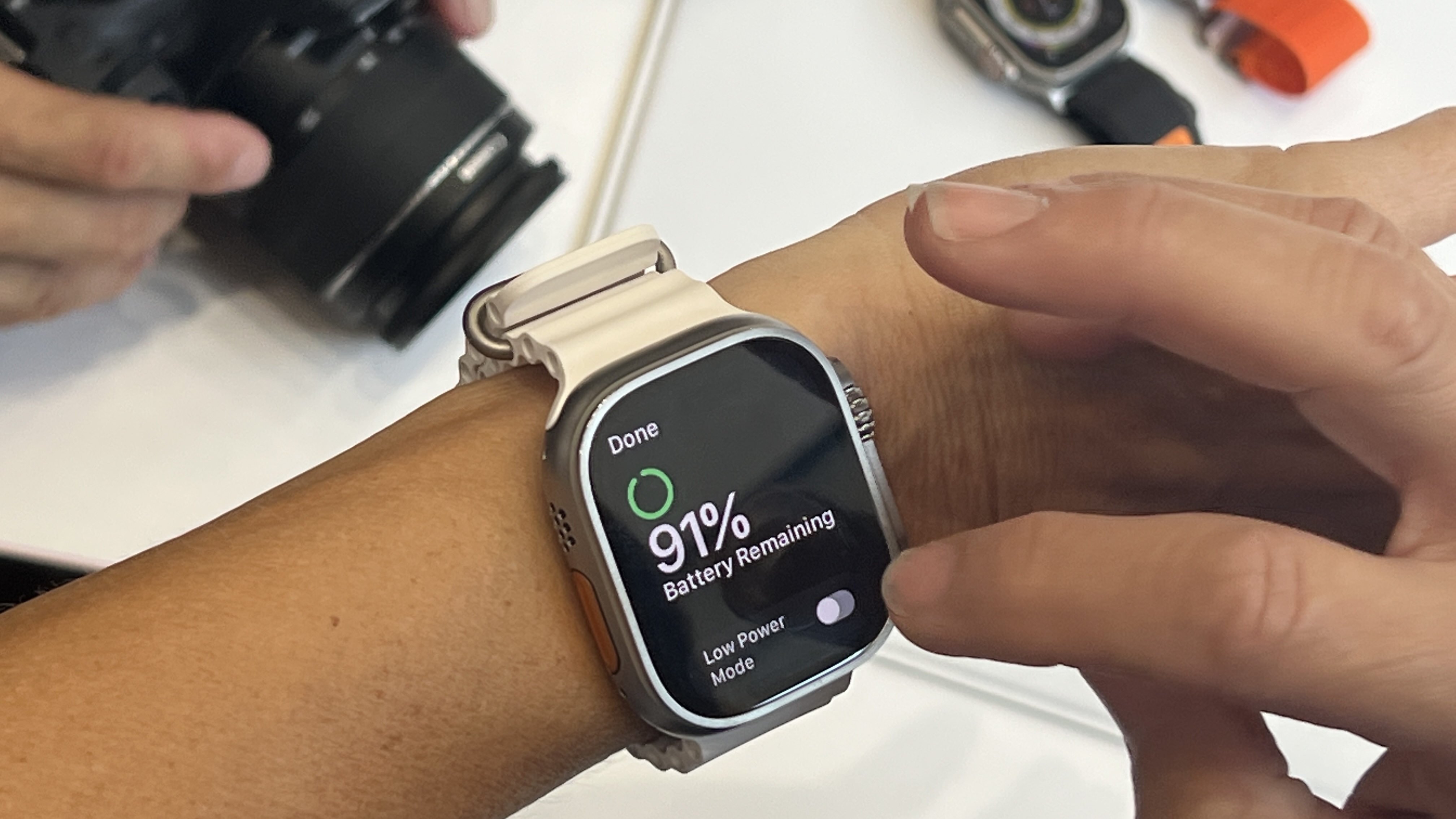
One question we have is whether these rumored upgrades are planned for the Apple Watch Ultra 2 or the Apple Watch Ultra 3.
The original Apple Watch Ultra landed in September 2022, so September 2023 would seem obvious launch timing for the Apple Watch Ultra 2, especially since standard Apple Watch models have been releasing every September ever since the Apple Watch 2.
But this isn’t a standard Apple Watch – rather, it’s the beginning of a new line, so we can’t be certain that Apple will treat it in the same way.
In fact, there’s reason to think we might not see an Apple Watch Ultra 2 until 2024. For one thing, the leaks we’re hearing so far are talking about a 2024 model, and you’d think we’d have also heard about the 2023 release, if one was planned.
Plus, the Apple Watch SE line isn’t yearly, with the Apple Watch SE 2 landing two years after the original model, so Apple may well do something similar with the Apple Watch Ultra.
Based on the first Ultra, these are big, flashy watches, with enormous price tags, so Apple may need to find some significant upgrades for a new one to justify its existence, which again suggests we might be waiting more than a year between them.
One thing’s for sure though, whenever the Apple Watch Ultra 2 does land, it’s likely to be one of the very best smartwatches – especially if it includes the upgrades above.
Microsoft Teams Premium is now generally available for everyone, bringing personalization, organization and AI-powered convenience to the video conferencing platform, alongside some new ChatGPT features.
In a post on the Microsoft 365 blog, the tech giant reiterated many features that it first trailed during its 2022 Ignite event, including advanced Microsoft Teams meeting protections like watermarks and recording restrictions, several upgrades to webinars such as a virtual green room, and several features for the collaboration software’s appointments system, such as SMS reminders.
However, the blog post also revealed that Microsoft Enterprise Content Deliver Network (eCDN) is now included in Teams Premium, promising seamless delivery of town halls and all-hands meetings without any additional strain on corporate connections.
The biggest draws to Microsoft's new service will undoubtedly be the inclusion of GPT 3.5, the artificially intelligent (AI) language model developed by OpenAI, to automate certain mundane tasks surrounding meetings as part of its “intelligent recap” feature.
These tasks include creating automatic chapter markings for recordings, as well as “automatically generated meeting notes, recommended tasks, and personalized highlights”, even to those who miss meetings
As TechRadar Pro has covered previously, Teams will also lock AI-powered live translated captions behind the new Premium option, despite previously earmarking it for inclusion in standard Teams licenses.
Should the new Microsoft Teams pricing model appeal to you, it’s worth noting that, besides a 30-day free trial offered in perpetuity, a special introductory price-per-user of $7 is available for subscriptions purchased prior to June 30, 2023.
Purchases after that will cost $10 per user, so it’s worth considering getting in early if you’re sure Teams Premium is right for your business.
Amazon has revealed that by the end of January 2023, it had set a new corporate record for the most renewable energy purchased by a single company in one year.
The company has long been investing in green energy, and according to a Bloomberg New Energy Finance report, has been the single largest corporate buyer of renewable energy since 2020.
Last year, it added 133 new projects to its portfolio, operating in 11 countries with a combined output of 8.3 gigawatts. That means that last year’s additions alone now account for 41.5% of its 20-gigawatt portfolio.
The tech giant reckons that these 20 gigawatts of energy, provided by more than 400 projects in 22 countries, are enough to power 15.3 million European homes
The investments in 164 wind farms and 237 rooftop solar projects are designed to support the grids that supply a number of its operations, including its fulfillment centers, retail stores, and AWS data centers.
As well as building its existing portfolios in a number of countries last year, Amazon also entered new countries with its renewable energy ambitions, including Brazil, India, and Indonesia.
All of this, Amazon hopes, will help it reach its target of powering its operations with 100% renewable energy by 2025, which is five years ahead of its initial 2030 target.
The company believes that rapidly scaling renewable energy is one of the most effective ways to combat climate change, and the figures suggest that it’s willing to put its money where its mouth is.
Kyle Harrison, head of sustainability research at Bloomberg New Energy Finance, said that “Amazon's clean energy portfolio doesn't just top the corporate charts - it is now among the leading utilities globally as well”. Its readiness to continue pushing despite the lasting effects of the pandemic and subsequent global economic uncertainty should motivate other companies to do the same.
To that point, Amazon isn’t the only company racing to reduce its carbon footprint. Microsoft announced last month that it would be opening a new South Korea project to generate 2.5 gigawatts of solar energy to meet its 2030 renewable-only target.

A welcome upgrade is coming to Microsoft Teams Rooms on Windows that should make using the service a bit more bearable.
The company has revealed that its video conferencing platform will be updated in order to make it more seamless across different services, as well as an aesthetic makeover to make Microsoft Teams Rooms more appealing visually.
In a blog post announcing the news, Microsoft says that the move will mean "key elements of the user interface" are aligned across the Windows and Android ecosystems, making the entire platform smoother and easier to use.
The updates, forming Microsoft Teams Rooms on Windows version 4.16, will present users with an entirely new look for the platform, including "vivid new ambient screens" and a refreshed calendar view that presents upcoming appointments for the entire day, as well as detailing when a room is available.
Microsoft says it has also updated a number of buttons on the Teams Room console to make it quicker and easier to access the most-used features. This includes placing the Meet, Call, Share and Join via ID buttons front and center, negating the need to cycle through long menus.
Users will also be able to customize the look and feel of Teams Room to their liking, with a range of personalization options available.
This includes a range of ambient screens to choose from, with five new themes added to the eight themes currently available. The front-of-room display shown during a meeting can also be tweaked to whatever specification is required, with an updated interface for the view switcher menu that includes the option to view either content + people, or people only.
Users will also be able to customize the Front Row view in a meeting, including the visibility of the meeting chat, as well as choosing which meeting component is displayed on the left and right panel.
Microsoft says the updates will be generally available towards the end of Q1 2023.
 faran follow
Maintaining SAP’s confidentiality, integrity, and availability triad
BLUETTI FridgePower review
Axeleo Capital raises $51 million fund
Xiaomi Mi CC9 Pro with 108MP penta-cam to be announced on November 5
ICYMI: the week's 7 biggest tech stories from the Nintendo Switch 2 launch to Samsung Galaxy Z Fold 7 Ultra leaks
Best Amazon Prime TV shows (August 2018): great series to watch today
Harlan Coben's Run Away ending explained: who dies, where is Paige and what is The Shining Haven?
'Zombie subscriptions’ are a silent killer – here are 3 ways to fix them for 2026 in minutes
Examining the ‘pipeline problem’
faran follow
Maintaining SAP’s confidentiality, integrity, and availability triad
BLUETTI FridgePower review
Axeleo Capital raises $51 million fund
Xiaomi Mi CC9 Pro with 108MP penta-cam to be announced on November 5
ICYMI: the week's 7 biggest tech stories from the Nintendo Switch 2 launch to Samsung Galaxy Z Fold 7 Ultra leaks
Best Amazon Prime TV shows (August 2018): great series to watch today
Harlan Coben's Run Away ending explained: who dies, where is Paige and what is The Shining Haven?
'Zombie subscriptions’ are a silent killer – here are 3 ways to fix them for 2026 in minutes
Examining the ‘pipeline problem’
Follow Us
Were this world an endless plain, and by sailing eastward we could for ever reach new distances