Home Top Ad

Responsive Ads Here

Until very recently, it had begun to seem like anyone with a thick enough checkbook and some key contacts in the startup world could not onl...

Until very recently, it had begun to seem like anyone with a thick enough checkbook and some key contacts in the startup world could not only fund companies as an angel investor but even put himself or herself in business as a fund manager.

It helped that the world of venture fundamentally changed and opened up as information about its inner workings flowed more freely. It didn’t hurt, either, that many billions of dollars poured into Silicon Valley from outfits and individuals around the globe who sought out stakes in fast-growing, privately held companies — and who needed help in securing those positions.

Of course, it’s never really been as easy or straightforward as it looks from the outside. While the last decade has seen many new fund managers pick up traction, much of the capital flooding into the industry has accrued to a small number of more established players that have grown exponentially in terms of assets under management. In fact, talk with anyone who has raised a first-time fund and you’re likely to hear that the fundraising process is neither glamorous nor lucrative and that it’s paved with very short phone conversations. And that’s in a bull market.

What happens in what’s very suddenly become among the worst economic environments the world has seen? Managers who’ve struck out on their own suggest putting any plans on the back burner. “I would love to be positive, and I’m an optimist, buut I would have to say that now is probably one of the toughest times” to get a fund off the ground,” says Aydin Senkut, who founded the firm Felicis Ventures in 2006 and just closed its seventh fund.

It’s a perfect storm for first-time managers,” adds Charles Hudson, who launched his own shop, Precursor Ventures, in 2015 and is raising its third pre-seed venture fund now.

So what to do while putting everything on hold? Get educated, suggests Eva Ho, cofounder of the three-year-old, seed-stage L.A.-based shop Fika Ventures, which last year closed its second fund with $76 million.

Know it’s hard, even in the best times

As a starting point, it’s good to recognize that it’s far harder to assemble a first fund than anyone who hasn’t done it might imagine.

Hudson knew he wanted to leave his last job as a general partner with SoftTech VC when the firm — since renamed Uncork Capital — amassed enough capital that it no longer made sense for it to issue very small checks to nascent startups. “I remember feeling like, ‘Gosh, I’ve reached a point where the business model for our fund is getting in the way of me investing in the kind of companies that naturally speak to me,” which is largely pre-product startups.

What Hudson says he didn’t appreciate was what a hard sell his idea would be to create a single GP fund that backs ideas, basically. “We had a pretty big LP based [at SoftTech] but what I didn’t realize is the LP base that’s interested in someone who is on fund three or four is very different than the LP base that’s interested in backing a brand new manager.”

Hudson says he spent a “bunch of time talking to fund of funds, university endowments — people who were just not right for me until someone pulled me aside and just said, ‘Hey, you’re talking to the wrong people. You need to find some family offices. You need to find some friends of Charles. You need to find people who are going to back you because they think this is a good idea and who aren’t quite so orthodox in terms of what they want to see in terms partner composition and all that.’

Collectively, it took “300 to 400 LP conversations” and two years to close his first fund with $15 million.

Ho says it took less time for Fika to close its first fund but that she and her partners talked with 600 people to close their $41 million debut effort, adding that she felt like a “used car salesman.”

Part of the challenge was her network, she says. “I wasn’t connected to a lot of high-net-worth individuals or endowments or foundations. That was a whole network that was new to me, and they didn’t know who the heck I was, so there’s a lot of proving to do.” A proof-of-concept fund instill confidence in some of these investors, though Ho notes you have to be able to live off its economics, which can be miserly.

She also says that as someone who’d worked at Google and helped found the location data company Factual, she underestimated the work involved in running a small fund. “I thought, ‘Well, I’ve started these companies and run these big teams. How how different could it be? Learning the motions and learning what it’s really like to run the funds and to administer a fund and all responsibilities and liabilities that come with it . . . it made me really stop and think, ‘Do I want to do this for 20 to 30 years, and if so, what’s the team I want to do it with?'”

Investors will offer you funky deals; avoid these if you can

In Hudson’s case, an LP offered him two options, either a typical LP agreement wherein the outfit would write a small check, or an option wherein it would make a “significant investment that have been 40% of our first fund,” says Hudson.

Unsurprisingly, the latter offer came with a lot of strings. Namely, the LP said it wanted to have a “deeper relationship” with Hudson, which he took to mean it wanted a share of Precursor’s profits beyond what it would receive as a typical investor in the fund.

“It was very hard to say no to that deal, because I didn’t get close to raising the amount of money that I would have gotten if I’d said yes for another year,” says Hudson. He still thinks it was the right move, however. “I was just like, how do I have a conversation with any other LP about this in the future if I’ve already made the decision to give this away?”

Fika  similarly received an offer that would have made up 25 percent of the outfit’s debut fund, but the investor wanted a piece of the management company. It was “really hard to turn down because we had nothing else,” recalls Ho. But she says that other funds Fika was talking with made the decision simpler. “They were like, ‘If you sign on to those terms, we’re out.” The team decided that taking a shortcut that could damage them longer term wasn’t worth it.

Your LPs have questions, but you should question LPs, too

Senkut started off with certain financial advantages that many VCs do not, having been the first product manager at Google and enjoying the fruits of its IPO before leaving the outfit in 2005 along with many other Googleaires, as they were dubbed at the time.

Still, as he tells it, it was “not a friendly time a decade ago” with most solo general partners spinning out of other venture funds instead of search engine giants. In the end, it took him “50 no’s before I had my first yes” — not hundreds —   but it gave him a taste of being an outsider in an insider industry, and he seemingly hasn’t forgotten that feeling.

Indeed, according to Senkut, anyone who wants to crack into the venture industry needs to get into the flow of the best deals by hook or by crook. In his case, for example, he shadowed angel investor Ron Conway for some time, working checks into some of the same deals that Conway was backing.

“If you want to get into the movie industry, you need to be in hit movies,” says Senkut. “If you want to get into the investing industry, you need to be in hits. And the best way to get into hits is to say, ‘Okay. Who has an extraordinary number of hits, who’s likely getting the best deal flow, because the more successful you are, the better companies you’re going to see, the better the companies that find you.”

Adds Senkut, “The danger in this business is that it’s very easy to make a mistake. It’s very easy to chase deals that are not going to go anywhere. And so I think that’s where [following others] things really helped me.”

Senkut has developed an enviable track record over time. The companies that Felicis has backed and been acquired include Credit Karma, which was just gobbled up by Intuit; Plaid, sold in January to Visa; Ring, sold in 2018 to Amazon, and Cruise, sold to General Motors in 2016, and that’s saying nothing of its portfolio companies to go public.

That probably gives him a kind of confidence that it’s harder to earlier managers to muster. Still, Senkut also says it’s very important for anyone raising a fund to ask the right questions of potential investors, who will sometimes wittingly or unwittingly waste a manager’s time.

He says, for example, that with Felicis’s newest fund, the team asked many managers outright about how many assets they have under management, how much of those assets are dedicated to venture and private equity, and how much of their allotment to each was already taken. They did this so they don’t find themselves in a position of making a capital call that an investor can’t meet, especially given that venture backers have been writing out checks to new funds at a faster pace than they’ve ever been asked to before.

In fact, Felicis added new managers who “had room” while cutting back some existing LPs “that we respected . .. because if you ask the right questions, it becomes clear whether they’re already 20% over-allocated [to the asset class] and there’s no possible way [they are] even going to be able to invest if they want to.”

It’s a “little bit of an eight ball to figure out what are your odds and the probability of getting money even if things were to turn south,” he notes.

Given that they have, the questions look smarter still.


from TechCrunch https://ift.tt/3aCVoJf

In the wake of the financial crisis, Congress passed regulations limiting the types of investments that banks could make into private equity...

In the wake of the financial crisis, Congress passed regulations limiting the types of investments that banks could make into private equity and venture capital funds. As cash strapped investors pull back on commitments to venture funds given the precipitous drop of public market stocks, loosening restrictions on the how banks invest cash could be a lifeline for venture funds.

That’s the position that the National Venture Capital Association is taking on the issue in comments sent to the chairs of the Federal Reserve, the Securities and Exchange Commission and the Federal Deposit Insurance Corp., and the Commodities Future Trading Commission.

The proposed revisions of the Volcker Rule would exclude qualifying venture capital funds from the covered fund definition.

“The loss of banking entities as limited partners in venture capital funds has had a disproportionate impact on cities and regions with emerging entrepreneurial ecosystems — areas outside of Silicon Valley and other traditional technology centers,” NVCA president and chief executive Bobby Franklin wrote. “The more challenging reality of venture fundraising in these areas of the country tends to require investment from a more diverse set of limited partners.”

Franklin cited the case of Renaissance Venture Capital, a Michigan-based regionally focused fund that estimated the Volcker Rule cost them $50 million in potential capital commitments resulting in the loss of a potential $800 million in capital invested in the state of Michigan.

“This narrative unfortunately repeats itself, as we have heard firsthand from investors about how the Volcker Rule has affected venture capital investment and entrepreneurial activity across the country,” wrote Franklin. “The majority of these concerns about the Volcker Rule have come from members located in regions with emerging ecosystems, including states like Ohio, Michigan, North Carolina, New Hampshire, Wisconsin, Georgia, and Virginia, to name a few.”

It’s not only small states that could be impacted by the decision to reverse course on banking investments into venture firms in these uncertain times.

There’s a growing concern among venture investors that — just like in 2008 — their limited partners might find that they’re over-allocated into venture investments given the decline in markets, which would force them to pull back on making commitments to new funds.

“Institutional LPs will run into the same issues they had in 2008. If you used to manage $10B and the market declines and you now manage $6B, the percentage allocated to private equity has now increased relative to the whole portfolio,” Hyde Park Ventures partner, Ira Weiss told a Forbes columnist in a March interview. “They’re really not going to look at new managers. If you’ve done really well as a manager, they will probably re-up but may reduce commitment amounts. This will bleed backwards into the venture market. This is happening at a time when Softbank has already had a lot of trouble and people had not really modulated for that yet, but now they will.”

Some of the largest investment funds have already closed on capital, insulating them from the worst hits. These include funds like New Enterprise Associates and General Catalyst. But newer funds are going to have a harder time raising. For them, giving banks the ability to invest in venture firms could be a big boon — and a confidence boost that the industry needs at a time when investors across the board are getting skittish.

“Fundraising for new funds in 2020 and 2021 might prove to be more difficult as asset managers think about rebalancing their portfolio and/or protecting their assets from the current volatility in the market,” Aaron Holiday told Forbes. “This means that VC investing could slow down in 12 – 24 months after the most recent wave of funds (i.e. 2018 and 2019 vintages) are fully deployed.”


from TechCrunch https://ift.tt/2ys6XVA

Detroit Mayor Mike Duggan said today on Wolf Blitzer’s CNN show that the city of Detroit is on track to be the first city to deploy Abbott L...

Detroit Mayor Mike Duggan said today on Wolf Blitzer’s CNN show that the city of Detroit is on track to be the first city to deploy Abbott Labs’ five-minute COVID-19 test. The mayor said the test would be available for first responders. The goal, he said, was to test those first responders who are self-isolating but have yet to test positive for the virus.

The city of Detroit received the Abbott Labs tests today, April 1. They will be available for use within the next 24 hours, the mayor said.

This system from Abbott received emergency clearance for use by the U.S. Food and Drug Administration. It’s a lab-in-a-box that is roughly the size of a small kitchen appliance. The small size and rapid test results mean it can be deployed and utilized more quickly than other methods.

The City of Detroit is getting hit especially hard by the novel coronavirus. According to recent numbers, the counties around Detroit contain 81% of Michigan’s 7,615 coronavirus cases. More than 20% of the 2,500-strong police force is quarantined with suspected instances of COVID-19.

The significant number of cases in Detroit led the mayor to go outside of traditional channels to obtain the tests first.

As The Washington Post tells it, Mayor Mike Duggan secured the cellphone number of Miles White, the chairman and outgoing CEO of Abbot Labs, and woke him up Sunday morning to beg for the test. This early morning phone call netted the city five machines and 5,000 tests.

Today the company said in a tweet that it’s making the system available this week in an urgent care setting in the U.S. where the company already has instrumentation. Abbott Labs says it already holds the most significant molecular point-of-care footprint in the U.S., and is “widely available” across doctor’s offices, urgent care clinics, emergency rooms and other medical facilities.

Abbott expects it will be able to produce 5 million tests in April, split between the new rapid tests and traditional lab tests that received emergency authorization from the FDA on March 18.


from TechCrunch https://ift.tt/2UxKfUq

If you’re after a smart speaker that will satisfy your audio needs and is able to give you a serious sound blast, then you'll want to ta...

If you’re after a smart speaker that will satisfy your audio needs and is able to give you a serious sound blast, then you'll want to take a look at the monster-sized Google Home Max. 

The Home Max is the largest and most powerful out of Google’s family of smart speakers, weighing 5.3kg – at that level of heft, it could potentially double as a music-playing dumbbell! It also houses two 4.5-inch subwoofers for bass lovers and of course, has the popular Google Assistant built-in.

What sets this speaker apart from the rest is that it’ll adjust its music playback automatically depending on room-size and placement. This is super handy and an incredible advancement in home tech which makes it one of the smartest speakers around.

The microphone has also been improved and is more than capable of picking up your requests from the other side of the room – even with music blaring out at significant volume.

In summary, the Google Home Max is among the smartest speakers around, delivering amazingly large sound from a relatively small device with a clever design that lifts it above the competition. Currently available in charcoal through JB Hi-Fi for only AU$198 – that’s an incredible saving of AU$199!


from TechRadar - All the latest technology news https://ift.tt/39xtnBv

Apple and Amazon seem to have made nice, with the Prime Video app on iOS, iPadOS and tvOS now supporting in-app purchases. Apple device user...

Apple and Amazon seem to have made nice, with the Prime Video app on iOS, iPadOS and tvOS now supporting in-app purchases. Apple device users, be it an iPhone, iPad or Apple TV, will now be able to rent or purchase anything from the Prime Video library directly from the app.

Previously, to skirt around Apple's exorbitant 30% cut on in-app purchases, Amazon would direct customers away from the app – i.e. take them to a browser page – whenever they wanted to get something from the Prime Video content store. 

Many app makers, like Spotify, offset that high fee by increasing the cost of subscriptions or purchases, although it seems Amazon hasn't raised the price of its Prime Video offerings. Instead, as per a statement issued by Apple, the e-commerce giant is taking advantage of "an established program for premium video subscription providers to offer a variety of consumer benefits".

Amazon, however, has not made any announcements, but the update has begun rolling out and Apple users logging into the Prime Video app can see a banner advertising the change on the homepage.

Spending pattern

The updated Prime Video app now includes a new Store tab from where Apple users can either rent or purchase content, including in-cinema and early digital releases of movies like Pixar's Onward.

It appears that Apple has allowed Amazon to bill customers directly using the payment method that has been saved to an Amazon account.

The updated app doesn't seem to be available globally... at least not yet. TechRadar's Australian team were unable to see the changes, while TechCrunch has been told that the in-app purchases are currently available only in the US, UK and Germany. We're hoping the changes will be rolled out to other markets in the coming weeks.

Whether the deal the two companies have reached flows both ways is as yet uncertain, with the Apple TV app on Amazon's Fire TV platform still not supporting in-app purchases.

[Via The Verge]


from TechRadar - All the latest technology news https://ift.tt/2w6mJoh

via TechRadar - All the latest technology news https://ift.tt/39xtnBv


via TechRadar - All the latest technology news https://ift.tt/39xtnBv

via TechRadar - All the latest technology news https://ift.tt/2w6mJoh


via TechRadar - All the latest technology news https://ift.tt/2w6mJoh

It's day two of week two of Joe Wicks' PE workout, and millions of people are that much fitter and happier thanks to a morning routi...

It's day two of week two of Joe Wicks' PE workout, and millions of people are that much fitter and happier thanks to a morning routine of exercise with a bouncy, chirpy chap.

Joe Wicks, AKA The Body Coach, has been increasing rapidly in popularity, and if you've heard of anyone doing 'that PE workout' in the morning, this is the one they mean. 

While it was originally dubbed as 'just for kids' during self-isolation, it's also great for adults too, with modified versions for those of us who have 'neglected' strength training for the last... twelve years.

Wicks is not only donating his advertising revenue, which he described as "unlike anything I've seen or experienced on my channel before", but has now upgraded his workouts with music after artists like George Ezra and Dua Lipa waiving royalties to allow their tunes to soundtrack the workouts.

We'll be updating this article with the live video below as soon as it goes live - check back just before 9AM and we'll embed it. Also, see all the videos at the bottom of the article to catch up on what's happened already.

Want to get the best out of the workout? Here's our quick picks of things you might need to make jumping in front of the TV a little easier:

Or, if you don't want to buy a whole new TV to get easy smarts, a Chromecast or Roku stick will allow you to easily stream to your TV too:

And if you want to track your heart rate and effort over the course of the workout, or just want to make it that little bit harder with some extra bands, then check out these picks:

What time does Joe Wicks’ PE lesson start each day?

If you’re itching to get your fix of Wicks live each day, then you’ll need to have YouTube open and waiting at 9AM BST each day. 

(If you're in other parts of the world and don't want to get up ridiculously early each day to watch live, we've got the recent uploads listed at the bottom of this article).

The sessions last for 30 mins, and include a warm up and cool down, and two repetitions of the circuits he walks (or sprints) you through.

How do I watch Joe Wicks’ PE sessions?

If you‘re interesting in getting involved with The Body Coach as it happens, and can cope with irrepressible enthusiasm as this hour, then you’ll need to have your YouTube portal open on your TV, tablet or smartphone at around 8:55AM BST.

Once ready, navigate to The Body Coach’s YouTube channel on your TV, phone or iPad (more on how to do that below).

You won't see him on camera straight away - but try to memorise all the items on his shelves as there's a daily spot the difference for the die-hard fans.

(If you want to watch it on catch up each day, at a time that suits you, then you can just follow the same instructions above, where the previous workouts will be posted to catch up on.)


How to watch Joe Wicks’ kids workout on a TV

The best way - if you’ve got the space - is to watch the workout in front of a TV. There are myriad ways to get YouTube on your tellybox, thus making it simpler to get active.

Using your smart TV

The easiest way is if you've got a smart TV into your life - open up your smart hub and navigate to YouTube, where you can follow the searching instructions above to find The Body Coach TV, with a new video going live each day at 9AM GMT.

If you don't see it straight away, then it should appear just before 9AM - and Wicks gives you a few minutes to get ready too.

Using Google Chromecast

Alternatively you can use streaming sticks - one of the simplest is Google's Chromecast, which plugs into your HDMI socket and will stream content from your phone to the TV.

Fire up YouTube on your smartphone or tablet and look for the icon below in one of the corners:

(The same icon will also show you any compatible smart TVs or streaming sticks on your network that you can 'cast' the show to - you might be surprised which devices are already enabled).

The Chromecast isn't too expensive either, and is a simple way to turn your TV smart - allowing you to stream a multitude of services (like Netflix and other streaming platforms) from your small phone screen to a larger display:

How to watch on a Roku stick:

More advanced than a Chromecast, the Roku stick turns your TV into a smart hub easily too. When plugged in, hit the 'source' button on your remote and navigate to the HDMI port where your Roku stick is located (or, with some modern TVs, just pressing the 'Home' button on the Roku remote will achieve the same thing).

From there, open the YouTube app and navigate to the Body Coach TV at 9AM GMT...  or fire it up on your smartphone or tablet and look for the 'cast' icon above, tap it and see if the Roku is listed (which it should be if all devices are connected to the same Wi-Fi network).

How to watch Joe Wicks’ PE workout on an iPad

You’ve got two options here: if you’ve already got the YouTube app downloaded onto your tablet, then just search for ‘The Body Coach’ and click the icon at the top of the screen for ‘Body Coach TV’.

From there you’ll see a list of all the videos, and at 9AM the new option should pop up - although you may need to refresh.

You can achieve the same thing if you don’t have the iPad app by heading to your Safari or Chrome browser and clicking the link to the The Body Coach’s YouTube channel - you can play the video directly from there, and hit the full-screen option in the bottom right-hand corner.

How did Joe Wicks break his arm?

For those wondering why Joe Wicks' PE workouts feature a man that can't do all of his exercises because of the cast on his wrist, it's because he fell off his bike before embarking on a pledge to become the nation's PE teacher - you can see all about it over on his Instagram Stories.

How to catch up on Joe Wicks' other PE workouts

If you missed anything, or want to browse previous workouts, they're all available on the same YouTube channel above - or you can watch them right here:


from TechRadar - All the latest technology news https://ift.tt/2ypoMEI

Star Trek: Picard season 2 was official even before the first arrived. Still, thanks to that astonishing finale , the wait for more has been...

Star Trek: Picard season 2 was official even before the first arrived. Still, thanks to that astonishing finale, the wait for more has been agonising. It was a return that befitted Star Trek's greatest captain, with a stellar performance from Sir Patrick Stewart. 

The story of season 1 was full of intrigue and mystery that kept us hooked over the course of its action-packed ten episodes and contributed to the wider Trek canon in engrossing ways. But what's in store for the second season? We now know that plenty of the season one story changed as it was being shot - more on that and the challenges facing the Picard season 2 showrunners below.

Besides that there isn't a huge amount of news about what the second season will look like, and when the release date will be. Fingers crossed it won't be adversely affected by COVID-19 like many other films and TV shows at the moment.

However there are a few tidbits of information we've gathered, so here's everything we know about Star Trek: Picard season 2. Spoilers follow from the first season, so make sure you're all caught up before reading on.

Star Trek: Picard season 2 release date: probably 2021

No official date has been set for season 2 of Star Trek: Picard yet, but the early renewal suggests a 2021 release. However, this may be impacted by the coronavirus pandemic, which is currently halting the production of all CBS shows. 

Based on how Star Trek: Discovery has been released with more than a year-long gap between seasons, it's likely we'll see Star Trek: Picard season 2 slightly later in 2021. 

Star Trek: Picard season 2 was confirmed before the show started

Even before the first episode of Star Trek: Picard aired on January 23, CBS All Access had announced its renewal for a second series. At the Television Critics Association's winter press tour, it was officially revealed that Patrick Stewart would be returning for another season. “The energy and excitement around the premiere of Picard has reached a magnitude greater than all of us could have hoped for," CBS said. “We’re thrilled to announce plans for a second season."

What will Star Trek: Picard season 2's story be?

Of course we expect Picard himself to be central to the story of season 2, but balancing his story with the characters he meets on his travels through the Final Frontier will be a returning challenge from season 1.

"That's the challenge," showrunner Michael Chabon told The Hollywood Reporter. "First, it's got to be good, right? It has to be focused on Picard but have room for all the other characters. It's never going to be just a show about the crew of a starship that's part of Starfleet and everyone's wearing uniforms and they're flying around, encountering alien life and weird planets. Those are the challenges we face going into season two, and I'm so excited about the story we've come up with."

At the end of the first season, Picard managed to stop a group of synthetics from summoning a race of mechanical 'higher beings' that would wipe out all organic life in the galaxy. We briefly saw these beings – giant centipede-like machines – but they were sucked back into a portal before they could reach our galaxy.

This ending stuck to the original plan, but plenty changed along the way. Chabon also told THP that "even though our original outline changed significantly to what you eventually saw, the plan — and Sir Patrick's plan from the beginning — was ‘let's tell more stories with Picard.'" The original story document penned by Chabon, Alex Kurtzman, and Akiva Goldsman apparently didn't even feature Data.

Regardless, it seems unlikely that the threat of these creatures will be the focus of season 2, but we will almost certainly return to the fight against the synth-hating Romulan General Oh, who was moments away from declaring all-out war on the Federation. She backed down after a threat from Captain Riker and a powerful Federation fleet, but it's likely she'll be back for revenge on Starfleet, Picard, and the synths whose lives he helped save.

We also know that Picard lives to fight another day, having had his memories implanted into a new synthetic body. Although Alton Soong, who performed the procedure, makes it clear that his new body is identical to his old one, including its ability to age and die. But the brain abnormality that haunted him in season 1 is now gone.

Picard has a full, loyal crew now, including Jurati, Seven of Nine, Elnor, Rios, and Raffi — and a ship, the La Sirena – so he's more than ready to face whatever new adventures are thrown at him in Star Trek: Picard season 2.

There could also be a Star Trek: Picard season 3

Although CBS has yet to confirm it, and won't comment on rumours, the Hollywood Reporter claims sources have revealed that season 3 has been informally given the go ahead – and may be filmed back-to-back with season 2.

Star Trek: Picard season 2 will be more personal

According to co-creator Michael Chabon, the second season of Picard will have more time to spend fleshing out its characters. Speaking to Variety about the relationship between Dr. Jurati and Rios in season one, he said: "It’s about letting people’s identities emerge. I think we’ll have more time for that in the second season than we’ve had in the first season. We just had so many characters and so much story to tell in this first season, that a lot of the sort of more personal aspects of things – including again, like people’s families, and all that stuff – just all got sort of left [behind]."

Guinan will return in Star Trek: Picard season 2

During an appearance on American TV show The View, which is co-hosted by Whoopi Goldberg, Patrick Stewart formally invited her to join the cast of season 2 of Star Trek: Picard, reprising her role as Guinan. “It was wonderful having you, and we cannot wait to have you with us again one more time," said Stewart. Guinan was a recurring, and fan favourite, character in Star Trek: The Next Generation – an enigmatic bartender on the USS Enterprise who became close friends with Picard. It's unclear what her role in Star Trek: Picard season 2 will be, but it'll likely be an important one.

Star Trek: Picard season 2 will see a showrunner change

According to an interview in Variety, Michael Chabon won't be as heavily involved in season 2 of Star Trek: Picard as he was in the first. He's shifting his attention to developing a TV series for Showtime based on his novel The Amazing Adventures of Kavalier & Clay. But he will continue to work on Picard season 2 as an executive producer, and give notes to the writers. "I’m still an executive producer on Picard," he told Variety. "I’m writing two episodes. I was there breaking the second season, all the way through. I was engaged, I think, to exactly the same degree as I was on the first season."

According to the Hollywood Reporter, the co-creator of 2015's 12 Monkeys TV series, Terry Matalas, will join Star Trek: Picard season 2 as an executive producer. The source also suggests he was pulled from CBS's MacGyver reboot, as Picard is now a high priority for the studio. 

Star Trek: Picard is available to watch on CBS All Access in the US, Amazon Prime Video internationally.


from TechRadar - All the latest technology news https://ift.tt/3bA35jk

Grab announced today that it has hired Peter Oey as its new chief financial officer. Prior to joining Grab, Oey was the chief financial off...

Grab announced today that it has hired Peter Oey as its new chief financial officer. Prior to joining Grab, Oey was the chief financial officer at LegalZoom, an online legal services company based near Los Angeles.

Before that, he served the same role at Mylife.com, an online platform that aggregates information about people based on public records. Oey also held financial leadership positions at Activision for twelve years, including corporate controller.

Grab, whose services include ride-sharing, food delivery and online financial services provider GrabPay, announced in February that it had raised a total of $856 million from Japanese investors Mitsubishi UFJ Financial Group and TIS INTEC, to grow its financial services and digital payments infrastructure.

In a statement, Grab said Oey will be based in Singapore and report to co-founder and CEO Anthony Tan. He will also work with Grab president Ming Maa, who took over many responsibilities from Grab’s last CFO, Linda Hoglund, when she left in 2016. Grab said Maa will continue to lead its strategic business planning.

Grab, which acquired Uber’s Southeast Asia business in March 2018, has reportedly been in discussions to merge with merge with rival GoJek.


In a press statement, the company said that in 2019, GrabFood’s gross merchandise volume grew by over 400%, while GrabPay increased payment volume by 170%, thanks to strong performance in Indonesia.

Tan said “Last year, we made tremendous progress in growing our food delivery, payments and financial services business. The growth of these businesses give us a good foundation for achieving long-term sustainable growth for our company. I’m excited to welcome Peter to the Grab family where his extensive experience scaling rapidly growing technology companies makes him a valuable addition to our business.”

Grab has raised a total of about $9.9 billion from investors including SoftBank Vision Fund, which invested $1.46 billion into the company last year. Tan told CNBC last November that the company will not go public until its entire business is profitable.


from TechCrunch https://ift.tt/2xCNTU3

In March, the virus gripping the world — COVID-19 — started to spread in Africa. In short order, actors across the continent’s tech ecosyste...

In March, the virus gripping the world — COVID-19 — started to spread in Africa. In short order, actors across the continent’s tech ecosystem began to step up to stem the spread.

Early in March Africa’s coronavirus cases by country were in the single digits, but by mid-month those numbers had spiked leading the World Health Organization to sound an alarm.

“About 10 days ago we had 5 countries affected, now we’ve got 30,” WHO Regional Director Dr Matshidiso Moeti said at a press conference on March 19. “It’s has been an extremely rapid…evolution.” 

By the World Health Organization’s stats Tuesday there were 3671 COVID-19 cases in Sub-Saharan Africa and 87 confirmed deaths related to the virus — up from 463 cases and 8 deaths on March 18.

As the COVID-19 began to grow in major economies, governments and startups in Africa started measures to shift a greater volume of transactions toward digital payments and away from cash — which the World Health Organization flagged as a conduit for the spread of the coronavirus.

Africa’s leader in digital payment adoption — Kenya — turned to mobile-money as a public-health tool.

At the urging of the Central Bank and President Uhuru Kenyatta, the country’s largest telecom, Safaricom, implemented a fee-waiver on East Africa’s leading mobile-money product, M-Pesa, to reduce the physical exchange of currency.

The company announced that all person-to-person (P2P) transactions under 1,000 Kenyan Schillings (≈ $10) would be free for three months.

Kenya has one of the highest rates of digital finance adoption in the world — largely due to the dominance of M-Pesa  in the country — with 32 million of its 53 million population subscribed to mobile-money accounts, according to Kenya’s Communications Authority.

On March 20, Ghana’s central bank directed mobile money providers to waive fees on transactions of GH₵100 (≈ $18), with restrictions on transactions to withdraw cash from mobile-wallets.

Ghana’s monetary body also eased KYC requirements on mobile-money, allowing citizens to use existing mobile phone registrations to open accounts with the major digital payment providers, according to a March 18 Bank of Ghana release.

Growth in COVID-19 cases in Nigeria, Africa’s most populous nation of 200 million, prompted one of the country’s largest digital payments startups to act.

Lagos based venture Paga made fee adjustments, allowing merchants to accept payments from Paga customers for free — a measure “aimed to help slow the spread of the coronavirus by reducing cash handling in Nigeria,” according to a company release.

In March, Africa’s largest innovation incubator, CcHub, announced funding and engineering support to tech projects aimed at curbing COVID-19 and its social and economic impact.

The Lagos and Nairobi based organization posted an open application on its website to provide $5,000 to $100,000 funding blocks to companies with COVID-19 related projects.

CcHub’s CEO Bosun Tijani expressed concern for Africa’s ability to combat a coronavirus outbreak. “Quite a number of African countries, if they get to the level of Italy or the UK, I don’t think the system… is resilient enough to provide support to something like that,” Tijani said.

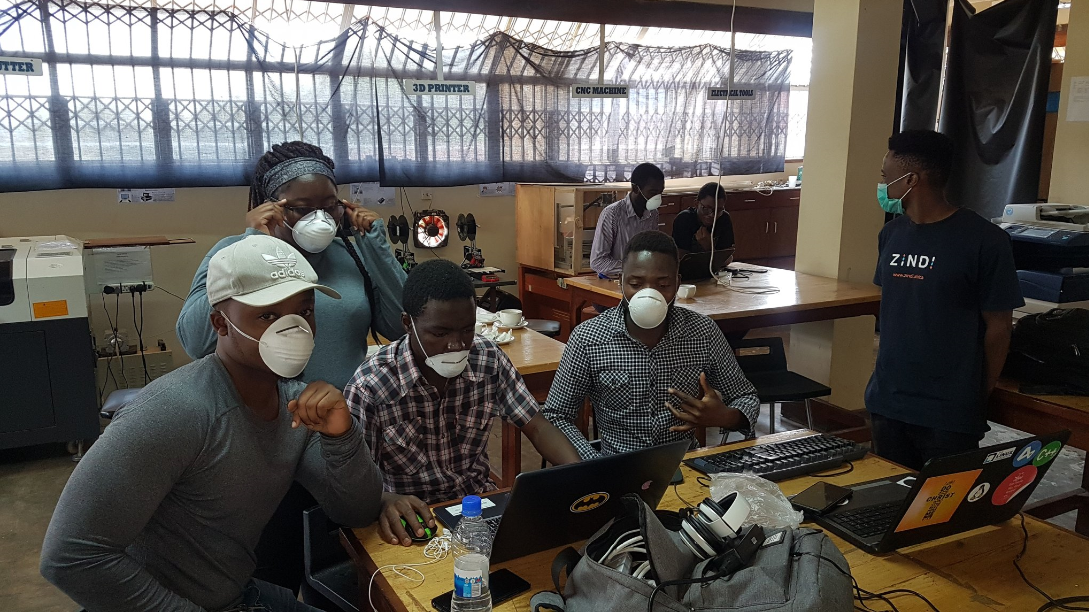
Cape Town based crowdsolving startup Zindi — that uses AI and machine learning to tackle complex problems — opened a challenge to the 12,000 registered engineers on its platform.

The competition, sponsored by AI4D, tasks scientists to create models that can use data to predict the global spread of COVID-19 over the next three months. The challenge is open until April 19, solutions will be evaluated against future numbers and the winner will receive $5,000.

Zindi will also sponsor a hackathon in April to find solutions to coronavirus related problems.

Image Credits: Sam Masikini via Zindi

On the digital retail front, Pan-African e-commerce company Jumia announced measures it would take on its network to curb the spread of COVID-19.

The Nigeria headquartered operation — with online goods and services verticals in 11 African countries — said it would donate certified face masks to health ministries in Kenya, Ivory Coast, Morocco, Nigeria and Uganda, drawing on its supply networks outside Africa.

The company has also offered African governments use of of its last-mile delivery network for distribution of supplies to healthcare facilities and workers.

Jumia is reviewing additional assets it can offer the public sector. “If governments find it helpful we’re willing to do it,” CEO Sacha Poignonnec told TechCrunch.

More Africa-related stories @TechCrunch

African tech around the ‘net


from TechCrunch https://ift.tt/342yFEc

Netflix’s wholesome hit Sex Education is officially back for season 3. The streaming service announced the renewal less than a month after t...

Netflix’s wholesome hit Sex Education is officially back for season 3. The streaming service announced the renewal less than a month after the excellent second season's debut, which we burned through too quickly. While we don't know the release date of the third yet, let's hope it isn't impacted COVID-19 in the way many other movies and TV shows have.

Sex Education follows the lives, insecurities, and sexual hang-ups of various students, parents, and faculty members of Moordale High School, set in the breathtaking Welsh countryside. Its timelessness ensures it can't be pegged back to a certain point in time: its themes are universal.

Here, mother and son Jean and Otis – Gillian Anderson and Asa Butterfield – attempt to apply their knowledge of sexual psychology to their increasingly complicated lives: Otis for some quick cash, and Jean to satisfy her curiosity. But the show quickly outgrew this premise and widened its view to a diverse ensemble cast ready to tackle various social and sexual problems. 

Below, we'll break down what we know about Sex Education season 3 so far, including its likely release date, returning cast and possible storylines. Spoilers follow. 

Sex Education season 3 is confirmed

Netflix confirmed that Sex Education season 3 is in the works on February 10, 2020.  As reported by Deadline back in 2019, the first season of the show drew in an impressive 40 million viewers during its premiere week, so the renewal is no surprise. Given the show's apparent popularity on social media, it's safe to assume Sex Education has found its audience. 

Sex Education season 3 release date predictions: expect it in 2021

Fortunately, Netflix seems to understand exactly how thirsty Sex Education fans are for more of the show, and marked the season 3 renewal announcement with a teaser. Much like season 2’s initial reveal trailer, which featured Gillian Anderson delivering a sultry monologue about the benefits of sex ed, the season 3 teaser is playfully narrated by Alistair Petrie’s Principal Groff.

We see the troublemaking principal walking the halls of Moordale High, passing portraits of Sex Education’s main cast as he notes what the future could possibly hold for each of them. The teaser wraps up with an invitation to find out more in the coming third season, but stops short of revealing an actual release date. 

If Netflix holds true to its current pattern of release for the show, which given its rating success seems possible, we predict we'll see season 3 release in January 2021. Production details are still quite scarce, but Production Weekly has the third season listed in a recent 2020 production schedule for May, so the timing roughly lines up. 

Sex Education season 3 cast: who we expect to return

While a confirmed cast list for season three is yet to hit the web, we feel pretty confident in assuming the characters featured in the teaser video are returning. 

Series headliners Butterfield (Otis Milburn) and Anderson (Dr Jean Milburn) are featured, along with a sizeable chunk of the supporting cast including Emma Mackey (Maeve Wiley), Ncuti Gatwa (Eric Effiong), Connor Swindells (Adam Groff) and Patricia Allison (Ola Nyman). Given how heavily season 2 leaned into an ensemble narrative approach, it would be difficult to imagine the show returning without the bulk of the cast reprising their roles.

Anderson tweeted about Sex Education season 3 on the day of the renewal (note the patterns on the ceiling above her):

Sex Education season 3 story: what we expect from the next set of episodes

Series creator and writer Laurie Nunn was already hard at work on the script for a third season well before Netflix renewed the show

In an interview with LADbible, Nunn touches on the tight working schedule for the series, noting that the writing process of another season before confirmed renewal is a normal part of how TV production works. When asked about the potential for future stories, Nunn said, "I love writing these characters. It's such a big ensemble and I think the theme of the show – in terms of it being about sex and relationships – it really just offers up endless story opportunities."

Season two pivoted away from its focus on Otis and instead opted to lend almost equal time to the wonderfully diverse characters around him. The internet’s newest queer icon Eric (Gatwa) benefited the most from this shift in show structure, allowing for a nuanced and moving insight into the struggles of a young black queer man. His popularity clearly hasn’t gone without notice, as the teaser video for the third season is largely focused on the potential of his blooming romance with his former bully Adam.

Eric isn’t the only student with love on the brain, of course. The timeless 'will they, won’t they?' dance between Otis and Maeve (Mackey) seems set to come to a head. The somewhat divisive final scenes of season two saw Otis confess his love to Maeve in a voicemail, only for it to be deleted by Maeve’s new love interest before she could hear it. 

While some fans have been critical of this story beat as an artificial extension of the character’s ongoing love dilemma, the show’s director shrugs off any potential backlash. In a chat with BT, Ben Taylor says "I think shoes will be thrown at screens. In a good way. I love being p***ed off at stuff. You think you want it, but you don't”. 

There are plenty more threads featuring the supporting cast that need to be picked up in Sex Education season 3. Jean ends season two with a newfound appreciation for emotional intimacy with her on-again, off-again partner Jakob thanks to her friendship with Adam’s freshly divorced mother Maureen. Elsewhere, various students are now grappling with revelations about their identity and place in the world as they face the realities of sexual assault trauma, non-conventional identities and the looming prospects of the future. 

It's one of Netflix's best shows

Speaking to The Hollywood Reporter about further developments for the show, Nunn is excited about the places she and her writers can take the eclectic cast. “These characters ... they've got legs. I think I could do some more with them if we're given the chance,” she said. “[Netflix] is very supportive and really wanting us to tell the stories that we feel passionate about. It really feels like we're all on the same page, wanting to make the same show.”  

It’s an exciting prospect for a show primarily made by young, diverse talent both in front of and behind the camera. It’s not hard to see why Sex Education has resonated so deeply with fans. It offers a very human, non-judgemental look at the issues facing not just teenagers, but many adults who are still coming to terms with their own sexuality. Nunn’s writing is razor-sharp, and the show’s inclusive agenda makes it a fine addition to Netflix’s growing library of progressive media and stories. 

Bring on season 3. 


from TechRadar - All the latest technology news https://ift.tt/3bxdmxL

Remote working has become the norm for businesses of all sizes during these trying times. Over the past few weeks we’ve seen an unprecedente...

Remote working has become the norm for businesses of all sizes during these trying times. Over the past few weeks we’ve seen an unprecedented rise in remote workers never seen in the business world before. Even organisations who have been shy to remote working are now adapting their strategies to enable employees, if able, to log on from home on a greater scale.

Working from home isn’t a new concept, especially for smaller businesses who are leading the charge with workplace transformation and achieving unparalleled mobility. As millions follow government advice to stay home, we’re seeing a surge in conversations around the advantages of mobile and remote working for businesses and employees alike, and whether this somewhat unplanned experiment will be the future of work. However, what’s certain is that this rise of remote workers doesn’t come without its challenges – from having the right employee technology in place to remote-access network capacity and, unsurprisingly, security concerns.

So, what are these obstacles? And how can smaller to medium businesses overcome them?

Invest in the right technology for maximum productivity

Small, more agile businesses are leading the way when it comes to mobile and remote working. While large enterprises have long- established ways of working, and often have cumbersome legacy processes, SMBs are much more adaptable and open to change. For SMBs, remote workers not only offset the pressure of securing fixed office space but also boosts employee engagement and productivity.

In order to maintain productivity, there are common requirements that all remote and mobile workers need. Most importantly, employees need to be equipped with the right technology. In the last month laptop demand has risen sharply in response to a greater demand for remote working, with device manufacturers seeing significant increases in sales. Businesses need to ensure they are investing in lightweight and portable, yet powerful devices designed to accommodate the remote workforce. Connectivity and performance are critical, so employees can connect with colleagues through the multitude of web-enabled collaborative tools available, overcoming any obstacles of distance and preserving collaboration within teams.

Look to new technology to overcome network capacity concerns

The challenge for any business adding connected devices and solutions to their network is the amount of data these devices will create and how they manage and process this data effectively and securely. Unsurprisingly, the rise in new remote users as a result of the coronavirus has stepped up and SMBs perhaps have the advantage over larger enterprises in that they are often newer companies who are less reliant on legacy systems. However, they still need to have the right technology and infrastructure in the first place.

Completely overhauling networks can be time and resource-intensive, especially for SMBs with limited resources. For those who can’t “rip and replace”, edge computing offers a viable solution to resolve this, and at the same time creating new methods of gathering, analysing and redistributing data and derived intelligence. Processing data at the edge reduces strain on the cloud so users can be more selective of the data they send to the network core.

Think carefully about security

Probably the most prominent challenge which comes with remote working is security. Universal remote working presents unique cybersecurity challenges that smaller businesses won’t have seen before. The NCSC recently warned of cybercriminal groups exploiting the coronavirus outbreak with sophisticated phishing, malware and ransomware campaigns. For small businesses, in particular, cyberattacks can have a devastating effect as they often lack the in-house expertise or the resources to fully recover.

As more devices access potentially sensitive corporate data away from the office, this opens up the threat vector for cybercriminals to compromise networks. It’s no surprise, then, that security is now a top priority for small businesses, constantly needing to be reviewed and updated. In the first instance, businesses need to ensure employees are equipped with the right tools and security features to reduce the risk of cyber-attacks. This, in turn, reduces the need for remediation resources should an attack occur. Devices with facial or fingerprint recognition and hardware-based credential storage capabilities provide a secure first defence against cybercriminals, reducing the risk of unsolicited login to the device. Other defences include zero client solutions which ensure devices themselves do not retain sensitive information. Instead, information is stored on a central, cloud-based system so if a device is lost or stolen, this information remains secure.

There’s no doubt that the current global situation has brought us into a new phase of remote and mobile working. As with any business change, there are number of stumbling blocks to think about – especially from an employee device, bandwidth availability and cybersecurity perspective. More so than ever, no matter what your size of business, it is imperative to navigate the challenges of remote working.

Nick Offin is Head of Sales, Marketing and Operations at dynabook


from TechRadar - All the latest technology news https://ift.tt/2JtFLbl

The Grand Tour season 4 – called The Grand Tour Presents – kicked off in December with a special called Seamen (get it? Do you get it? Do yo...

The Grand Tour season 4 – called The Grand Tour Presents – kicked off in December with a special called Seamen (get it? Do you get it? Do you, though?). It saw the three hosts Jeremy Clarkson, James May and Richard Hammond swap cars for boats in Cambodia and Vietnam, and was largely a successful spin on the series' formula. 

Several more feature-length The Grand Tour specials are confirmed to follow, and host/co-creator Jeremy Clarkson has explained that episode 2 is nearly ready. Season 4's episodes were always going to have staggered release dates, but the wait between episodes might be a little longer after episode 2. 

Clarkson has indicated that two further specials have been delayed because of coronavirus and the resulting caution around non-essential international travel. Below, we'll explain what we know about The Grand Tour season 4 episode 2's release date, and what else we know about further episodes of the show. 

The Grand Tour season 4 episode 2 release date seems close

Responding to a complaint from a viewer on Twitter, host Jeremy Clarkson says that the next episode of The Grand Tour is "pretty much ready to go", as you can see above. When asked about further episodes beyond the three confirmed in this tweet, Clarkson responded with "Give us a break."

The Grand Tour season 4 is delayed by coronavirus

Two more episodes, likely from the same series of specials, are delayed because of coronavirus and the current concern around international travel. Responding to another complaint about the wait for new episodes of The Grand Tour on Twitter, Clarkson said, "Maybe you haven’t heard. There's a virus you see and it's making international travel tricky."

Coronavirus is a developing situation, obviously, so while you can probably expect episode 2 of The Grand Tour season 4 soon, you might have a longer wait for more episodes.

Co-star James May appears to also be set to launch his own cooking show, according to The Sun. Oh Cook! is based on May's Top Gear catchphrase, but that may not be the only thing the show borrows. It's unlikely this side project will delay The Grand Tour any further, however.

What is The Grand Tour season 4 episode 2 about?

The exact theme of this episode is unclear, but as of late 2019 when promoting the Seamen special, Clarkson told Globalnews that the next episode "starts in La Réunion and then ends largely in Madagascar. We started on the very same beach that a Scotsman was eaten the other day." 

The shallow lagoons around there are snorkeling hotspots – but it doesn't give us many clues of what to expect from this next episode. We do know that the hosts were "marooned" on a tropical island in November during filming for this special miles away from their crew, but they eventually made it out of Madagascar alive and well.

Presumably the trio will be wreaking as much havoc as ever. An now-removed job vacancy for a team member you can handle "grumpy officials" has now been pulled. With the hijinx and capers the three have got up to in the past, god help whomever gets that gig.


from TechRadar - All the latest technology news https://ift.tt/2WeEDQv

via TechRadar - All the latest technology news https://ift.tt/3bxdmxL


via TechRadar - All the latest technology news https://ift.tt/3bxdmxL

via TechRadar - All the latest technology news https://ift.tt/2JtFLbl


via TechRadar - All the latest technology news https://ift.tt/2JtFLbl

via TechRadar - All the latest technology news https://ift.tt/2WeEDQv


via TechRadar - All the latest technology news https://ift.tt/2WeEDQv

via TechRadar - All the latest technology news https://ift.tt/2WUvYmu


via TechRadar - All the latest technology news https://ift.tt/2WUvYmu