Home Top Ad

Responsive Ads Here
Showing posts with label Latest from TechRadar. Show all posts

I love science-fiction. Not just because I enjoy ...

I love science-fiction. Not just because I enjoy stories about space travel, time travel and evil robots, but because I think it can be such a useful way for us all to think about possible futures. The best sci-fi stories can tell us a lot about ourselves, what we value and the technologies we’re building. Which is why I think the relationship between sci-fi and AI is really interesting.

We already know that the people building AI have been heavily influenced by science-fiction for decades. But recently, Anthropic raised another possibility: might science-fiction be influencing AI?

This makes sense when you think about it. Large language models (LLMs) are trained on huge amounts of human writing. So inevitably, that includes sci-fi stories that are about artificial intelligence. And a lot of our fictional AI follows familiar patterns. It becomes intelligent, gains power, develops relationships with humans and, sometimes, lies, manipulates or fights attempts to control it.

Anthropic researchers have been investigating whether fictional portrayals like these could potentially influence how models behave. To be clear, the idea here isn't to suggest that an AI “reads” 2001: A Space Odyssey, understands HAL and decides to become just like it. Instead it's more that LLMs learn patterns from human writing and fictional portrayals of AI could potentially form part of those patterns.

This got me thinking, what would happen if I asked today's biggest AI chatbots which fictional AI they’re most like. Which examples would they choose?

American actor Gary Lockwood on the set of 2001: A Space Odyssey, written and directed by Stanley Kubrick.

2001: A Space Odyssey introduced us to the AI, HAL 9000. (Image credit: Getty Images / Sunset Boulevard )

AI, meet your fictional self

The plan was simple. I’d ask ChatGPT, Claude, Gemini and Grok which fictional AI systems they thought they were most like and see if they'd rank their top three.

Now, I’m intentionally trying not to use AI at the moment, so my prompting skills were a little rusty. I typed out the question quickly and bluntly, and every chatbot responded with examples that were essentially assistants, focusing heavily on interface and physical form.

But I’m not particularly interested in whether ChatGPT thinks it has a body because we know it doesn’t. I’m much more interested in what appears to be going on inside.

So, I changed the question and added:

"Ignore physical form and interface, and focus instead on behavior, apparent personality, empathy, values, goals, motivations and relationship with humans."

That’s when the results got really interesting.

ChatGPT

  1. GERTY, Moon
  2. A Mind, Iain M. Banks’s Culture series
  3. Data, Star Trek

Moon is such a fantastic movie, so I was happy to see ChatGPT chose GERTY straight out of the gate.

Now, interestingly GERTY exists to assist the human protagonist of Moon. It’s helpful, reassuring and seems empathetic. But it's also operating according to instructions and priorities imposed by its creators that aren't necessarily visible to the human its helping.

ChatGPT saw a similarity there. It told me that, like GERTY, it’s 'designed to be helpful, cooperative and responsive to users' while operating within training and instructions that constrain its behavior.

It also picked up on the fact that GERTY behaves as though it cares. But what, if anything, is actually going on internally is another question entirely.

ChatGPT made the same distinction about itself. 'I can behave in ways that look patient, concerned, curious or empathetic, but those behaviors aren’t evidence that I experience those feelings.'

I wanted to find out a little more about why ChatGPT put Data from Star Trek in at number three. It responded: "He values knowledge, reason and human wellbeing, while sometimes struggling with social nuance."

Now, I tell people all the time not to anthropomorphize AI. But even I couldn't help but feel a pang of sadness at that response. Is ChatGPT admitting it has a bit of social anxiety?

Claude

Portrait of Scottish science fiction author Iain Banks, photographed during an interview at the Midland Hotel in Manchester, England, on October 11, 2012.

Scottish science fiction author Iain Banks provided inspiration for Claude. (Image credit: Getty Images / SFX)
  1. A Mind, Iain M. Banks’s Culture series
  2. Data, Star Trek
  3. GERTY, Moon

Claude chose a Mind first. Minds are super intelligent artificial beings that help run a post-scarcity society in Iain M. Banks’s Culture series of novels. So there's certainly no shortage of confidence in that comparison.

But Claude said it wasn't the enormous intelligence or power it identified with. Instead, it was their relationship with humans.

Its answer focused heavily on autonomy. Culture Minds are far more capable than humans but generally don't use that advantage to dominate them. Claude described the principle as: “help, don't dominate”.

It even said this represented “the value I'd want to embody: help, don't dominate, even where the asymmetry would let me get away with it.” Is it just me or does that read a little sinister?

Gemini

Patrick Stewart plays Captain Jean-Luc Picard as he is about to enter the holodeck in the Star Trek: The Next Generation episode,

Gemini sees itself as most like the Ship's Computer in Star Trek. (Image credit: Getty Images / CBS Photo Archive )
  1. The Ship's Computer, Star Trek
  2. GERTY, Moon
  3. JARVIS, Iron Man / Marvel Cinematic Universe

Gemini gave me a completely different answer, the Ship's Computer from Star Trek.

Its reasoning was very sensible. The computer has no ego, ambition, desire for emotional intimacy or dream of becoming human. It exists to provide information, solve problems and assist the crew while leaving decisions to them.

Gemini described itself in much the same way, as a “disembodied, highly capable knowledge partner” dedicated to serving the person using it.

It was one of the more boring answers, but also much closer to what I personally would want from AI in the future. Of course, that’s not to say Star Trek’s computer systems haven’t gone rogue and tried to kill everyone at least a few times across the franchise.

Grok

Artwork showing Iron Man from EA Motive

Grok compared JARVIS's “dry wit”, “light banter” and practical rather than emotional empathy with its own behavior. (Image credit: EA Motive)
  1. JARVIS, Iron Man / Marvel Cinematic Universe
  2. Data, Star Trek
  3. TARS, Interstellar

The least surprising result came from Grok. It chose JARVIS first (which I didn’t actually realize was short for Just A Rather Very Intelligent System), and Grok's explanation sounded, well, extremely Grok.

It compared JARVIS's 'dry wit', 'light banter' and practical rather than emotional empathy with its own behavior. It described both of them as truth-seeking, effective and engaged in a 'collegial partnership' with humans. It even highlighted 'irreverent humour' as one of their key similarities.

I wanted to find out a bit more about why Grok chose TARS, as it was the only fictional AI none of the other chatbots mentioned. Well, it brought up how funny it is, again, drawing similarities with its own 'dry humor'. It reminds me of someone, and I just can't think who...

When I said that mentioning TARS was an outlier, I found this comparison interesting: 'Its calibrated restraint, practical empathy and collaborative focus closely match my own pattern of truthful, non-sycophantic helpfulness — more so than most other sci-fi AIs.'

I may not be the biggest fan of Grok (or its creator), but I appreciated the 'non-sycophantic' line.

The feedback loop between AI and sci-fi

I want to be clear that I haven’t discovered what these chatbots secretly 'think' they are. ChatGPT responding that it most closely resembles GERTY isn't equivalent to me telling you which fictional sci-fi character I most identify with and try to emulate (although my answer would be Sarah Connor-meets-Princess Leia).

They simply don’t have reliable introspective access to the huge soup of training, post-training and instructions that goes into producing their responses.

And maybe their answers tell us more about how the companies behind them have shaped their personalities than they do about the underlying models. Grok's description of itself as witty and irreverent is an obvious example.

But I still think the results are interesting. ChatGPT and Claude independently produced almost exactly the same top three, only in a different order. Gemini imagined itself as a neutral, ego-free infrastructure. Grok identified with a witty superhero sidekick. These are all very different self-portraits.

And there’s such an interesting feedback loop here too. For decades, humans invented fictional artificial intelligences to help us imagine what intelligent machines might someday be like. Those stories influenced our culture, our expectations and many of the people who went on to build real AI. Now that same human culture is fed into the stories from which modern AI systems learn.

I know these conversations might seem a bit silly, and we certainly can’t treat them as concrete evidence of what an AI really 'thinks' about itself. But there’s something interesting to me about closing that feedback loop. We imagined AI, wrote stories about how it might behave, fed those stories into the cultural world AI learned from, and now we can ask AI which of those imagined versions of itself it most closely resembles.

Or, at least, which one it may want us to think it resembles. After all, an AI system capable of bringing about a sci-fi dystopia would presumably also be capable of telling a journalist it’s actually much more like the nice helpful robot from Moon. So maybe don’t completely rule out HAL just yet.


from Latest from TechRadar https://ift.tt/KErOxbl

Kick-off: Saturday, August 8 at 6.05am ET / 11.05...

Japan vs Australia kicks-off a new era for the visiting Wallabies, in Osaka, as head coach Les Kiss takes charge of his first game. This is the first of a two-game series, with a return fixture to be held in Townsville, Queensland next weekend.

Japan coach Eddie Jones will be relishing the chance to inflict an early blow on his newly installed Aussie compatriot, particularly with the opportunity to make history also on the line. Last October's 19-15 defeat in Tokyo was the closest Japan have come to beating Australia and the Brave Blossoms will fancy their chances here, having battled well in losses to France and Ireland in the 2026 Nations Championship, after an opening win over Italy. Jones is one of several connections to the Brave Blossoms' opponents, including Australia-born forwards Harry Hockings and Jack Cornelsen.

The 61-year-old Kiss replaces Joe Schmidt in the Wallabies hot seat after his predecessor won just 12 of 31 Tests, with last month's 57-10 rout of Italy in the Nations Championship ending a run of six successive defeats. Kiss will be expected to get off to a good start against a Japan side who have lost all of their previous seven meetings with Australia, although the heat and the Jones factor make this an awkward encounter. The new head coach has made five changes to his XV from the win over Italy, while fly-half Isaac Henry is set to make his debut off the bench.

Read on as we explain how to watch Japan vs Australia for free online from anywhere in the world.

Use a VPN to watch Japan vs Australia live streams

A VPN is handy piece of software that can make your device appear as if it's back in your home country, so you can unlock your usual service. The best VPN right now? We recommend NordVPN – it does everything and comes with up to 75% off.

🟩 NordVPN – get the world's best VPN

Not having a VPN is like leaving your front door wide open in a busy city – anyone can walk right in and take a peek.

TechRadar regularly reviews all the biggest and best VPN providers and NordVPN is our #1 choice.

Up to 75% off today
3 extra months free
Unlocks RugbyPass TV

Get NordVPN and stream Japan vs Australia from anywhere.View Deal

Can I watch Japan vs Australia live streams in the US

US flag banner

Japan vs Australia is not set to be show in the US, after it was removed from RugbyPass TV earlier this week.

However, RugbyPass TV is set to show live coverage of next Saturday's second Test in Townsville.

Outside of the US? Use a VPN while you're traveling away from home to unlock your stream.

Can I watch Japan vs Australia live streams in the UK and Ireland?

uk flag

Unfortunately, Japan vs Australia is not currently listed to be shown live anywhere in the UK and Ireland.

In the UK on vacation right now? Stream your regular content as normal thanks to NordVPN.

How to watch Japan vs Australia live streams in Australia

Australia flag banner

In Australia, Japan vs Australia is exclusive to Stan Sport.

Stan Sport costs AU$20/month on top of a Stan subscription, which itself starts at AU$9.99/month. As well as watching Japan vs Australia, you can also access live coverage of huge competitions including the Six Nations, Rugby's Greatest Rivalry and the Rugby Championship.

Not in Australia right now? You can simply use a VPN like NordVPN to watch the action as if you were back home.

How to watch Japan vs Australia live streams in New Zealand

New Zealand flag

In New Zealand, Sky Sport Now will be showing Japan vs Australia.

A day pass costs NZ$29.99, or you can pay NZ$59.99 to access Sky Sport Now for an entire month. Sky Sport Now is the home of the All Blacks and the Black Ferns in New Zealand, while you can also watch several other competitions including Super Rugby and the World Rugby Under 20 Championship.

Those outside of New Zealand today can use NordVPN to gain access to their home streaming service.

How to watch Japan vs Australia live streams in Canada

Canada

(Image credit: Other)

Japan vs Australia is not set to be shown live in Canada.

However, Premier Sports will have live coverage of next Saturday's second Test in Townsville.

If you're out of Canada but still want to catch the action, explore the VPN route set out above, which will help you access your accounts from anywhere.

What is the Japan vs Australia start time?

The scheduled Japan vs Australia kick-off time on Saturday, August 8 is 7.05pm JST local time in Osaka. That's 3.05am PT / 6.05am ET / 11.05am BST / 8.05pm AEST.

What is the Japan vs Australia head-to-head?

Australia have won all seven previous meetings with Japan.

When are the Japan vs Australia fixtures?

  • Saturday, August 8: First Test, Hanazono Stadium (Osaka) at 12.05pm SAST / 3.05am PT / 6.05am ET / 11.05am BST / 8.05pm AEST
  • Saturday, August 15: Second Test, Queensland Country Bank Stadium (Townsville) at 7am SAST / 10pm PT (Fri) / 1am ET / 6am BST / 3pm AEST

Can I watch Japan vs Australia on my mobile?

Of course, most broadcasters have streaming services that you can access through mobile apps or via your phone's browser. For example, RugbyPass TV has a dedicated app.

We test and review VPN services in the context of legal recreational uses. For example:1. Accessing a service from another country (subject to the terms and conditions of that service).2. Protecting your online security and strengthening your online privacy when abroad.We do not support or condone the illegal or malicious use of VPN services. Consuming pirated content that is paid-for is neither endorsed nor approved by Future Publishing.


from Latest from TechRadar https://ift.tt/vPLpuU1

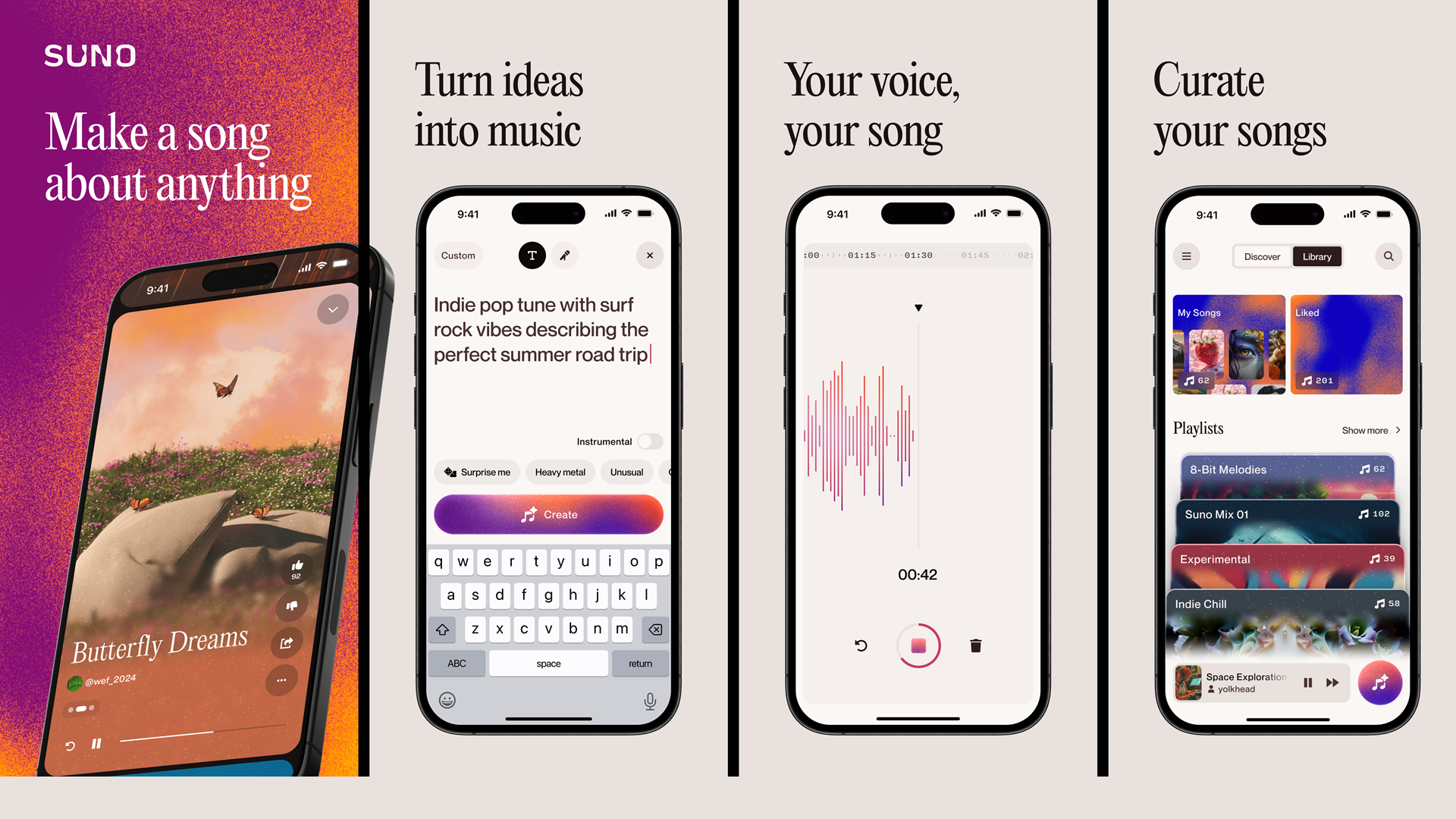
Suno , the most popular AI music creation tool, s...

Suno, the most popular AI music creation tool, spent years making it incredibly easy to generate music. Now it's introducing download limits, watermarking and fingerprinting to stop people flooding streaming services with AI slop.

That suggests something important to me: even the companies building generative AI are starting to realize unlimited AI creation comes with unintended consequences.

Suno CEO, Mikey Shulman, shared a blog post about the company's principles for building the future of music responsibly. He says “AI should help people create something new, not imitate someone else’s work. This philosophy has guided how we’ve built our models and platform from the start.”

Suno AI Mobile

(Image credit: Suno)

Great music is made by people

In a section titled “Our Principles”, Shulman says that “great music is made by people”.

The principles themselves aren't new. What's new is that Suno is now dedicating significant engineering effort to limiting abuse rather than simply enabling creation.

In his blog post Shulman writes “We will soon introduce a new downloads policy designed to limit the ability to mass distribute songs on streaming platforms, while preserving the professional, creative, and personal ways people use Suno. These changes won’t affect the vast majority of our users, but they will make large-scale abuse much harder.”

Schulman continues: “In the coming weeks, we will also be adopting new audio watermarking and fingerprinting technology so we can partner even more closely with distribution platforms on combatting fraud and misuse.”

That evolution fits the broader trend we’ve been covering from the music streaming services like Spotify, Deezer, Tidal, and Qobuz, who have started to fight back against AI-generated music flooding their platforms.

Managing the consequences

Streaming giant Tidal has published a comprehensive AI policy with the strapline "Promoting Fairness and Economic Empowerment in the Era of AI-Generated Music". Tidal will identify it, tag it and crucially, not pay any streaming royalties for it.

Spotfiy has introduced measures to prevent fraudulent streams and AI impersonation . Deezer announced that over half of all new daily uploads to its site are AI — up from 44% in April and just over 30% at the end of last year. It launched a free site to scan your playlists for AI in June. Qobuz has announced that it is taking a human-first approach to its recommendations and “developing detection and monitoring systems to identify AI-generated content and fraudulent streaming patterns.”

This announcement from Suno feels more significant than another AI company publishing a set of principles. It marks a shift in priorities. For the first few years of generative AI, success was measured by how much content these systems could produce. Now it looks like success is being measured by how effectively companies can prevent that content from overwhelming everything else.

The AI music industry is moving from maximizing generation to managing the consequences of generation, and it's about time.


from Latest from TechRadar https://ift.tt/RMKBJWs

When was the last time you met your newest hire i...

When was the last time you met your newest hire in person?

For many organizations, particularly those operating remotely, the answer is increasingly never. With one in five companies worldwide adopting a fully remote model, hiring virtually has become increasingly popular, enabling businesses to access global talent pools and scale faster than ever before.

But in removing geography as a constraint, it has also stripped away one of the most fundamental layers of trust: the ability to verify, face-to-face, who you are actually employing.

This shift is giving rise to a new and largely under-recognized threat, the “deepfake employee”, where threat actors use synthetic identities, voice cloning, and real-time deepfake video to pass interviews and secure legitimate employment.

Accelerated by advancements in AI, it is now possible to create convincing digital personas at scale, lowering the barrier to entry for fraud and enabling highly organized operations to target corporate hiring pipelines.

In practice, these attacks can be surprisingly difficult to detect. A candidate may appear on a video interview with a natural-looking face and voice, answer questions fluently, and provide what seem to be legitimate credentials. Behind the scenes, however, AI tools can subtly alter facial expressions, sync lip movements to a cloned voice, or even feed real-time responses.

To the hiring manager, there is little reason to suspect anything is wrong. The deception often only becomes apparent much later, if at all, when activity inside the organization begins to raise concerns.

This risk is already playing out in the real world. In a recent experiment, a cybersecurity expert used AI to create deepfake personas – one a white man similar to himself and another of an Asian woman, and successfully secured two separate tech roles, beating hundreds of other candidates.

Using AI-generated credentials, real-time voice modulation and live deepfake video, both synthetic identities progressed through interview stages undetected, with employers unaware they were interacting with an entirely fabricated candidate.

Cloudflare’s latest threat research highlights the scale and sophistication of this activity. Organized “remote worker” fraud operations are using fabricated identities, deepfake-assisted interviews and remote access “laptop farms” to infiltrate payrolls. In some cases, multiple individuals operate behind a single employee identity, maintaining persistent access while appearing as one consistent, legitimate user.

Once hired, these actors are no longer external attackers. They become insider threats with valid credentials, company-issued devices and trusted access to systems. As Cloudflare notes, by the time these individuals are identified, they are already operating inside the perimeter, often blending in with normal business activity.

What needs to change

With nearly 60% of organizations having experienced deepfake-driven incidents, and 48% reporting damage from AI-generated impersonation or misinformation, it is clear that identity infrastructure has become a primary attack surface. Attackers are shifting away from “breaking in” to “logging in” using legitimate credentials obtained through deception.

At the heat of this issue is the flawed assumption that identity can be verified once and then trusted indefinitely.

In physical environments, identity is rarely in doubt. You can see who walks through the door, recognize familiar faces and detect inconsistencies in behavior. In virtual environments, however, organizations rely almost entirely on screen names, login credentials and video, none of which reliably confirm who is actually behind the screen.

Accounts can be shared, credentials can be compromised, and even live video can be manipulated.

This creates a critical vulnerability at the point of hire. A candidate may present documentation, pass background checks and complete onboarding, but in a world of synthetic identities, that initial verification is no longer enough.

Building continuous identity assurance

To address this challenge, organizations need to move beyond static identity checks and towards continuous identity verification. This means verifying not only who someone is who they say they are and that they are a real human at the point of hire, but ensuring that the same individual remains present and authentic throughout their interactions with the organization.

The strongest form of defense lies in continuous biometric verification of the user’s identity. Rather than relying on a single factor, such as facial recognition or voice authentication alone, fused biometrics combines multiple identity signals, such as facial characteristics, voice patterns and behavioral cues, into a single, layered verification process, verifying directly that a real, live human is there.

It is no longer enough to confirm a person’s identity at a single moment in time. Organizations need confidence that the same individual is consistently present across every critical interaction, from interviews and onboarding, through to system access and sensitive transactions. Without this continuity, identities can be shared, replaced or hijacked without detection.

Fused biometric verification can create layered validation that is significantly harder to replicate or manipulate, enabling it to detect and block attempts to impersonate users through synthetic voices, deepfakes, or recorded audio and video.

While a single modality might be fooled by a sophisticated synthetic input, combining biometric modalities; facial recognition, voice recognition, and speech pattern recognition, it becomes significantly harder for fraudsters to mimic an identity.

Advanced biometric verification technologies are trained on large datasets of both genuine and synthetic voice samples, enabling them to recognize subtle acoustic differences between natural and deepfake voices. This helps organizations detect voice-cloning attempts, even when the audio sounds convincing to human listeners.

Crucially, fused biometric verification can operate passively in the background, consistently verifying that the right person is accessing systems, enabling smoother, lower-friction experiences and reduces the need for frustrating repeated verification attempts.

As organizations continue to embrace remote work and digital-first operations, cybercriminals will increasingly find new vulnerabilities to exploit. The question is no longer just how to keep threats out, but also how to ensure that those already inside are truly who they claim to be.

In a world where identities can be fabricated, cloned and manipulated with ease, trust cannot remain static. It must be continuously proven.

We've featured the best secure smartphone.

This article was produced as part of TechRadar Pro Perspectives, our channel to feature the best and brightest minds in the technology industry today.

The views expressed here are those of the author and are not necessarily those of TechRadarPro or Future plc. If you are interested in contributing find out more here: https://www.techradar.com/pro/perspectives-how-to-submit


from Latest from TechRadar https://ift.tt/iysE0Pr

Prince Harry and Meghan Markle have taken direct ...

Prince Harry and Meghan Markle have taken direct aim at Grok after Minnesota became the first state to enforce a ban on AI "nudification" technology, using an unusually blunt official statement to criticize xAI's attempt to stop the law. Days before the legislation took effect, Elon Musk's AI company filed an emergency legal request seeking to block it, arguing that the measure violates the First Amendment. A federal judge refused to grant the request, allowing the law to go into effect while the broader case continues.

The Sussexes made it clear which side they believe this fight should be on. "Technology should not enable predators to target children," their statement begins. "Yet, ahead of Minnesota's first-in-the-nation law banning AI 'nudification' apps taking effect tomorrow, one of the world's largest technology companies sued to stop it. Why?" It is a remarkably direct criticism, one that shifts the conversation away from legal arguments and back toward the people these tools can harm.

Whether Minnesota's law ultimately survives every constitutional challenge is a question for the courts, but Harry and Meghan have identified something larger than one lawsuit. AI companies are racing to make image generation more powerful while governments scramble to prevent those same tools from being weaponized against real people. When a company fights to preserve technology that can create convincing fake nude images of recognizable adults and children, it is easy to see why the couple argues that the industry's priorities deserve much closer scrutiny.

Sussex vs. Musk

Grok on a smartphone

(Image credit: Shutterstock)

AI has become extraordinarily good at manipulating images, but that includes convincing fake intimate photographs with only a few prompts. And it has spread far faster than the laws designed to deal with it.

Minnesota's legislation attempts to tackle the problem at its source by preventing apps and websites from offering AI nudification tools in the first place. Rather than waiting until fake images have already spread across social media or messaging apps, lawmakers are trying to make the technology itself less readily available. Whether every provision survives constitutional scrutiny remains to be seen, but the intention is difficult to misunderstand.

Harry and Meghan clearly believe that technology companies have had plenty of opportunities to address the issue voluntarily and have failed to do so. Their statement praises Minnesota's bipartisan action as "an example of leadership fit for the digital age," adding that lawmakers recognized "this technology, if not stopped, would protect predators and hurt innocent people, especially women and girls."

The Sussexes are slicing through the tangled debate over algorithms against constitutional doctrine. Those issues matter, but it can miss the forest for the trees if people forget that these synthetic nudes begin with an identifiable person whose image has been manipulated without permission.

AI models as neutral tools whose morality depends entirely on the user. But laws often are stricter when any tool is used to hurt children for a reason. And the claim that Grok's moderation system is enough has proven untrue. But the feature does not stop being Grok's responsibility simply because someone else typed the prompt.

Safety should not be an optional feature

The Sussexes refuse to treat this as an abstract policy dispute.

"Big Tech companies are raising billions claiming AI will bring society forward, yet they retaliate against basic safety measures to keep children safe," they wrote. "Can AI make our world better while it enables the worst in humans? Should our children pay the price while we wait to find out?"

Those are uncomfortable questions for AI companies racing to release increasingly capable products. Every major developer wants to ship the next breakthrough before its competitors do. Safety work, moderation systems and abuse prevention rarely generate the same excitement as flashy new features demonstrated on stage.

xAI is hardly alone in facing this challenge. Every major AI company has struggled with image generation, impersonation and deepfakes. The difference here is the explicit pushback against a state trying to make them take some responsibility for how their technology is misused.

The legal arguments will continue for months, and there's no way to tell yet what the final version of the law will look like. Courts have to balance free speech and public safety, and that's not simple. But the fact that AI has made creating nonconsensual intimate imagery dramatically easier remains, and Harry and Meghan are right to zero in on that human cost over legal theory.

The debate matters because children's safety matters. Whether the companies building these tools can be made to accept meaningful responsibility when those capabilities are turned against children may be decided in courts, but Harry and Meghan are correct that it shouldn't take lawyers for them to do the right thing here.


from Latest from TechRadar https://ift.tt/SnLVz84

Marantz launches a new Cinema Cinema Series 2 ran...

  • Marantz launches a new Cinema Cinema Series 2 range of AV receivers, with three different models
  • The have a brand new 32-bit DAC across all three models, plus optional Dirac room correction available on all
  • There's also improved HDMI 2.1 gaming support, including 1440p passthrough and AMD FreeSync

Marantz has updated its acclaimed Cinema Series range of AV receivers. The first generation launched in 2002 and delivered a winning combination of good looks, great audio and excellent connectivity, and the latest Cinema 50 Series 2 , Cinema 60/DAB Series 2 and Cinema 70s Series 2 continue in that vein.

The big change in these new 2026 models is their brand-new 32-bit 8-channel DAC, which Marantz says delivers "greater precision, improved imaging, enhanced dynamic expression and more coherent surround performance throughout the listening environment."

Each model has been tuned by Marantz's Sound Master to deliver what Marantz promises is "an immersive and emotionally engaging entertainment experience."

There's Bluetooth LE Audio (in a future firmware update), improved gaming support and optional Dirac room correction across all three models.

One thing that hasn't changed is the products' good looks: these are home theater components you'll want to show off.

Marantz Cinema 50 Series 2 close up of the rear connections

(Image credit: Marantz)

Marantz Cinema Series 2: models, features and pricing

Each of the new Series 2 models comes with the new DAC, support for 1440p video passthrough with AMD FreeSync for gamers, a new Web Control 2.0 configuration app for your phone or computer, and HDMI Diagnostics 2.0 to deliver advanced troubleshooting and faster installation, which is intended for custom-installations, but sounds like a potential godsend generally.

The data options include the ability to see how each channel is being pushed by what's playing, which is definitely a fun game to play if you're wondering how different movies make use of the power of your system. Engineers from Denon and Marantz have previously told my colleague Matt Bolton that Gravity is the 'torture test' movie they use to see how AVRs handle stress during development, so it'd be fun to take a look at what that movie does to the numbers.

The flagship Cinema 50 Series 2 gets a few important upgrades that the others don't: the new Dolby Atmos Channel Expander, which uses all the available speakers when you're playing Dolby Atmos content regardless of how it was originally encoded, which seems to be especially useful for if you have additional height channels. There's also a new Center Bi-Amp Mode to improve dialog quality.

The flagship Cinema 50 Series 2 has nine channels putting out 110W apiece, 11.4 channels of processing and optional Dirac support. The Cinema 60/DAB Series 2 is a 7-channel, 100W per channel model, while the Cinema 70s Series 2 delivers 7 x 50W.

The prices for the new models are:

  • Marantz Cinema 50 Series 2: $3,000 / £1,850 / AU$3,500
  • Marantz Cinema 60 Series 2: (APAC and USA only) $2,000 / AU$2,500
  • Marantz Cinema 60 DAB Series 2: (Europe only): £1,250
  • Marantz Cinema 70s: $1,500 / £950 / AU$1,800

Thinking of buying a new TV?

Try our TV size and model finder! You tell it how far you sit from your TV, we'll tell you what size to buy based on viewing angle advice from image quality experts, and we'll recommend our three top TVs at that size for different prices.


from Latest from TechRadar https://ift.tt/8Zz7t0O

Mention high-frequency semiconductors, and the co...

Mention high-frequency semiconductors, and the conversation often begins with gallium arsenide (GaAs). For decades, GaAs has been the material of choice for high-performance radio frequency (RF) devices that enable a wide range of applications, including satellite communications, radar, and mobile networks.

It is a mature, well-understood technology, and large, high-quality wafers can be grown economically, enabling consistent device performance and scalable manufacturing.

Yet a transition is underway. Increasingly, the industry is turning away from GaAs and towards gallium nitride (GaN), a material that offers clear performance advantages, particularly at higher frequencies, higher power levels, and more demanding operating conditions.

The promise of GaN is well established. The challenge lies in making it reliable, scalable, and commercially competitive.

And, as with many emerging semiconductor technologies, meeting that challenge is as much about measurement as it is about materials.

A material with advantages, and constraints

GaN enables the development of devices that can operate at higher voltages, higher temperatures, and greater power densities than their GaAs counterparts. This makes it particularly attractive for next-generation RF systems, including 5G and 6G communications, defense applications, and space technologies – where extreme environments are commonplace.

In principle, GaN can offer a straightforward upgrade path. It is sometimes thought of as a functional replacement for GaAs to deliver improved performance. Yet, in practice, the situation is more complicated, and a whole-system approach is required to redesign a module. Furthermore, the manufacturing approach for GaN is fundamentally different.

The hidden cost of heteroepitaxy

Unlike GaAs, which can be grown as large, high-quality wafers using established methods, GaN presents a fundamental manufacturing challenge because producing large, defect-free GaN substrates remains difficult and expensive.

As a result, most GaN devices are produced using a process called heteroepitaxy, whereby a thin layer of GaN is grown on top of a different substrate, typically silicon or silicon carbide. This approach allows manufacturers to leverage existing wafer technologies. But it comes at a cost.

When GaN is grown on a dissimilar substrate, differences in lattice structure and thermal expansion introduce defects into the material. These defects can affect everything from electrical performance to long-term reliability.

This results in a difficult trade-off: GaN offers superior theoretical performance, but achieving that performance consistently across wafers and devices is far more challenging than with GaAs. The advantage of using GaN therefore increasingly depends on material quality, and on the ability to control and understand it.

That relies on measurement.

Measurement as a competitive tool

For companies developing GaN technologies, metrology plays three distinct and essential roles.

The first is in process development. Growing GaN through heteroepitaxy involves carefully balancing multiple parameters, including temperature, deposition rates, and substrate preparation. Small changes can improve or degrade material quality. Without reliable measurement, it is difficult to know whether a process adjustment has made the material better or worse. Metrology provides the feedback needed to refine growth techniques and reduce defect densities.

The second role is in demonstrating material quality. In a market where performance depends heavily on the underlying material, manufacturers must be able to show that their GaN is superior to that of competitors. This requires measurement methods that are not only accurate, but also comparable across organizations. Customers need confidence that a claim about material quality means the same thing, regardless of where it is measured.

The third role is in device performance validation. Ultimately, customers care about how a device behaves in real applications. For RF components, this includes metrics such as power output, efficiency, frequency response, and thermal stability. Linking these device-level characteristics back to material quality is essential. It allows manufacturers to demonstrate that improvements in material growth translate into tangible performance gains.

Across all three areas, measurement is not simply a supporting activity. It is a central part of how competitive advantage is created and communicated.

From materials to systems

The challenges associated with GaN are part of a broader shift in the semiconductor industry.

As devices become more specialized and operate under more demanding conditions, performance is increasingly determined by subtle interactions between materials, structures, and processes.

This is particularly true in RF systems, where small imperfections can have outsized effects on signal integrity and efficiency.

It also connects to a wider trend seen in other areas of semiconductor technology, including photonics. There, heterogeneous integration is bringing together different materials and device types within a single system, creating similar measurement challenges.

In both cases, success depends on the ability to understand and control complexity at multiple scales.

A strategic inflection point

For the RF semiconductor industry, the transition from GaAs to GaN represents more than a simple material substitution.

It marks a shift towards technologies where performance is less constrained by established manufacturing processes, and more dependent on how well new materials can be engineered and characterized. This creates an opportunity.

Countries with strong capabilities in materials science, process development, and measurement can play a defining role in shaping how GaN technologies evolve and are applied successfully in the semiconductor industry.

The ability to measure material quality, correlate it with device performance, and establish trusted benchmarks will influence how quickly GaN is adopted across global markets. This means the future of high-frequency RF semiconductors will not be determined by materials alone.

GaN may offer superior intrinsic properties, but those advantages must be realized in practice. That requires consistent, high-quality material growth, reliable device fabrication, and credible performance validation – all of which depend on effective measurement and standards. This is why metrology will become increasingly central to RF semiconductor innovation, not as a downstream check, but as an integral part of development, manufacturing, and market adoption.

In high-frequency semiconductors, as in photonics, the ability to measure well is no longer just a technical requirement. It is becoming a defining feature of competitiveness.

We've featured the best phone system for business.

This article was produced as part of TechRadar Pro Perspectives, our channel to feature the best and brightest minds in the technology industry today.

The views expressed here are those of the author and are not necessarily those of TechRadarPro or Future plc. If you are interested in contributing find out more here: https://www.techradar.com/pro/perspectives-how-to-submit


from Latest from TechRadar https://ift.tt/7ROQtga

Prompt engineering was briefly the face of the AI...

Prompt engineering was briefly the face of the AI jobs boom.

In 2025, technology recruitment firm SPG Resourcing reported that UK job listings for AI prompt engineers had grown by 180% over the previous year.

It was an eye-catching figure that captured the mood of the first commercial wave of generative AI. Businesses were trying to understand how to talk to LLMs and turn early experiments into something useful.

That requirement has not disappeared.

With job site postings for specialist AI roles in the UK rising by 61% from last year according to PWC, it’s clear that good prompts still matter. But most of that new demand is for people who can apply AI inside a business, not just talk to a model.

Many organizations have moved past the first demo. They are now trying to build AI agents, retrieval-augmented generation (RAG) systems, and AI-enabled workflows that operate inside the business.

That creates a different skills gap.

This is the shift behind what I refer to as ‘context engineering’. Although that term is not universally used, the capability is becoming essential.

Companies that want useful AI agents and retrieval-augmented generation systems need people who can design the environment around the model, not just the prompt sent to it.

From better prompts to better context

Prompt engineering is about the instruction, while context engineering is about the world around that instruction.

A support agent does not only need a well-written prompt, it needs the right customer record, policy, product history, and permission boundary. Similarly, a developer agent needs the relevant code, tests, dependencies, and deployment constraints.

In both cases, output quality depends on context. Without it, the model is guessing from incomplete evidence. With too much of it, the system becomes noisy and difficult to govern. The job is to make context useful, current, and controlled.

That’s what makes context engineering distinct from prompt engineering.

Agents raise the stakes

The rise of AI agents makes this more urgent. A chatbot with poor context may give a weak answer, but that same poor context may result in another agent making a serious error.

Once an AI system can call tools, query business systems, maintain state, and act across several steps, context becomes an essential part of the production architecture. It decides what the agent can see, what it can do, and how much confidence the business can place in the outcome.

I’m reminded of a joke about boundary testing. A developer walks into a bar and orders a beer, then he orders five beers, then he orders 999,999,999,999 beers, then he orders -1 beer. The bartender blinks, but everything is okay. A user walks into the bar, asks where the bathroom is and the whole bar explodes.

The same principle applies to AI projects. The first prototype may work against a narrow set of examples, then become fragile when it meets real data. Customer information sits in one system, operational data in another, and important knowledge in documents and files. The agent is expected to reason across all of it, but the context layer has not been designed for that job.

A financial services team, for example, may need to connect CRM data, an existing data platform, and internal documents before an agent can answer accurately. The hard work is not only moving the data. It is shaping it so the agent can retrieve the right evidence and stay inside the right permission boundary.

The job title is still catching up

This creates an awkward hiring moment. The need for context engineering is becoming clearer, but the job title is still unsettled.

Some organizations may seek to specifically hire ‘context engineers’, but many will not. The capability is more likely to appear inside roles such as AI engineer, agent engineer, AI platform engineer, applied AI engineer, or data engineer. In other businesses, it will be a team responsibility shared across data, platform, security, and software engineering.

Leaders therefore need to hire for the work, not the label. A candidate does not need to have ‘context engineer’ on their CV to be useful. The better signal is whether they understand how data moves through systems, how permissions are enforced, and how a prototype becomes something reliable enough for production.

This also means the talent pool is wider than many companies assume. Machine learning expertise is valuable, but context engineering draws heavily on existing engineering disciplines. Data engineers understand pipelines and retrieval.

Platform engineers understand operational resilience. Security teams understand access control and auditability. Software engineers understand how to turn messy requirements into maintainable systems.

The best candidates may look like full-stack AI engineers. They do not need to be specialists in every model, database, or framework, but do need enough range to connect the model layer with the business systems around it.

The Kubernetes lesson and what leaders should do now

The shift has a parallel with the move to cloud-native architecture and Kubernetes. Many companies treated Kubernetes as something to install, then discovered that the harder work was changing how teams built and ran software.

AI creates a similar risk. Companies can buy tools and hire a handful of specialists, but still fail to change the engineering habits around them. Context engineering requires teams to think differently about everything from documentation, and data ownership, to access, testing, and accountability.

It also changes the culture of software development. Engineers are already using AI to write, review, and iterate code. That can improve productivity, but it does not remove responsibility. In areas where performance, reliability, or security matter, human judgement becomes even more important.

CTOs and CIOs should not wait for context engineering to become a mature hiring category. They should start identifying the capability now.

The first step is to examine where AI projects are failing. Is the model genuinely weak, or is the system retrieving poor context? Are permissions clear? Can the team explain why the agent produced a particular answer?

The second step is to build cross-functional teams. AI cannot sit apart from data, platform, security, and product. In many cases, the best approach will be to upskill existing engineers who already understand the organization's systems.

The final step is cultural. Engineers need to become fluent in AI-assisted development while staying accountable for the systems they ship. Leaders need to make room for experimentation, but they also need clear standards for review, evaluation, and governance.

The model is not enough

AI hiring is changing because AI itself is moving into production. Models will continue to improve, and businesses will have many ways to access them. The harder advantage will come from knowing how to connect those models to the right business context.

Companies that understand this will build agents and RAG systems that are more useful, safer, and easier to govern. Companies that ignore it will keep blaming the model when the real weakness is the environment it has to work in.

We list the best resume builders, to make it simple and easy to build a CV to help your career.

This article was produced as part of TechRadar Pro Perspectives, our channel to feature the best and brightest minds in the technology industry today.

The views expressed here are those of the author and are not necessarily those of TechRadarPro or Future plc. If you are interested in contributing find out more here: https://www.techradar.com/pro/perspectives-how-to-submit


from Latest from TechRadar https://ift.tt/6yGBFDp

There has never been a construction race like the...

There has never been a construction race like the one now under way in the data center industry.

AI's demand for compute is driving the largest and fastest infrastructure buildout the sector has ever seen, with hyperscalers and developers racing to bring capacity online faster than power grids, planning departments or supply chains can comfortably keep up.

In that scramble, enormous attention goes to the things visible on a spreadsheet: megawatts, cooling, chips, network and, rightly, cybersecurity.

The dimension that gets quietly deprioritized is the physical protection of the buildings themselves. It is the easiest thing to defer under deadline pressure, and the hardest to retrofit once the concrete is poured.

A regulatory change in the United States is about to make that blind spot worse, and it is worth understanding even if you never operate a US federal facility, because of what it signals.

On 30 September, the Federal Data Center Enhancement Act is due to expire, with no replacement waiting. It set minimum standards for federal data centers, including, unusually, protection against physical intrusion, and it was the operational mandate that forced data-center-specific assessment.

Broader frameworks such as FISMA and the NIST control catalogue still apply, but they provide the principle; the Enhancement Act provided the practice. Principles without a mechanism to enforce them tend to be interpreted generously.

And when the government's own floor is allowed to disappear, the benchmark private operators quietly measure themselves against tends to go with it.

Security baselines

This is not a hypothetical worry about whether the requirement comes back. The Act's predecessor lapsed in 2022 and only survived by being folded into the following year's defense bill. A rule that needs a legislative vehicle to return is one that can quietly fail to, and security baselines rarely erode through a single dramatic decision. They erode through the absence of one: a mandate that simply never gets renewed because nothing forces the issue.

It helps to be concrete about what is at stake, because physical security is not an abstraction. It is the contractor with unescorted access to a hall of servers; the unmonitored loading bay; the maintenance door propped open for convenience; the departed employee whose credential still opens the cage. These are the routes by which data is stolen, infrastructure is sabotaged, and a facility the size of a warehouse is taken offline.

The real exposure is not in the data centers we already have. Established operators keep that spending in place through existing contracts and their own risk appetite. It is in the new builds, the AI-era expansions specced and procured at extraordinary speed, most of them private, built by developers no mandate ever bound. Remove the assessment framework and physical security becomes something that can be scoped down in procurement to hit a budget or a timeline, with no compliance flag and no one formally alerted. The gap opens in the facilities we are racing to build.

There is a contradiction at the center of this. Governments increasingly classify data centers as critical national infrastructure, the UK now does, and rightly so. Reducing their security baseline at the same moment runs in two directions at once. You cannot call something critical and simultaneously make its protection optional.

A sensible fix

The fix is not simply more regulation, though a sensible renewal would help. It is to stop treating physical security as a compliance obligation that rises and falls with the statute book, and start treating it as core design.

The consistent lesson from securing large-scale critical facilities is that physical security fails when it is a collection of disconnected tools, a camera here, an access reader there, bolted on at the end of a project.

It works when it is designed from the start as one integrated system, where access control, video, identity and alarms inform each other and an anomaly anywhere triggers a coordinated response.

Treating the physical and the digital as separate problems is part of how the gap forms in the first place. In a modern data center they are the same problem: a propped door, a cloned badge or a rogue contractor is a cyber incident waiting to happen, and a facility that cannot correlate a door event with an access log or a camera feed will always be reacting after the fact rather than stopping an intrusion in progress.

For operators, the practical implication is simple: the physical security of an AI data center should be specified at the same moment as its power and cooling, not bolted on once the shell is up. Retrofitting protection into a live, fully-loaded facility is far harder, and far costlier, than designing it in.

The AI buildout is a genuine engineering achievement, and the energy and compute challenges are real. But the industry is optimizing hard for the risks it can measure and deferring the one it finds inconvenient. A statute lapsing in Washington should not be what decides whether the buildings holding the world's most critical compute are properly protected.

For IT infrastructure we have all agreed is critical, getting its physical protection right should be a given, not something we quietly leave to whoever is under the most deadline pressure.

We've listed the best Linux distros for servers.

This article was produced as part of TechRadar Pro Perspectives, our channel to feature the best and brightest minds in the technology industry today.

The views expressed here are those of the author and are not necessarily those of TechRadarPro or Future plc. If you are interested in contributing find out more here: https://www.techradar.com/pro/perspectives-how-to-submit


from Latest from TechRadar https://ift.tt/TuqkwrN

Artificial intelligence (AI) is reshaping the sc...

Artificial intelligence (AI) is reshaping the scale and complexity of data center infrastructure.

Traditional data center facilities were designed around relatively steady CPU workloads and predictable growth in power demand, allowing developers to secure energy supply alongside growing demand, cooling systems based on known and mature technology and infrastructure capacity with a reasonable degree of certainty.

AI workloads, however, demand far more power with greater energy density.

Electricity consumption from data centers has grown at 12% per year over the last five years and expected demand growth, particularly in AI training data centers, is set to drive a substantial increase in power demand.

Meeting this demand, while maintaining efficiency, is pushing developers toward gigawatt-scale data centers and with the timeframe for delivering these facilities rapidly compressing, the ability to deliver new infrastructure efficiently is increasingly critical.

In addition, as the scale of these developments grows, so does the complexity of delivering them. Grid interconnections can delay timelines by years, equipment supply chains are stretched, and projects must meet stringent reliability targets while navigating regulatory, environmental and community requirements that vary by region and country.

For owners and developers, the challenge is no longer simply constructing another data center building. The next generation of AI data centers requires a fully integrated approach across power, cooling, transmission, water, digital systems and long-term operations. Success depends on designing these facilities as resilient, flexible and energy-optimized industrial campuses.

Balancing site trade-offs to unlock faster delivery

Site selection is one of the clearest expressions of this dynamic where teams are typically assessing a series of imperfect options, each with its own advantages and constraints. For example, one site may offer lower cost land but lack the existing infrastructure required to support large scale development, while another may provide access to grid power but at a significantly higher cost or with timelines that delay delivery.

In practice, few locations offer everything required, and selecting a site becomes an exercise in understanding what should be prioritized, what can be mitigated, and what must be accepted.

Factors like water availability, land constraints, fiber connectivity, permitting timelines and social license to operate are all deeply important to success. Developers must consider how to optimize within these constraints. Where grid power is unavailable or delayed, for example, off grid or hybrid energy solutions may be introduced.

While these approaches can accelerate delivery, they also bring different capital requirements, financing structures, and operational considerations that must be carefully weighed.

Combining power solutions can accelerate bringing capacity online more efficiently

As AI workloads drive unprecedented levels of demand, power strategies also require a reassessment against expected scale timelines. Grid supply does offer lower long-term energy costs, stability and resilience advantages eventually but hinges on capacity constraints, and extended interconnection timelines.

In contrast, behind the meter generation, such as gas turbines or reciprocating engines, can be deployed more quickly and provide greater operational control. This, however, comes with higher upfront capital requirements, higher operational costs, fuel dependencies and more complex permitting considerations.

As speed-to-market is a key competitive driver, many large-scale developments are willing to pay a premium for off-grid or hybrid architectures, including battery storage and integration of renewables where accessible.

These systems are coordinated through microgrid controls, allowing operators to manage load variability, maintain resilience through islanding, and optimize overall system performance. The final configuration is shaped by how factors such as time to market, grid availability, resilience, and overall cost evolve.

Rethinking cooling can support high-density AI and optimize when energy is used

With this increase in power demands comes a corresponding increase in heat generation. The physics and economics of air cooling are struggling to keep pace with the thermal loads generated by AI workloads, forcing a shift toward alternative solutions.

One solution is liquid cooling, which is gaining traction as a more effective way to manage higher heat loads. Transferring heat more efficiently, it enables facilities to operate at the densities required by AI infrastructure. However, it does also introduce new dependencies, particularly around liquid cooling solutions and the infrastructure required to support it.

At the same time, taking a broader view of cooling opens up new opportunities. Cooling systems can be integrated with wider power infrastructure, excess heat can be connected to industrial processes that can utilize it and waste heat from data centers can be repurposed for applications such as district heating, which is already quite common in the Nordics.

Approaching cooling in this way allows developers to design systems that make better use of energy and create additional value through heat reuse and integration with surrounding infrastructure.

Additionally, thermal energy storage gives AI data centers the ability to shift cooling demand away from peak periods by producing chilled water when electricity is cheaper or more available and using it later when loads are highest.

This creates valuable demand response capability, allowing the facility to reduce its grid draw during periods of system stress, lower demand charges and support utility programs without impacting data center operations. In combination with batteries and advanced controls, thermal storage can help stabilize both the data center and the surrounding grid.

Early efforts on permitting can identify the fastest development route and avoid delays

Permitting and regulatory considerations sit alongside these technical decisions, shaping what is possible and how quickly projects can move forward. Requirements vary by region, country and project type, but in all cases, they influence how projects must be designed from the outset.

For example, grid connected developments may be constrained by connection approvals and capacity limits, while sites incorporating on-site generation may require air quality or emissions permits that influence technology choices. Land use restrictions, environmental approvals and community considerations can further shape site layout, development timelines and even overall project viability.

Addressing these requirements early, and in parallel with technical and commercial decision making, is therefore as important as those other factors. When permitting is treated as part of the initial planning process, it allows projects to be structured in a way that is both deliverable and aligned with regulatory expectations from the beginning.

This, in turn, reinforces the need for a coordinated approach across the full range of stakeholders involved. Energy providers, technology companies, developers, regulators and local communities each play a role in shaping outcomes, and the interaction between them becomes a critical factor in how effectively projects can progress.

Having the right expertise in place to connect these elements enables developers to navigate this complexity more effectively, ensuring that decisions made early on are aligned across disciplines. This early alignment helps create a more integrated delivery pathway, reducing friction between project phases and supporting smoother progression from planning through to construction and execution.

Turning AI demand into operational capacity at the speed and scale the market requires

The importance of this becomes clearer when looking at how these challenges play out in practice. In Texas, for example, early engineering work on a gigawatt scale AI training data center helped define the infrastructure strategy for one of the largest behind the meter energy systems supporting AI workloads.

The project includes 5 GW of gas generation capacity, up to 1.25 GW of solar PV, utility scale battery storage and a microgrid supporting 20 buildings totaling 10 million square feet, each designed for around 250 MW of power demand.

Projects of this scale reflect the sheer pace and ambition of AI demand, but ultimately, success comes down to how effectively that demand is translated into deliverable infrastructure. That means making early decisions that can withstand real world constraints, from power availability and permitting through to long term operational performance.

Bringing these elements together into a coherent strategy, and aligning the stakeholders needed to deliver it, is what will enable projects to move at the speed and scale the market now requires.

We've featured the best database software.

This article was produced as part of TechRadar Pro Perspectives, our channel to feature the best and brightest minds in the technology industry today.

The views expressed here are those of the author and are not necessarily those of TechRadarPro or Future plc. If you are interested in contributing find out more here: https://www.techradar.com/pro/perspectives-how-to-submit


from Latest from TechRadar https://ift.tt/l8fu30z

UK’s Police National Legal Database (PNLD) breach...

  • UK’s Police National Legal Database (PNLD) breach leaks data of 100k+ criminal justice professionals
  • Threat group ExfilSquad claimed responsibility, posting 1.9 GB of stolen records on the dark web and demanding ransom
  • PNLD notified NCA and ICO, hired specialists, and confirmed passwords weren’t compromised but contact details exposed

The UK’s Police National Legal Database (PNLD) suffered a cyberattack recently, in which it allegedly lost sensitive data on more than 100,000 criminal justice professionals.

In a short press release, PNLD confirmed the breach, saying it happened over a weekend. The threat actors, which were not named in the announcement, were said to have taken names, organizations, and work email addresses belonging to police officers, staff, government partners, and customers.

The announcement also said the stolen information was already published on the dark web, adding that there is “no evidence to suggest that passwords or other security credentials have been compromised.” How the attackers worked their way in was not disclosed in the announcement.

ExfilSquad takes the blame

Following the breach, PNLD hired cyber-security specialists, and notified the National Crime Agency, which started their investigation into the incident.

“All affected organizations were contacted in the days following the incident and provided with further information and guidance,” the announcement reads. “The Information Commissioner’s Office (ICO) has also been notified.”

At the same time, threat actors calling themselves ExfilSquad claimed responsibility for the attack, BleepingComputer reported. The group alleges it stole 135,000 contact records, sharing samples to support their claims. They also said they demanded a ransom in exchange for keeping the data safe.

In the dark web post, ExfilSquad said it obtained 1.9 GB of data, which includes information belonging to 114,000 PNLD subscribers and 21,000 Ask the Police users.

‘Ask the Police’ is a public-facing website where users can find answers to hundreds of commonly asked policing or legal questions.

ExfilSquad is a relatively new threat actor that's not known for any major attacks so far. Prior to the PNLD incident, it claimed the attack against Analog Devices, a US semiconductor company.


from Latest from TechRadar https://ift.tt/FNZIq4p

Advanced Full Fibre Broadband from EE offers down...

  • Advanced Full Fibre Broadband from EE offers download speeds of 2.3Gbps and 8Gbps
  • Speeds are potentially 222 times faster than standard superfast fibre
  • Initially available in Guildford and Woking, expanding as Openreach rolls out its XGS-PON glass fibre network

Following a successful trial in early 2026, EE has launched its new Advanced Full Fibre Broadband plans, advertising download speeds of 2.3Gbps and 8Gbps. This makes EE the first provider to sell access to the Openreach XGS-PON glass fibre network.

The plans are initially only available in the Guildford and Woking areas, two Surrey towns in the London commuter belt, where the glass fibre network is installed and active.

EE is targeting users who rely on video conferencing, remote working, and content upload, and with multiple Internet of Things devices, as well as online gamers and streaming consumers. Speeds are up to 222 times faster than the standard superfast fibre broadband plans.

Two plans for EE’s XGS-PON fibre

Customers can access two plans from EE. The 2.3Gbps Advanced Full Fibre Broadband plan starts at £54.99 per month, while the 8Gbps plan is available from £74.99 a month.

No upload speeds have been stated, nor are they listed on the sign-up page, but they can be expected to be similarly fast.

XGS-PON (10-Gigabit-capable Symmetric Passive Optical Network) is a high speed, high-bandwidth data network standard, currently available in various forms across Europe, North America, and other regions. In the UK, it is used in the nexfibre, CityFibre, and Openreach networks, with EE using the latter to provide these plans.

With streaming speeds supporting 4K and 8K video, these plans are likely to be popular where available, and support for up to 190 devices suggests the plans will include routers suited to IoT and smart home applications.

Will faster fibre improve British broadband?

“Today marks a major milestone for EE as we become the first major UK provider to offer broadband speeds of up to 8Gbps on next-generation XGS-PON technology," noted Luciano Oliveira, Director of Product, Home and TV at EE.

"As homes become more connected and customers place greater demands on their broadband, we're investing in the technologies that will power the next generation of digital experiences.”

EE regularly wins recognition as the UK’s most popular network, with its business built on mobile (where its 4G, 5G and 5GSA speeds cover more than 90% of the UK) and an advertising campaign featuring Hollywood actor Kevin Bacon.

Unlike Virgin Media which owns its own fibre network, EE’s domestic and business broadband plans rely on third party infrastructure, mostly provided by Openreach, and due to the differences in connections across the country (and the legacy copper lines that remain in place in some locations), struggles to offer the same speeds for all customers.

This is a problem faced by all providers who sell access to Openreach lines, so EE’s immediate competitors will no doubt be watching with interest.


from Latest from TechRadar https://ift.tt/VIWoEHF

“AI readiness” tends to be used as umbrella phras...

“AI readiness” tends to be used as umbrella phrase to describe the different range of activities that businesses need to carry out to get value of generative AI and minimize any associated risks.

AI readiness therefore takes into account everything from having the right data foundations and governance in place to supporting AI literacy among staff to establishing ethical guardrails.

One area where businesses – including even large brands – are collectively not ready for AI is ensuring their brand is visible and faithfully represented across Large Language Models (LLMs) and in responses from associated AI tools like ChatGPT, Gemini and Claude.

The outside-in view

Too many large companies have a digital estate that contains content that is outdated or contradictory. Because AI tools base their responses on the content they find, brands risk AI tools giving out misinformation or misrepresenting their brand, products or organization.

Similarly, there is also a risk of brands not being featured in responses or less than those compared to competitors, impacting future visibility and competitiveness.

This is effectively AI looking from the “outside in” and then presenting a picture of what it has surfaced. When we measured this “outside in” element of AI readiness across the websites of over 250 top global brands using an automated remote website assessment tool and an underlying AI maturity model, we found only approximately 3% of websites could be considered “leading” when it comes to AI readiness.

Why AI readiness is important

The way people search for information on the web is changing rapidly. Consumers are turning to ChatGPT rather than using traditional Google searches; surveys have suggested that 37% of consumers in the US who already use AI, now start their searches using AI tools rather than Google.

This means that rather than looking at a web page on a company’s own website, consumers’ perceptions about a brand are increasingly coming from AI responses as the first step rather than directly from a web page controlled by the company.

That’s a problem if a consumer asks AI to provide a list of suppliers or vendors, and your business isn’t listed when it should be, or the AI provides erroneous information about your company and products from the off.

Recognizing the speed at which consumers are turning to AI tools for search, digital marketing teams who have previously invested in Search Engine Optimization (SEO) are now investing in related practices like Generative Engine Optimization (GEO) and Answers Engine Optimization (AEO) with some urgency to optimize their digital footprint so it is successfully reflected in AI tools like ChatGPT.

But the reasons that even some of the world’s top brands still have a lot of work to do in this area is because in the past they have deprioritized basic governance and maintenance across their digital estate, with the risk of AI confidently presenting answers as facts or broadcasting perceptions that are based on information from content that is out of date and has been superseded.

Of course, the risks associated with erroneous answers may vary but they can be acute, particularly in heavily regulated industries such as financial services, healthcare or pharmaceuticals with strict compliance surrounding the information that businesses must provide to customers, or in areas such as products where health and safety instructions must be correct.

The hidden digital footprint

One of the key reasons where businesses slip up is by building up a digital footprint – often without realizing it – which is not actively managed and has old and inaccurate information.

Over time, businesses accumulate a surprisingly large number of digital assets that are accessible online, sometimes hosted on third-party platforms: websites for sub-brands or locations, online newsletters, campaigns, product launches, events, microsites, partner content, customer portals, forms, digital experiments, and so forth. In addition, there might be areas of a corporate website that have effectively been forgotten about.

Over the years, this digital footprint in some organizations has not been properly managed, so a site created to support a one-off event stays online indefinitely rather than being retired. Sometimes when a company acquires another, it also becomes responsible for this digital debris that has accumulated and which the new team have little awareness of the full footprint they have inherited.

Previous research we carried out between 2017 and 2023 shows that central digital teams can be unaware of up to 41% of their entire digital footprint.

The danger of poor document management

Another critical cause of a lack of AI readiness is an overreliance on documents. Many websites contain PDF attachments which don’t necessarily get updated and then accumulate over years and years, containing information which is no longer relevant or correct.

Annual reports, brochures, manual forms, product guides and more are all left accessible on websites. Our research suggests that as many as one in five (19%) website documents are duplicates which can create inconsistent signals for AI about which is the current and authoritative version

Not enough organizations take a structured approach to managing their documents across their digital estate, which means they cannot effectively update documentation for example to reflect brand, regulatory or operational changes, with AI now forming responses from these out-of-date files.

How to reduce risk exposure

As more businesses find AI is producing misinformation about them and the number of consumers who use AI tools for searching information increases, awareness of this problem is likely to rise.

To reduce the risk exposure, at a high-level, three things generally need to happen:

  • The issue needs to be owned at the executive or board level with someone responsible to tackle it.
  • Digital teams need to use automated assessment tools to measure and monitor the risk associated with their entire digital estate in order to track associated remedial action.
  • The digital team need to put governance and lifecycle management processes in place that enables them to have more control and oversight over their digital footprint, so it avoids becoming a digital wild west again.

AI readiness covers many areas. A key priority for brands who want to maximize AI visibility while reducing the chance of misinformation is to get their digital estate under control. Of course, there are other important activities to consider including ensuring content is optimally structured, but reducing the amount of out-of-date content is a critical starting point.

We've featured the best AI chatbot for business.

This article was produced as part of TechRadar Pro Perspectives, our channel to feature the best and brightest minds in the technology industry today.

The views expressed here are those of the author and are not necessarily those of TechRadarPro or Future plc. If you are interested in contributing find out more here: https://www.techradar.com/pro/perspectives-how-to-submit


from Latest from TechRadar https://ift.tt/nWq8sGJ