The much-leaked Apple AR/VR headset isn't going to see the light of day until 2023 according to a new report citing "people familiar" with the project, which means we won't get to see it revealed at the WWDC 2022 event this coming Monday.
It's the New York Times that has the report, saying that the device – "a headset that blends the digital world with the real one" – is now scheduled to launch next year, after "continuing challenges" with battery power put an end to any chance of a 2022 reveal.
The headset is apparently going to combine both augmented reality (digital graphics on top of the real world) and virtual reality (entirely enclosed digital worlds), and has been described as a mixed reality device. Think part Oculus Quest, part HoloLens.
Hollywood involvement
There are a few more details to be teased out of this latest New York Times article. It says that Hollywood directors including Jon Favreau (who helmed films including Iron Man and the 2019 version of the Lion King) are being tapped up by Apple to develop video content for the new hardware.
Favreau is an executive producer on the Prehistoric Planet series that recently appeared on Apple TV Plus, so he already has a relationship with Apple. It seems that there will be at least some content available for the headset when it sees the light of day.
What we will get at WWDC 2022 next week are new tools for developers to add extra camera and voice functionality to their projects, leading the way to more hands-free control of apps. There have been rumors that the upcoming device could use 3D hand tracking as an input system.
Analysis: Apple is going to take its time
When trademarks for a realityOS software platform popped up last week, we dared to hope that Apple might be about to unveil its AR/VR headset at the Worldwide Developers Conference, which gets underway on June 6. A launch next week would have been surprising, but not entirely out of the question.
Now it looks very unlikely that we'll see the new hardware, even if it has already been shown off to the Apple board. What we might get at WWDC 2022 are some glimpses of the software without any kind of hardware reveal – it is a developer conference after all, and it would mean app makers could get to work on apps for the headset.
What we do know from Apple's history is that it often likes to take its time with products, whether that's folding phones or smartwatches. While it's not always first to market with products, when Apple does introduce something in a new market category, it usually becomes one of the best options almost straight away.
It looks like being the same story here. We already have plenty of VR and AR devices on sale of course, with plenty more in the pipeline – and there are constant reminders of the potential of the metaverse. Apple won't rush into pushing out a headset until it's completely happy with the hardware and software.
We've been waiting for a long time for the MacBook Air 2022, and there's a lot of rumor and speculation that it will show up at the Apple WWDC event on Monday – but what colors can we expect the refreshed laptop to show up in?
Product leaks and unofficial renders have suggested that the updated MacBook Air could come in a range of colorful shades, just like the 2021 iMac that Apple pushed out last year. Now a reliable source has weighed in, suggesting that won't be the case.
According to Bloomberg's Mark Gurman on Twitter, we're going to get the standard space gray, silver and gold again, plus Gurman's "favorite iMac color" – which, going by the image that he's included in his tweet, is the blue one.
The much-reported idea of the new MacBook Air coming in a range of “several colors” is probably exaggerated. Right now it comes in space gray, silver and gold. I wouldn’t expect more than those colors (though the new gold will be more champagne like) plus my favorite iMac color. pic.twitter.com/vYl56FOikgJune 3, 2022
See more
What happens next?
Gurman also says that the gold version of the MacBook Air 2022 is going to be tweaked: he says that "the new gold will be more champagne-like", so make of that what you will. On the current model, space gray, silver and gold are the options.
So, instead of an array of new colors – the 24-inch iMac is currently available in a total of seven – we're just getting the standard selection plus one extra. Gurman is usually accurate in his Apple predictions, although nothing is certain until Apple says so.
The refreshed MacBook Air 2022 is also expected to feature a next-gen M2 chipset from Apple, which should mean boosts in terms of both performance and battery life compared with the previous model launched in 2020.
Analysis: a missed opportunity?
Most of the time, Apple knows what it's doing when it comes to laptop launches – but after so many months of speculation about a colorful MacBook Air range, we can't help but feel a little disappointed that the color schemes won't get shaken up all that much.
We've already expressed our opinion about the potential color refresh – we'd quite like the purple version to appear, thank you very much – and it does feel as though a lot of the anticipation around the 2022 version of the MacBook Air has come from the expectation that the design would get changed up a bit.
As we argued last year, the same aesthetic "breath of fresh air" that's been applied to the iMac range would work well on Apple's consumer-level laptop as well. "New color options... will help the [MacBook Air 2022] stand out as something fresh and exciting," we wrote at the time.
And we're not the only ones who think so. Concept artists have been busy imagining what colorful MacBook Air laptops could look like, and the results are impressive. We'll have to wait and see what Apple does, but this could be a missed opportunity.
No TV brand currently has a more diverse line up of TVs than Sony. Whether you’re an LED, Mini LED, OLED or even new Quantum Dot OLED kind of person, Sony has a TV for you. No matter which direction you’ve headed in for your Sony TV, though, and however happy you might be with it, there’s a very good chance that you may actually not be getting the absolute best out of it.
After all, research has shown time and again that the majority of us turn into such couch potatoes as soon as our new TV has been installed that we hardly ever revisit any of its set up options. Yet every TV – even the best TVs in the world – ships carrying out of the box settings that can significantly diminish its performance.
With this in mind, here we’ve identified five common setting mistakes Sony TV owners make – and explained how you can fix every single one of them with just a few moments work.
1. Use the right picture presets
The essentially passive experience of watching TVs can make us overly chilled out when it comes to taking advantage of the many features today’s television sets provide. This even applies to arguably the very simplest setting all TVs carry: Picture presets.
Sony actually works harder than most brands to provide a wide selection of picture presets to suit different tastes and content types. Yet many people will never even think of switching away from their Sony TV’s default picture presets even once, never mind revisiting the preset list regularly to select the most appropriate preset for whatever content they’re watching. Even though they really should.
Particularly important, we’d say, are Sony’s Cinema Home and Cinema Pro presets. These have been carefully calibrated to get the best from 24 frames a second films, combining the most appropriate motion playback settings for such material with other picture settings designed to unlock the maximum subtlety and naturalism from such carefully mastered, usually relatively high-quality sources.
You may well find, though, that you prefer to switch back to Sony’s more aggressive Standard preset for regular TV viewing, and you should definitely remember to switch to Sony’s Game preset for gaming if you want to get the sort of fast response times from the screen you need to optimise your gaming skills (though with newer TVs, it should switch automatically).
Unusually Sony even provides Animation and Sports modes that again genuinely deliver subtle tweaks that actually enhance the experience of watching those different content types. In fact, such is the variety of sources they cover and the quality of the results that changing your picture presets regularly is even more worthwhile with Sony TVs than it is with those of any other brand.
2. Avoid the ‘light sensor’ eco feature
It’s common these days for TVs to carry built-in light sensors that they can use to adjust picture settings to suit different ambient light conditions. These can be quite useful if they’re used in conjunction with the new Dolby Vision IQ feature many Sony TVs support these days, where the sensor information is typically used to insert more brightness, color and contrast into HDR pictures in a bright room, so they stand out better.
Where a light sensor isn’t useful is if it’s used as part of a Sony TV’s Eco features. Using ambient light monitoring from an eco perspective causes pictures to routinely look darker than they should. This is especially true if you’re watching TV in a very dark room, where the light sensor thinks it can get away with removing really significant amounts of light from the picture, all for the sake of saving very little energy in the end. In short, if you want a consistent and consistently satisfying picture, especially with HDR, make sure ambient light eco mode features are off.
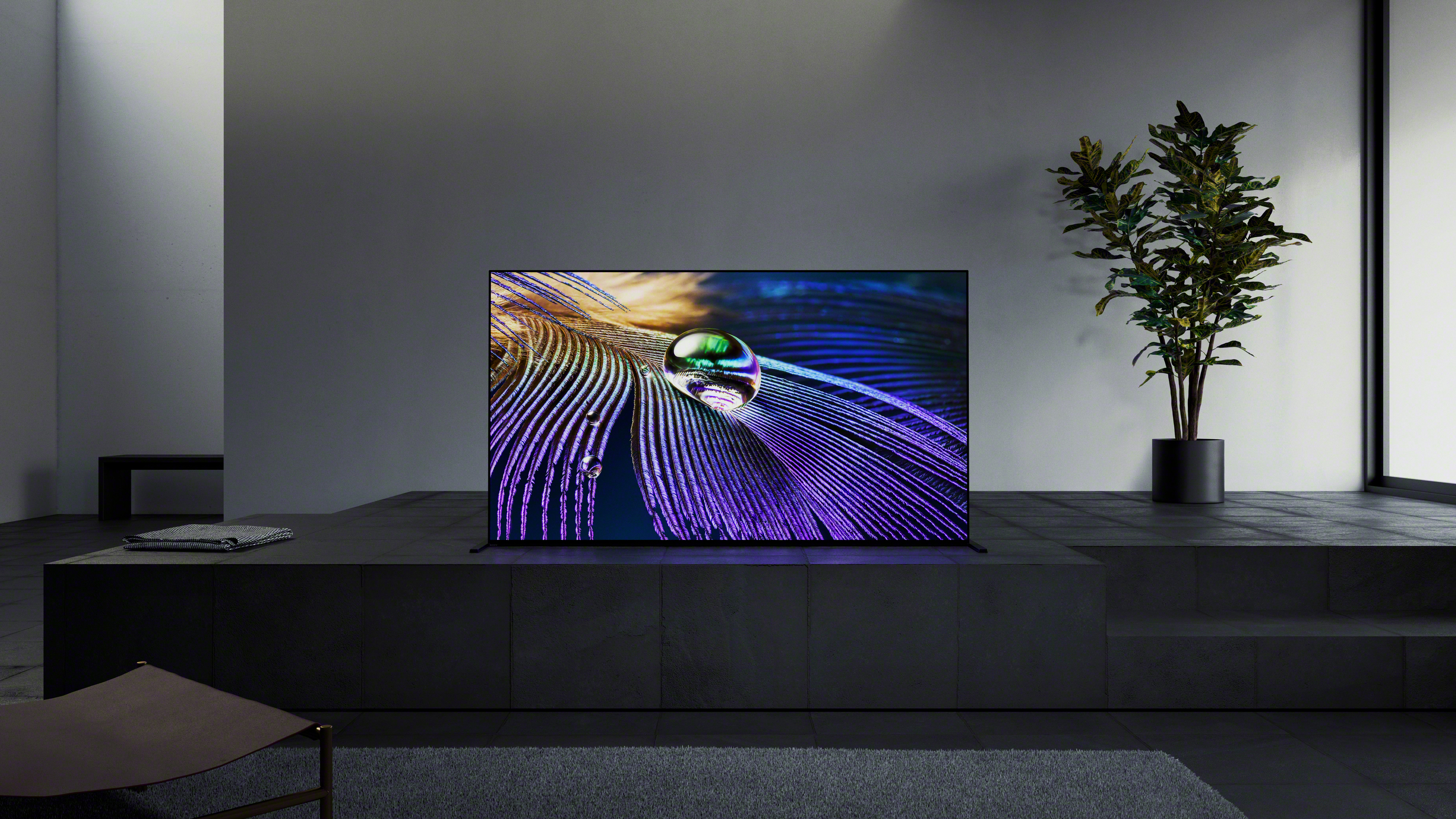
When it gets dark, you want your TV to stay consistent, not to darken too…(Image credit: Sony)
3. Don't use noise reduction features
Removing digital noise from pictures sounds like a great idea. Who wouldn’t want cleaner pictures with these imperfections from compression creeping in, right? Unfortunately, it’s not quite so simple.
The issue is that the processing required to remove such things as excessive grain, MPEG compression artefacts and color noise from sources needs to be seriously clever to be able to ensure that it only targets actually noise, rather than also ‘smoothing away’ natural grain, unusually fine details and so on. It’s so complex, in fact, that even the most premium TVs from the most respected brands typically struggle to do it well enough to avoid such unwanted side effects as a loss of sharpness, removal of fine detail, smearing, the screen-door effect (where natural grain turns into what looks like a fine gauze lying over the picture), and image lag.
Sony, to be fair, has handled noise reduction better than most brands since the arrival of its X1 processor a few years back, and this processing prowess continues with the Bravia XR processor in its 2021 and 2022 TVs. Nonetheless, for most sources – pretty much all 4K content, as well as decent quality HD content – we strongly recommend making sure noise reduction of all sorts is turned off on your Sony TV if you want the cleanest, sharpest, most natural looking images.
4. Choose the right motion processing option
Motion processing on TVs has become something of a hot potato. The film industry has engaged in a high-profile campaign to try and get TV owners to always turn it off, while most TV manufacturers seem keen for you to leave it on.
As you might expect, there are issues with both sides of the argument. Excessive or poor-quality motion processing can indeed look pretty horrible, either turning films into daytime TV, or causing lots of ugly, unintended processing side effects. On the other hand, many TVs – which are simply not built to the same standards as professional monitors – can suffer distracting levels of judder or blur when showing moving objects. Especially with 24fps movies.
Unfortunately, engineers typically get their way with default TV motion settings, with many picture presets running with more aggressive levels of motion processing than we’re comfortable with. However, just turning motion processing off fully isn’t always the best solution either – especially if you have a Sony TV, given that the brand has a well-earned reputation for having the best motion processing in town.
Basically, the only way to pick your way through the motion processing battleground is to spend a few minutes experimenting with your Sony TV’s impressively numerous motion settings – including trying different settings with different types of content. What works for a film source will likely not be as effective for a 60Hz sports event.
To get you started, we’d suggest looking at Sony’s True Cinema setting when watching films, and the Clear option for streaming sources. Or, if those still don’t look quite right to you when you start focusing on what they’re doing, you could try a Custom mode with the judder and blur elements kept to around a third of their full power. You can potentially try a more aggressive preset, such as the ‘Standard’ MotionFlow setting, for sport.
The exact settings that give the best results for different sources may vary from Sony TV to Sony TV, thanks to the different properties of all the panel types Sony uses. But if you haven’t experimented with the MotionFlow options before, you’ll likely be amazed what a difference a few moments of experimentation can make.
5. Don't fall for the Vivid picture preset
Most TVs carry a picture preset that’s expressly designed to push their screen’s capabilities to their extremes. On Sony TVs, this mode is labelled ‘Vivid’, and the ultra-vibrant colors, extreme contrast and enhanced sharpness it delivers undoubtedly look enticing at first glance. So much so that many households will likely have fallen for its charms.
The truth, though, is that the Vivid preset isn’t nearly as great as it first appears. Pushing colors hard can leave them looking cartoonish and unbalanced – and nothing like the way they were designed to look. The heavy color saturations can also cause subtle detailing to be washed out, making the picture look flatter and less realistic.
Too much sharpness can cause images to become gritty and noisy, too (though actually Sony’s Vivid mode suffers less with this than many rival brands’ Vivid mode equivalents). And while expanded contrast can certainly be impactful, it can also draw too much attention to itself.
This brings us to actually the main reason not to stick with Sony’s Vivid preset: inconsistency. The best experiences with any TV, at least when you’re watching films or high-quality TV dramas, are those where nothing about the TV’s picture performance distracts you from what you’re watching. Yet the Vivid mode’s desire to show off different elements of the TVs’ picture quality is almost designed to deliver the exact opposite of the consistency true immersion depends on.
from TechRadar - All the latest technology news https://ift.tt/sx3WSEm
via TechRadar - All the latest technology news https://ift.tt/EcFB4Lv
More AMD and Nvidia graphics cards are now at their recommended price – or have dipped below that level – than GPUs which exceed their MSRP, according to a new report; but it’s Team Red which offers the most competitive pricing.
This comes from Tom’s Hardware which crunched a load of data on sales to discover that for current-gen RTX 3000 and RX 6000 graphics cards in May, prices dropped by 15% on average compared to what retailers were asking in April.
As noted, just over half of current-gen GPUs are now at or below recommended pricing, although it’s AMD which is leading the way here, in that of its RDNA 2 offerings, only the RX 6800 and 6800 XT are now priced above their MSRP.
Unfortunately, most Nvidia RTX 3000 graphics cards are still over the MSRP, with Tom’s observing that the RTX 3050 through to RTX 3080 10GB models have their price bumped up by about 20% on average. That said, those cards are still seeing price drops compared to the previous month, and everything is moving in the right direction.
Analysis: Nvidia GPUs in great demand
It’s obviously good news to see prices dropping, and by quite a chunk in May, even if Nvidia’s Ampere offerings still haven’t normalized and returned to their MSRP. Of course, this is a measure of demand in many ways, because as we’ve seen in recent times, Team Green’s GPUs are selling strongly compared to AMD.
Recall that as we reported a month ago, at big US retailer Newegg, Nvidia models were all but one of the top 20 best-selling graphics cards, and indeed looking now, the situation is even worse for AMD – the company hasn’t got a single GPU in that top 20 chart (the highest entry is an RX 6600 model at number 24, in fact).
So greater demand seems like a plausible enough reason why prices aren’t going down quite so quickly for Nvidia GPUs. What might change things is the possibility that Nvidia could soon announce its next-gen Lovelace graphics cards, and those RTX 4000 GPUs could go on sale sooner than expected – which would doubtless persuade some (or indeed many) folks to consider playing a waiting game, forcing RTX 3000 prices to drop to seem more tempting.
Tom’s also did an interesting bit of comparison in terms of working out a rough performance per dollar metric for the top current-gen (and past) GPUs, and the interesting news is that AMD is winning here, perhaps unsurprisingly as Team Red’s prices are dropping faster as observed.
So, which is the best value proposition among the contemporary graphics cards out there right now? That would be AMD’s RX 6600 which represents an excellent choice for those gaming at 1080p, with a performance per dollar rating of 0.23 (lower is better) – although if you need something with more oomph for 1440p duties, then the top value pick is the RX 6700 XT rated at 0.201. For Nvidia, the value king for 1080p is the RTX 3060 (at 0.175), and for 1440p it’s the 3060 Ti (also ranked at 0.175, which isn’t that far behind the 6700 XT to be fair).
For those interested in some historical perspective, Tom’s ranked GPUs going back to 2015, and the best performer relative to its asking price turned out to be the GTX 780 (on 0.245, so the RX 6600 isn’t far off that anyway – and obviously offers way better overall performance, of course).
Ubisoft has confirmed that its remake of Prince of Persia: The Sands of Time hasn’t been canceled, but it has been delayed out of its 2023 window with no further release date proffered.
The announcement comes after some concern was expressed when retailers began delisting pre-orders for the game. Understandably, many thought this was an indication that the troubled game might simply be canceled. However, in a statement to IGN Ubisoft said that’s not the case and the Sands of Time remake is still in active development, reiterating the May announcement that work has moved from Ubisoft Pune and Ubisoft Mumbai over to Ubisoft Montreal.
“The development of Prince of Persia: The Sands of Time Remake will now be led by Ubisoft Montreal,” Ubisoft told IGN. “We’re proud of the work achieved by Ubisoft Pune and Ubisoft Mumbai, and Ubisoft Montreal will benefit from their learnings as the new team will continue the work to deliver a great remake."
It’s “as a consequence” of this move, Ubisoft added, that it is “no longer targeting a FY23 release anymore and the game has been delisted. If players wish to cancel their preorder they are invited to contact their retailer. They will be updated on the project as the development is moving along."
As those who have been waiting with bated breath for the release of the Prince of Persia: The Sands of Time remake will be well aware, this isn’t the first time the game has been subject to a somewhat indeterminate delay.
When it was initially announced back in 2020, Sands of Time was targeting a January 2021 release, which was then pushed to March, which was then pushed to “a later date”. In October 2021, it was reported that the game was looking at a 2022 to 2023 window. Now, without a new release window in sight, it looks like we could be waiting some time.
Even if Prince of Persia: The Sands of Time remake had been on better footing, it’s unlikely we’d have gotten an update on it from Ubisoft this summer as the publisher has confirmed to Axios that it has no plans for a dedicated E3-style showcase in June.
Ubisoft is usually a pretty reliable name for some kind of summer showcase but fortunately it’s not planning to sit out 2022 entirely, telling Axios that there are plans to do something “later this year”. It’s unclear whether or not other Ubisoft titles could make some kind of appearance in third-party shows such as the Summer Game Fest opening night.
The Sands of Time remake isn’t the only Ubisoft project with an extended development that we’re waiting on updates from, either, with titles like Beyond Good and Evil 2 and Skull and Bones continuing to intrigue.
Ubisoft isn’t, of course, the only publisher choosing not to host a stream this summer, with EA also announcing that its once-annual EA Play Live will not go ahead as “this year things aren't lining up to show you everything on one date.”
We're very much looking forward to the full launch of the Google Pixel 6a on July 28, but that's still a way off. In the meantime, another unboxing video has surfaced that gives us a close-up look at this new mid-range smartphone from Google.
The unboxing comes from @anjangz on TikTok (via 9to5Google), and delivers everything that you would expect from an unboxing. There are actually four units included in the brief demo, all in the gray Charcoal version of the phone.
We get a brief shot of the phone turning on but there's no glimpse of the software interface. We do get a look at the inside of the packaging, where a USB cable and USB adapter are clearly visible.
Tensor chip promotion
This isn't the first Pixel 6a unboxing that's come to our attention – we saw another one last month on one of Google's official YouTube channels in France. That clip has since been pulled from the web so it remains to be seen how long this latest one lasts.
While the new TikTok footage doesn't really reveal anything we didn't know about the phone, the Google Tensor processor gets a prominent shout out on the inside of the box, showing how important the chipset is to Google's phones now.
Google unveiled the Pixel 6a at Google IO 2022, announcing its existence on May 11. Preorders start (in Australia and the US at least) on July 21, and the phone will set you back $449 / £399 / AU$749.
Analysis: what we know about the Google Pixel 6a
Google has given us plenty of information about the Pixel 6a – much more than it's given us about the Pixel 7 and Pixel 7 Pro – and so we know quite a lot about it ahead of it going on sale across the globe on July 28.
The phone is going to be sporting a 6.1-inch OLED screen running at a 1080 x 2400 pixel resolution and a 60Hz refresh rate. There's an IP67 rating attached, which means the Pixel 6a is dust and water resistant, but you don't get any wireless charging.
Under the hood we have that aforementioned Google Tensor chipset – the same one that can be found in the Google Pixel 6 and the Pixel 6 Pro – and that's joined by 6GB of RAM and 128GB of internal storage. Camera-wise, there's a dual-lens 12.2MP+12MP camera on the back and an 8MP snapper on the front.
There are no variants in terms of the specs, but you will be able to pick up the smartphone in three different colors: Charcoal (gray), Chalk (white), and Sage (green). Once we get our hands on the device we will of course give you our own verdict.
Last night's State of Play brought us many surprises, but few could've expected we'd be seeing Marvel's Spider-Man Remastered coming to PC.
Launching on August 12, the newest Spider-Man title will be ported with the help of Nixxes Software, a support studio Sony acquired last year to help with PC ports. Much like the PS5 version of Remastered, this appears to be a straight port with few new extras. That includes the City That Never Sleeps DLC, meaning PC players are getting the full package.
But that isn't all Sony has planned. While it wasn't mentioned during State of Play, a PlayStation Blog post separately revealed Marvel's Spider-Man: Miles Morales will join Remastered on Steam and Epic Games Store later this year. Unlike Remastered, there is no set release date for Miles yet, although it will launch in Fall 2022.
Finally, Insomniac Games revealed new sales figures for Marvel's Spider-Man, and it's hit an incredible milestone. "I’m both ecstatic and humbled to share that Marvel’s Spider-Man series now has sold through more than 33 million copies globally, as of May 15, 2022," the studio explained on the PlayStation Blog.
Sony's PC investment seems to be paying off
Last September, a major leak from the Nvidia GeForce Now game streaming service detailed a number of top Playstation games that were supposedly coming to the PC. And many of the titles listed have since been confirmed for PC ports. God of War released in January, Uncharted: Legacy of Thieves Collection arrives this year, while Returnal and Sackboy: a Big Adventure are heavily rumored. Curiously, that list made no mention of Marvel's Spider-Man, making this more of a surprise than most.
Sony isn't prioritizing simultaneous releases on PC and PS4/PS5, not like Microsoft does for PC and Xbox Series X/S or Xbox One. While that's not great for PC players, it means Sony games still have timed exclusivity on consoles before arriving elsewhere. It means PlayStation remains the priority without restricting these experiences.
Right now, it's paying off. God of War saw high praise when it launched, joining existing ports like Horizon Zero Dawn and reportedly selling over two million copies. There's no word on whether the (currently) PS5 exclusive Marvel's Spider-Man 2 will also come to PC, and God of War Ragnarok similarly remains unconfirmed. At this stage, you can't help but feel like both are inevitable.
As the weeks roll by, we're getting a better idea of what to expect from the Samsung Galaxy Watch 5 – and references hidden in the latest beta version of the Samsung Health app have revealed more about the wearables that are coming later this year.
These references were spotted by 9to5Google and perhaps the most significant of the bunch is the reference to the Pro model of the smartwatch. There's no mention of a Classic edition, so it looks as though we're going to get a Galaxy Watch 5 and a Galaxy Watch 5 Pro, with a launch expected in August.
Previous leaks hinted that Samsung would release standard, Classic and Pro models of the Galaxy Watch 5, but we might be down to two now. That does tie in with another rumor that was doing the rounds based on conversations with sources inside Samsung.
Bye bye rotating bezel
With the Samsung Health app beta showing a list of compatible smartwatches, we can see that the Galaxy Watch 4 Classic could be the last wearable with that particular branding – and that might mean the demise of another popular Galaxy Watch feature.
The rotating bezel is a handy way of controlling apps and menus on the Galaxy Watch 4 Classic, but recent leaks have suggested that it's going to be dropped from the 2022 range. There's nothing in these new revelations from the Samsung Health app beta to suggest otherwise, either.
All of which means that we'll be getting a new Pro model this time around but some of the useful functionality will be disappearing from the range. At least we can console ourselves with the news that battery life may be improved this time around.
Analysis: Samsung prepares for the Pixel Watch
As it approaches the fifth generation of its flagship wearables, Samsung is now hugely experienced in putting out these watches. However, there's something slightly different about the 2022 launches, and that's the imminent arrival of the Google Pixel Watch.
With phones such as the Pixel 6 Pro, Google has been trying to take some market share away from Samsung while also staying on friendly terms with the company as one of its Android hardware partners. Now the same scenario is opening up as Google and Samsung go head-to-head in smartwatches.
Don't forget that Samsung switched back to Wear OS with the Galaxy Watch 4 devices, and that means that Android users wanting a smartwatch are going to have a direct choice between Samsung and Google. Google will be hoping that spurs Samsung on to make even better Wear OS hardware, which in the end would be good for everyone.
We're not entirely sure when the Google Pixel Watch is going to go on sale, but October is a decent bet. That gives Samsung a couple of months to make a good impression with its own smartwatches before some new competition arrives on the scene.
Google gave us all quite a surprise when it decided to announce the Pixel 7 and Pixel 7 Pro ahead of time last month, and it seems that at least one prototype version of the Pro model is already out in the wild.
A user posting on Reddit (via 9to5Google) claims to have bought a prototype version of the Pixel 7 Pro over Facebook Marketplace three weeks ago. The handset was advertised as a Pixel 6 Pro and it seems the new owner thought that's what the smartphone was.
There's been a recent flurry of activity when it comes to Pixel 7 handsets popping up for sale on sites such as eBay and Facebook, and it looks as though Google has taken note – the Redditor's phone has now been disabled and is stuck on the boot screen.
No more details
Unfortunately the person who has unwittingly been using Google's unreleased smartphone for the past three weeks hasn't provided too much in the way of extra detail, so it doesn't give us the opportunity to learn any more about the handset.
We do know what the Pixel 7 and the Pixel 7 Pro are going to look like, courtesy of Google, and we do know that the phones will feature an updated second-gen Tensor processor. Apart from that, there are still plenty of unanswered questions.
One of those questions is around the release date for these smartphones. All we know for sure is that they're coming out later this year – if Google follows its previous scheduling, expect to see the next-gen Pixels go on sale around October time.
Analysis: the perils of an early reveal
Google wasn't expected to reveal the Pixel 7 at the Google IO 2022 event in May, but it did it anyway. We didn't get a specs list or pricing or anything like that, but at least we know what the phones look like and that they're definitely on the way.
The early announcement is a useful way of building hype around the devices and encouraging Pixel fans to start saving to afford the next version of the phone. It also emphasizes Google's ongoing commitment to the Pixel series, on the back of the news that the Pixel 6 has been one of the most popular phones in the range so far.
On the other hand, we do still have a long time to wait before these devices actually go on sale. There are bound to be more rumors and leaks like the one we're reporting on today, which Google doesn't necessarily have control over – and it also has us wondering whether Pixel 6 sales might be affected too.
We're all for giving consumers certainty about what's coming down the line, but it's going to be interesting to see whether Google continues with this strategy in the future. We might also be in for a surprise or two when the Pixel 7 finally does get its full launch.
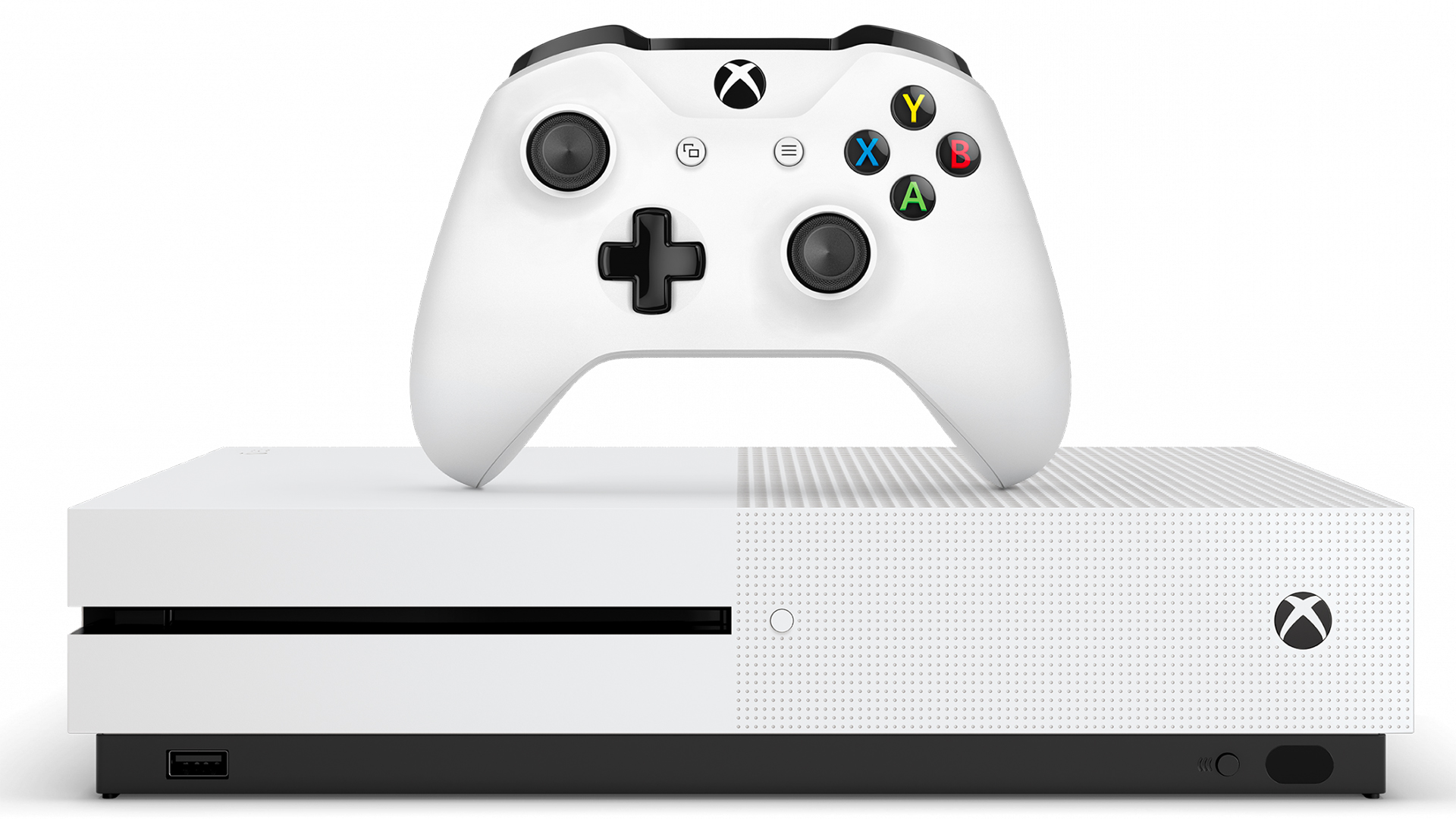
Microsoft has announced the June 2022 system update for Xbox consoles, and there's good news if you're an achievement hunter.
The latest firmware update for Xbox Series X|S and Xbox One lets you view hidden achievements. Confirmed via Xbox Wire, Xbox engineering lead Eden Marie advised this will also be available for the PC and mobile Xbox apps.
"If you don’t mind spoilers and want a hint on any of the achievements in the games you’re playing, it’s easy to find the secret achievement details on your Xbox," Marie said.
"From within a game, open the guide and go to Game activity > Achievements. When you see a secret achievement, you can now reveal details like the title, achievement description, and Gamerscore."
Once you've taken a look, you'll then be able to hide the achievement again, or keep the details fully displayed. It's very similar to Sony's approach, which has let PlayStation players view hidden trophies with potential spoilers since 2016. On both PS4 and PS5, you can view these by pressing square while looking at a hidden trophy.
(Image credit: Microsoft)
What else is in the June 2022 update?
Beyond secret achievements, there isn't much else included in the June update besides one other welcome quality-of-life change. The patch improves how quickly your Xbox Series X|S scans for game updates, a feature Xbox Insiders previously trialed back in April.
"You will see improvements to the speed and reliability of detecting available updates, both in your collection and when you launch a game," Marie confirms.
However, in her previous update back in April, Marie advised that the update scanning process can still be slow if you've got “extremely large amounts of installed content.”
It's very easy to fill up your console storage, thanks to Xbox Game Pass. While games often come and go, Microsoft's first-party selections like Halo Infinite and Sea of Thieves are always available, taking up significant space. Still, if storage space is minimal, or you've grown tired of lengthy updates, Xbox Cloud Gaming remains an option, providing you've subscribed to Xbox Game Pass Ultimate.
This new information comes from different (but equally reliable) leaker, Yogesh Brar, who tweeted what he claims is a near-complete specs list for Samsung's upcoming clamshell-style foldable phone.
Apparently, this upcoming phone will enjoy a 6.7-inch FHD+ 120Hz display, just like the Z Flip 3, but with a 2.1-inch outer display, which is a tiny bit bigger than the 1.9-inch panel on the previous-gen Flip.
There are said to be three cameras: a 12MP main camera joined by a 12MP ultra-wide on the back, and a 10MP selfie snapper on the front – both of these specs are seemingly unchanged from the Fold 3.
Also like that phone, the handset is said to come with either 128GB or 256GB storage, 8GB RAM and be compatible with 5G networks.
There look to be some changes from the Flip 3: the charging is apparently faster at 25W, the battery capacity could be increased by 400mAh to 3,700mAh, the handset will supposedly run Android 12, and the chipset is said to be the Snapdragon 8 Plus Gen 1.
This is of course a leak, so take all this information with a pinch of salt. That said, some of the leaked information, like the software and chipset, were things we were already all but certain of, due to these specs generally seeing iterative updates.
Judging by those leaked specs, the Samsung Galaxy Z Flip 4 might not be a huge improvement over its predecessor – the few upgrades are slight, and lots of areas have seen no changes at all.
But a specs list doesn't paint the full picture of a smartphone, particularly a foldable phone where there are more elements at play. The design is a more important consideration with a foldable, as the hinge, screen crease and waterproofing all have a dramatic impact on how long the device will last for.
Hopefully, we'll see some durability improvements with the Z Flip 4 – Flip 3 users have reported issues with creasing in the screen after having used the phone for a while. We've already heard that the new foldable could come in a few different colors, but we'd hope Samsung has some bigger design changes up its sleeves.
Klipsch has just announced not one, not two, but 11 new speaker models – aka the Klipsch Reference Premiere series speakers. The all-new lineup is an enhanced version of the company’s outgoing (and award-winning) Reference Premiere series, now into its third generation. Klipsch assures us that this latest iteration features the most impactful upgrades in the series’ history, including the latest technological audio advancements, premium materials, and dramatic cosmetic details – all of which is a roundabout way of saying that according to Klipsch, your Dolby Atmos-enabled home theater system never looked (or sounded) so good.
The series uses new, larger proprietary Tractrix horn technology to improve high-frequency response and extension as well as enhancing stereo imaging and dynamics. Klipsch's signature and proprietary copper Cerametallic woofers with aluminium Faraday rings and Tractrix ports handle the low frequencies while an exclusive Linear Travel Suspension (LTS) titanium tweeter should maximise dynamics and detail through the treble.
You're also getting new premium materials and dramatic design features. The speakers are available in two furniture-grade wood finishes – ebony and walnut – with enhanced cabinet bracing, aluminium binding posts, cast aluminium feet, and discrete Dolby Atmos connections that should allow for easy and refined integration. Signature Klipsch copper trim rings accentuate the tweeter and woofer, which can also be concealed by sturdy yet flexible magnetic grilles.
A big upgrade on your Dolby Atmos soundbar (big. Huge!)
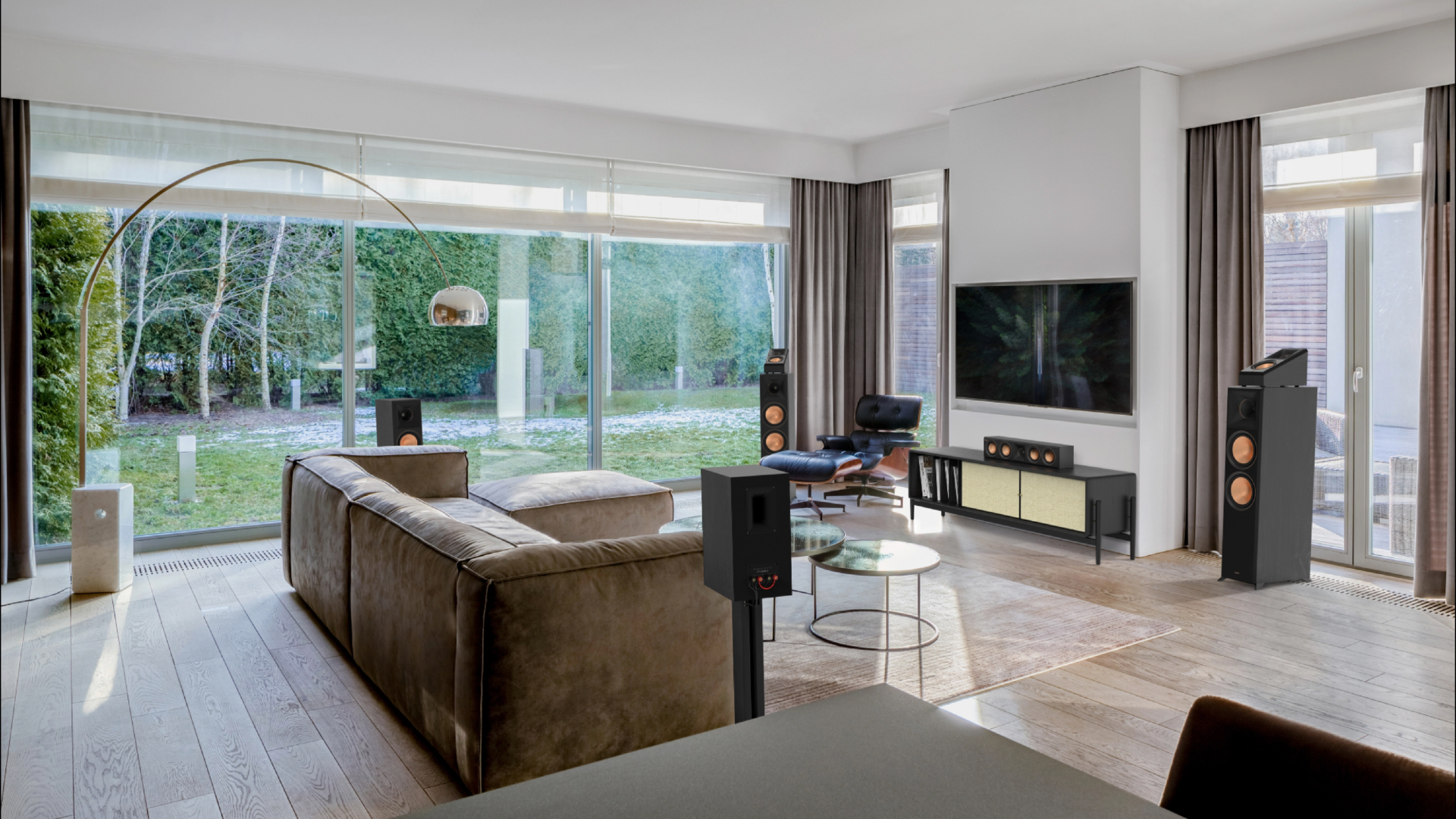
Klipsch's Reference Premiere adds sophistication and Dolby Atmos to your home theater setup(Image credit: Klipsch)
Time for a quick rundown of the series? Good, there's plenty to get through. The 11-strong new Klipsch Reference Premiere series comprises four floorstanding tower stereo speakers (RP-8060FA II which is Dolby Atmos enabled, RP-8000F II, RP-6000F II and RP-5000F II); two bookshelf stereo speakers (RP-600M II and RP-500M II); three center channel speakers (RP-504C II, RP-404C II and RP-500C II) and two surround speakers (RP-502S II and the innovative, dual-purpose RP-500SA II that functions as a Dolby Atmos elevation speaker or a rear/side wall-mountable surround).
That last surround-speaker is perhaps the most exciting of the bunch, since it can actually bring Dolby Atmos to your current speakers. Correct – no need to invest in an entirely new system if you want to bring immersive sound to your setup! Just put them on top of your existing speakers and let those upward-firing drivers add in the vertical height needed for Dolby Atmos, bouncing audio up to your ceiling and back down to your shell-likes.
Don't have any speakers to add to? That's fine, the RP-500SA (much like the relatively new Klipsch R-40SA) can be used on their own as side or rear surround channels and will certainly represent a solid step up from your soundbar – or of course, your TV's built-in speakers.
How much? Of course. In the order in which we've just grouped the Klipsch Reference Premiere series (because why not?) the recommended retail prices are as follows:
RP-8060FA II floorstanding speakers – $1,499 / £2,999 / €3198
RP-8000F II floorstanding speakers – $899 /£1,699 / €1898
RP-6000F II floorstanding speakers – $749 / £1,449 / €1598
RP-5000F II floorstanding speakers – $599 / £1,249 / €1398
RP-600M II bookshelf speakers – $749 / £729 / €799
RP-500M II bookshelf speakers – $599 / £599 / €649
RP-504C II center channel speaker – $799 / £729 / €799
RP-404C II center channel speaker – $599 / £549 / €599
RP-500C II center channel speaker – $499/ £459 / €499
RP-502S II surround speaker – $899 / £899 / €999
RP-500SA II surround speaker – $699 / £689 / €749 (around $867)
Our advice? If you're still searching for the ultimate home theater setup, the new Klipsch Reference series is definitely a name to add to your shortlist.


Follow Us
Were this world an endless plain, and by sailing eastward we could for ever reach new distances