What is the IoT? Everything you need to know
What is the IoT?
The world around us is getting smarter and more connected as technology becomes a common sight in many areas.
Digital devices are not just in our pockets or our offices, but increasingly in our homes, buildings, and many places and cities. Helping collect, analyse and monitor data and information about their surroundings, these devices are able to communicate with each other through the ‘Internet of Things’.
Often shortened to the IoT, this worldwide, interconnected network allows devices to talk to each other and to us, delivering reams of data through smarter processes that will greatly increase the quality of life around the world.
The Internet of Things is predicted to revolutionise the way in which we live our lives, with many industry experts tipping it to have the biggest technological impact since cloud computing, as more data than ever before can be collected, stored and analysed.
Many consumers are already enjoying the benefits of the IoT, as popular products such as the Amazon Echo smart speaker and the Nest thermostat from Google becoming common sights in homes around the world.
But the wider world can also benefit from the IoT, with businesses being able to streamline previously complex and data-hungry processes through improved automation, freeing up employees for other tasks.
Public sector organisations such as hospitals can also use sensors to monitor patients more effectively, and local governments can monitor pollution, traffic levels, weather data, and much much more.
The IoT is growing fast, and is set to affect more and more areas of our lives in the years to come, resulting in a smart world that previously was only imaginable in science fiction.

IoT - the latest news and views
27/09 - "Most sophisticated" Torii botnet targeting IoT devices - The newly discovered malware strain is building the most sophisticated botnet ever seen...
21/09 - Privacy in the age of IoT: the future’s connected for VPN - Many have asked: do ‘normal people’ actually care about online privacy and VPNs? Yes, they do...
20/09 - How can the IoT transform the sports business? - Sports venues are getting a much needed upgrade from IoT technology...
19/09 - IoT malware grew significantly during the first half of 2018 - New research from Kaspersky Lab reveals how cybercriminals are targeting IoT devices...
06/08 - Why IBM is pushing to be the driving force in the IoT - The IoT and IBM could prove to be a match made in heaven...
03/08 - Qualcomm reveals major IoT push - Chipmaker unveils its plans to help power the global IoT..
18/07 - Vodafone expands IoT range for businesses - New surveillance and energy management tools bring IoT to more companies across the UK...
17/07 - Microsoft and GE team up for major IoT launch - Partnership will see major expansion of Industrial IoT from Azure and GE Digital...
13/06 - Vodafone: 5G smartphone uncertainty means focus on core network and IoT - Vodafone UK CTO says 5G will be a gamechanger, but smartphone innovation in the 4G era won't be matched...
04/06 - Vodafone and Deutsche Telekom test NB-IoT roaming - Two operators claim trial is massive step forward for cross-border IoT...
01/06 - LPWAN is the final piece in the mobile IoT puzzle - Vodafone's IoT business is focusing on services and partnerships rather than technology...
31/05 - GSMA: Mobile operators must change to grab $1.1tn IoT market - GSMA warns that just 5 per cent of IoT revenue will be found in connectivity, so mobile operators need to evolve...
17/05 - Mobile IoT networks to be a 'core component' of 5G - GSMA says NB-IoT and LTE-M deployments are paving the way for massive IoT powered by 5G...
08/05 - Nokia snaps up SpaceTime Insights to boost IoT drive - SpaceTime Insights acquisition allows Nokia to expand IoT work...
24/04 - Telcos exploring mixed approaches to IoT - Communications providers see the potential in IoT but are taking multiple paths, Ericsson report says...
23/03 - Operator partnerships could be the key to IoT success - O2 says it wants to do more than just dish out SIMs and connectivity...
22/03 - IoT security spend to reach £1bn in 2018 - Gartner figures suggests increased awareness of threats is boosting spend...
07/03 - New internet of things security code aims to stamp out Mirai and other threats - The government is taking action on IoT security...
22/12 - Why 2018 could be a decisive year for IoT - Major report highlights struggle between competing technologies over the next year...
from TechRadar - All the latest technology news https://ift.tt/2Ozhzoj
Until data is misused, Facebook’s breach will be forgotten
We cared about Cambridge Analytica because it could have helped elect Trump. We ignored LocationSmart because even the though the company was selling and exposing the real-time GPS coordinates of our phones, it was never clear exactly if or how that data was misused.
This idea, that privacy issues are abstract concepts for most people until they become security or ideological problems, is important to understanding Facebook’s massive breach revealed this week.
The social network’s engineering was sloppy, allowing three bugs to be combined to steal the access tokens of 50 million people. In pursuit of rapid growth at affordable efficiency, Facebook failed to protect its users. This assessment doesn’t discount that. Facebook screwed up big time.
But despite the potential that those access tokens could have let the attackers take over user accounts, act as them, and scrape their personal info, it’s unclear how much users really care. That’s because for now, Facebook and it’s watchdogs aren’t sure exactly what data was stolen or how it was wrongly used.
The Hack That Broke The Camel’s Back?
This could all change tomorrow. If Facebook discovers the hack was perpetrated by a foreign government to interfere with elections, by criminals to bypass identity theft security checkpoints and steal people’s bank accounts or social media profiles, or to target individuals for physical harm, out will come the pitchforks and torches.
Given a sufficiently scary application for the data, the breach could finish the job of destroying Facebook’s brand. If users start clearing their profile data, reducing their feed browsing, and ceasing to share, the breach could have significant financial and network effect consequences for Facebook. After years of scandals, this could be the hack that’s broke the camel’s back.
Yet in the absence of that evil utilization of the hacked data, the breach could fade into the background for users. Similar to the tension-filled departures of the founders of Facebook’s acquisitions Instagram and WhatsApp, the brunt of the backlash may not come from the public.
The hack could hasten regulation of social media. Senator Warner called on Congress to “step up” following the hack. He’s previously advocated for privacy laws similar to Europe’s GDPR. That includes data portability and interoperability rules that could make it easier to switch social networks. That threat of people moving to competing apps could succeed in compelling Facebook to treat user privacy and security better.
One of the biggest questions about the attack is whether the tokens were used to access other services like Airbnb or Spotify that rely on Facebook Login. The breach could steer potential partners away from building atop Facebook’s identity platform. But at least you don’t have to worry about changing all your passwords. Unlike hacks that steal usernames and passwords, the lasting danger of the Facebook breach is limited. The access tokens have already been invalidated, whereas password reuse can lead people to have their other apps hacked long after the initial breach.
Desensitized
If government investigators, journalists, or anti-Facebook activists want to make the company pay for its negligence, they’ll need to connect it to some concrete threat to how we live or what we believe.
For now, without a nefarious application of the breached data, this scandal could blend into the rest of Facebook’s troubles. Every week, sometimes multiple times a week, Facebook has some headline grabbing problem. Over time, those are adding up to deter usage of Facebook and spur more users to delete it. But without an independent general purpose social network they can easily switch to, many users have endured Facebook’s stumbles in exchange for the connective utility it provides.
As breaches become more common, the public may be desensitized. Between Equifax, Yahoo, and the cell phone companies, we’re growing accustomed to letting out a deep sigh with maybe some expletives, and moving on with our lives. The ones we’ll remember will be those where the danger metastasized from the digital world into our offline lives.


from TechCrunch https://ift.tt/2xOPS54
Carpooling service Klaxit partners with Uber for last-minute changes
French startup Klaxit connects drivers with riders so that you don’t have to take your car to work every day. And the company recently announced a new feature with the help of Uber. If your driver cancels your ride home, Klaxit will book an Uber for you.
Klaxit is a ride-sharing startup that focuses on one thing — commuting to work. And this problem is more complicated than you might think. You can’t just go to work with the same person every day because you don’t always go to work at the same time. Similarly, sometimes your driver has to leave work early, leaving you at the office with no alternative.
As a driver, you want to take the quickest route to work. So you want to be matched with riders who are exactly on the way to work.
Klaxit currently handles 300,000 rides per day. In particular, the company has partnered with 150 companies, including big French companies such as BNP Paribas, Veolia, Vinci and Sodexo.
Klaxit can be particularly useful for companies with large office buildings outside of big cities. Promoting Klaxit instantly fosters supply and demand from and to this office. But you don’t have to work for one of those companies to use Klaxit.
Local governments can also financially support Klaxit to improve traffic conditions and mobility for users who don’t have a car or a driver’s license. “Subsidizing rides on Klaxit is 8 to 10 times cheaper than building a bus line,” co-founder and CEO Julien Honnart told me.
One of the biggest concerns as a rider is that you’re going to be stuck at work in the evening. Klaxit is now asking its users to request a ride with two other drivers. If they both decline your request, Klaxit will book you an Uber ride to go back home.
You don’t have to pay the Uber ride and then get reimbursed, Klaxit pays Uber directly. You don’t need an Uber account either as Klaxit is using Uber for Business. MAIF is the insurance company behind this insurance feature, and also one of Klaxit’s investors. This is a neat feature to convince new users that they can trust Klaxit.
Klaxit competes with other French startups on this market, such as Karos and BlaBlaCar’s BlaBlaLines.


from TechCrunch https://ift.tt/2Qk7blk
Relike lets you turn a Facebook page into a newsletter
French startup Ownpage has recently released a new product called Relike. Relike is one of the easiest ways to get started with email newsletters. You enter the web address of your Facebook page and that’s about it.
The company automatically pulls your most recent posts from your Facebook page and lets you set up an emailing campaign in a few clicks. You can either automatically pick your most popular Facebook posts or manually select a few posts.
Just like any emailing service, you can choose between multiple templates, decide the day of the week and time of the day, import a database of email addresses and more. If you’ve used Mailchimp in the past, you’ll feel right at home.
But the idea isn’t to compete directly with newsletter services. Many social media managers, media organizations, small companies, nonprofits and sports teams already have a Facebook page but aren’t doing anything on the email front.
Relike is free if you send less than 2,000 emails per month and don’t need advanced features. If you want to get open rates, click-through rates and other features, you’ll need to pay €5 per month and €0.50 every time you send 1,000 emails.
The company’s other product Ownpage is a bit different. Ownpage has been working with media organizations to optimize their email newsletters. The company is tracking reading habits on a news site and sending personalized email newsletters.
This way, readers will get tailored news and will more likely come back to your site. Many big French news sites use Ownpage for their newsletters, such as Les Echos, L’Express, 20 Minutes, BFM TV, Le Parisien, etc.
Ownpage founder and CEO Stéphane Cambon told me that Relike was the obvious second act. Using browsing data for customized newsletters is one thing, but many talented social media managers know how to contextualize stories and maximize clicks (even if it means clickbait, sure).
The startup was looking at a way to get this data, and ended up creating Relike, which could appeal to customers beyond news organizations. For now, both products will stick around. In the future, the company plans to add Twitter and Instagram integrations as well as better signup flows for newsletter subscribers.


from TechCrunch https://ift.tt/2zFxeO8
What the heck is going on with measures of programming language popularity?
I looked at the TIOBE index today, as I do every so often, as most of the software pros I know do every so often. It purports to measure the popularity of the world’s programming languages, and its popularity-over-time chart tells a simple story: Java and C are, and have been since time immemorial, by some distance the co-kings of language.
But wait. Not so fast. The rival “PYPL Index” (PopularitY of Programming Languages) says that Python and Java are co-kings, and C (which is lumped in with C++, surprisingly) is way down the list. What’s going on here?
What’s going on is that the two indexes have very different methodologies … although what their methodologies have in common is both are very questionable, if the objective is to measure the popularity of programming languages. TIOBE measures the sheer quantity of search engine hits. PYPL measures how often language tutorials are Googled.
Both are bad measures. We can expect the availability of online resources to be an extremely lagging indicator; a once-dominant dead language would probably still have millions of relict web pages devoted to it, zombie sites and blog posts unread for years. And the frequency of tutorial searches will be very heavily biased towards languages taught en masse to students. That’s not a meaningful measure of which languages are actually in use by practitioners.
There are lots of weird anomalies when you look harder at the numbers. According to TIOBE, last C went from its all-time lowest rating to Programming Language Of The Year in five months. I can buy that C has had a resurgence in embedded systems. But I can also easily envision this being an artifact of a highly imperfect measure.
The more flagrant anomaly, though, in both of those measures, is the relative performance of Objective-C and Swift, the two languages used to write native iOS apps. I can certainly believe that, combined, they have recently seen a decline in the face of the popularity of cross-platform alternatives such as Xamarin and React Native. But I have a lot of trouble believing that, after four years of Apple pushing Swift — to my mind, an objectively far superior language — Objective-C is still more popular / widely used. In my day job I deal with a lot of iOS/tvOS/watchOS apps, and interview a lot of iOS developers. It’s extremely rare to find someone who hasn’t already moved from Objective-C to Swift.
But hey, anecdotes are not data, right? If the only available measures conflict with my own personal experience, I should probably conclude that the latter is tainted by selection bias. And I’d be perfectly willing to do that …
… except there is another measure of programming language popularity out there. I’m referring to GitHub’s annual reports of the fifteen most popular programming languages on its platform. Those numbers are basically a perfect match for my own experience … and they are way disjoint from the claims of both both TIOBE and PYPL.
According to GitHub’s 2016 and 2017 reports, the world’s most popular programming language, by a considerable distance, is Javascript. Python is second. Java is third, and Ruby a close fourth. This is in stark contrast to TIOBE, which has Java and C, then a big gap, then Python and C++ (Javascript is eighth) — and also to PYPL, which claims the order is: Python and Java, a huge gap, then Javascript and PHP.
Obviously the GitHub numbers are not representative of the entire field either; their sample size is very large, but only considers open-source projects. But I note that GitHub is the only measure which counts Swift as more popular than Objective-C. That makes it a lot more convincing, to me … but its open-source selection bias means it’s still far from definitive.
These statistics do actually matter, beyond being an entertaining curiosity and/or snapshot of the industry. Languages aren’t all-important, but they’re not irrelevant either. People determine what languages to study, and sometimes even what jobs to seek and accept, based on their popularity and their (related) projected future value. So it’s a little upsetting that these three measures are so starkly, radically different. Sadly, though, we seem to still be stuck with tea leaves rather than hard numbers.


from TechCrunch https://ift.tt/2QeriB6
iPhone XS and iPhone XS Max reportedly hit with a charging bug
The brand new iPhone XS and iPhone XS Max handsets have only been in customers' hands for a week, but already a problem has emerged – namely that some models don't start charging when plugged into the mains if the screen is off when they're connected.
At the moment the issue is only anecdotal, but based on forum posts and YouTube videos it seems to be genuine, even if the scale of the problem isn't clear yet. We've tested charging behavior on our own iPhone XS in the TechRadar office and it works fine, so this isn't something that's affecting every handset out there.
Some users report it's phone inactivity that causes the charging cable not to be recognized, rather than the screen being off. In just about every case we've seen, charging carries on normally as soon as the phone gets unlocked or is interacted with.
It's a bug's life
Considering charging is only disabled under certain conditions, it seems that this is likely to be a software issue that Apple could fix with a quick iOS update, rather than having to recall millions of iPhones only days after the first batch got sent out. As yet Apple hasn't commented on the issue, but we'll post its response here if one arrives.
One possibility is that the bug is related to the restrictions Apple has placed around USB access to the iPhone with iOS 12. They're designed to make it more difficult to extract data from the device when the screen is locked, but it might have interfered with charging too.
For now though that's just speculation – we'll have to wait and see what the Apple engineers say when they've taken a look at the issue. Considering iOS 11 had its fair share of bugs, including autocorrect problems and unresponsive screens, Apple will want to get this one fixed as quickly as it can.
Via MacRumors
from TechRadar - All the latest technology news https://ift.tt/2P0yWPk
The Brett Kavanaugh Confirmation Hearings Top This Week's Internet News Roundup
But at least Zendaya is Meechee, amirite?
from Wired https://ift.tt/2NcwELx
https://ift.tt/eA8V8J
from Wired https://ift.tt/2NcwELx
https://ift.tt/eA8V8J
Elon Musk's SEC Lawsuit, Lyft’s Giveaway, and More Cars News
Plus, a secret cabal of flying car advocates, and a bridge that soldiers can build in 12 minutes.
from Wired https://ift.tt/2DGPsCV
https://ift.tt/eA8V8J
from Wired https://ift.tt/2DGPsCV
https://ift.tt/eA8V8J
Plantronics BackBeat FIT 2100 Review: Our Favorite Workout Headphones
Plantronics finally updated my platonic ideal of wireless running headphones.
from Wired https://ift.tt/2xXhqEu
https://ift.tt/eA8V8J
from Wired https://ift.tt/2xXhqEu
https://ift.tt/eA8V8J
These Stitched Photos of Greenland's Icebergs Are Sew Great
Adriene Hughes didn't just make beautiful images—she quilted over them to evoke how nature feels.
from Wired https://ift.tt/2xMwFRc
https://ift.tt/eA8V8J
from Wired https://ift.tt/2xMwFRc
https://ift.tt/eA8V8J
New iPhones, a Heated Razor, and Oculus Quest: September's Best Gear
Plus an Alexa-enabled microwave, the GoPro Hero 7 Black, and more.
from Wired https://ift.tt/2Oqh5o3
https://ift.tt/eA8V8J
from Wired https://ift.tt/2Oqh5o3
https://ift.tt/eA8V8J
Samsung Galaxy Watch Review: Function, But No Finesse
Samsung's Galaxy Watch puts old features in a new smartwatch.
from Wired https://ift.tt/2zG675I
https://ift.tt/eA8V8J
from Wired https://ift.tt/2zG675I
https://ift.tt/eA8V8J
Math Titans Clash Over Epic Proof of the ABC Conjecture
Two mathematicians say they found a glaring hole in a proof that has convulsed the math community for years.
from Wired https://ift.tt/2xRe1b3
https://ift.tt/eA8V8J
from Wired https://ift.tt/2xRe1b3
https://ift.tt/eA8V8J
Google launches “Abtal Al Internet” initiative to teach children online safety habits
Aiming to encourage children to be confident online explorers while avoiding potential cybersecurity pitfalls, Google has launched “Abtal Al Internet” (Internet Heroes) initiative in Arabic, a free online platform full of learning resources and interactive activities on online safety for kids, parents and educators. This move seems in line with Google’s Be Internet Awesome initiative launched last year.
Children now access the internet at very young ages and are vulnerable to online predators and scams whether it be on social media or online games. To that effort, Abtal Al Internet is designed to teach kids the fundamentals of digital citizenship and safety and help them confidently navigate the online world by being smart, alert, strong, kind and brave.
Also part of the online learning program is an online adventure, A’lam al Internet (Interland), that allows kids to develop good digital habits such as not sharing information online to those they don’t trust, building strong passwords, staying away from fake profiles and phishing scams, being kind to others online and reporting inappropriate content.
According to Google’s survey, majority of teachers in the Arab world believe that online safety should be part of curriculum and have reportedly witnessed concerning online incidents. To that end, Abtal Al Internet aims to provide guidance for educators and parents to teach kids about digital safety in homes as well as classrooms through videos, activities and more.
The program has been developed in collaboration with online safety experts including Family Online Safety Institute, the Internet Keep Safe Coalition and ConnectSafely. It can be accessed here: g.co/abtalinternet
from TechRadar - All the latest technology news https://ift.tt/2OmNQ5n
Ryder Cup live stream: how to watch Sunday's USA vs Europe singles golf wherever you are
And so it begins! If Sunday at the 2018 Ryder Cup is anywhere near as exciting as the first two days, then you're in a for a real treat today. It's time for the Day 3 Singles and we'll tell you how to live stream the Ryder Cup finale no matter where you live - it's even FREE to live stream if you're in the US.
It's surely Europe's for the taking? Four points up going into the Sunday of a Ryder Cup certainly suggests that, but the US team will inevitably have been watching videos of Brookline and Medinah on repeat for inspiration for an unlikely turn around.
Sunday sees every player of each team play in singles matchplay golf. That means there are 12 points in total to play for - more than enough for the USA to overturn the deficit. Justin Thomas and Rory McIlroy go out first at 12.05am local time (11.05am BST, 6.05am ET, 3.05am PT), with Bryson DeChambeau vs Alex Noren finishing things off. Leading the European troops at Le Golf National is Thomas Bjørn, desperate to wrestle back the Ryder Cup. But opposition captain Kim Furyk has no shortage of talent at his disposal to stop him.
Find out who will come out on top in 2018 by following the instructions below and tuning into a 2018 Ryder Cup live stream from wherever you find yourself in the world without paying a penny.

Watch all the singles games at RyderCup.com for FREE
Great news for golf fans in North America and Canada – the Ryder Cup's official site will be showing all the action for free. There may be some late nights/early mornings involved for US viewers to catch the action from France, but tuning in online should be a breeze wherever you are.
Live stream the Ryder Cup Day 3 from anywhere

How to watch the 2018 Ryder Cup: UK stream

Alternative ways to watch Ryder Cup golf in the US
There are number of options for watching the 2018 Ryder Cup golf if you're stateside:
- That live stream at RyderCup.com is the obvious way. Although you'll be limited to what the website wants to show you and we doubt the coverage will have the sheen and depth of most dedicated broadcasters.
- If you're at home and have cable, then NBC is the official broadcaster. The network will be splitting coverage between its main sports channels and it's specialist station, the Golf Channel, which is available from most cable providers. NBC has promised 220 hours of coverage to get right under the Ryder Cup bonnet this year.
- If you're outside the US this weekend but want to access one of the above options, then you can use a VPN service to effectively transport your computer, phone or tablet's IP back to a US location.
Sunday's Ryder Cup singles schedule:
Rory McIlroy vs Justin Thomas starts at 12.05pm local time (11.05am BST, 6.05am ET, 3.05am PT)
Paul Casey v Brooks Koepka starts at 12.17pm local time
Justin Rose v Webb Simpson starts at 12.29pm local time
Jon Rahm vs Tiger Woods starts at 12.41pm local time
Tommy Fleetwood vs Tony Finau starts at 12.53pm local time
Ian Poulter vs Dustin Johnson starts at 1.05pm local time
Thorbjorn Olesen vs Jordan Spieth starts at 1.17pm local time
Sergio Garcia vs Rickie Fowler starts at 1.29pm local time
Francesco Molinari vs Phil Mickelson starts at 1.41pm local time
Tyrrell Hatton vs Patrick Reed starts at 1.53pm local time
Henrik Stenson vs Bubba Watson starts at 2.05pm local time
Alex Noren vs Bryson DeChambeau starts at 2.17pm local time (1.17pm BST, 8.05am ET, 5.05am PT)
Europe team for the 2018 Ryder Cup
- Paul Casey
- Tommy Fleetwood
- Sergio Garcia
- Tyrell Hatton
- Rory McIlroy
- Francesco Molinari
- Alex Noren
- Thorbjørn Olesen
- Ian Poulter
- Jon Rahm
- Justin Rose
- Henrik Stenson
US team for the 2018 Ryder Cup
- Bryson Dechambeau
- Tony Finau
- Ricky Fowler
- Dustin Johnson
- Brooks Koepka
- Phil Mickelson
- Patrick Reed
- Webb Simpson
- Jordan Spieth
- Justin Thomas
- Bubba Watson
- Tiger Woods

Image courtesy of RyderCup.com
from TechRadar - All the latest technology news https://ift.tt/2zFh0Ve
20 ways to promote your website
We’re all familiar with the term ‘one hit wonder’, and many artists or groups have had huge success with a single song, then subsequently nosedived into commercial oblivion with their following tracks.
The lifecycle of a website can be disturbingly similar, at least to a point. There’s a kind of gravitational force which acts on all websites, pulling them down the search engine rankings as they’re replaced with newer, fresher, more successfully promoted sites.
If you want to defy this natural force, you’ll need a promotional plan, many clever tricks, and a concerted effort from your web development team. With that in mind, here’s a list of 20 ways in which you can promote your website, and keep it as visible as possible.
- We’ve chosen the best web hosting services right here

1. Be SEO smart
Most of the time, your website will be found via a search engine, and the vast majority of folks out there are using Google for search duties. And where your site is placed in terms of the rankings in any given search is heavily influenced by how Google matches the words and phrases that people are using to search.
Consider altering the site’s content to include popular phrases that people are searching for, and find the magic words that you need using the Google AdWord keyword planner. This process – although there’s a lot more to it – is known as SEO, which stands for Search Engine Optimization.
2. Get reciprocal
The more links that external websites have to your site, and the more links you make to them, will be seen by search engines as a good reason to elevate your importance as a web location.
Therefore if you have commercial relationships, you can strengthen those by exchanging links and building a flow of traffic between your mutual sites. This is especially useful if you are part of a bigger conglomerate, where the group site can link to all the subsidiaries without the need for permissions.
3. Facebook ads
If you want to sell door-to-door, then you need to turn up when people are at home, and the web equivalent of this is catching them on social media. Despite some recent flattening of growth, many millions of people still use Facebook, and this platform has the advantage that you can target users of a specific age or gender, those with certain interests, or those who follow particular brands or celebrities.
4. Connect with influencers
Perhaps you can’t get an A-list star to blog about your products or services, but maybe you could find a blogger who has a dedicated following that they can influence.
Compared with celebrity endorsements, the costs will be minimal, and some might even cover a product for a free sample if asked.

5. Go beyond Google
Google may be the search giant of the world, but not everyone uses it. For example, in China, more surfers use Baidu. Submitting to all those other search engines aside from Google and Bing is a worthwhile exercise, especially if you do business in locations outside of the US and Europe.
Instead of submitting to each engine in turn, use a tool like Submit Express to hit a large number in a single operation.
6. Use YouTube
The right video on YouTube can rapidly attract tens of thousands of views, and can subsequently generate links in Facebook and Twitter. Even if it’s just a recording of a seminar speech or something made to promote a new product line, it’s all worth placing on YouTube to create interest and attract visitors to your website.
7. Be adaptable
Tracking and analyzing information from your website will tell you where visitors typically enter, and the pages they most often access. You can then concentrate on enhancing the more popular areas of your site – and deprioritize the sections which see less traffic – and that should hopefully see your visitor count grow. Not only that, but those who do visit will be more likely to come back, elevating your status with search engines.

8. Use Reddit
Modestly labelled as the ‘front page of the internet’, any news story or press release from your company should be put on here, with links to bring people back to your site.
However, be advised that Reddit users can take a dislike to anything perceived as overtly corporate, so be careful about how you position content and interact with the denizens of the site.
9. Be a community player
As a representative for your business, you might want to join appropriate Facebook and Google+ groups, so that you can tap into what they’re thinking, and how they react to product launches and promotions.
10. Be professional
If you post images on your website or social media, then make sure they’re really good quality ones, and even consider having them link to the full resolution original.
The same goes for video footage. Avoid portrait recordings made by a phone with no image stabilization, at the very least.
11. Answer questions
People love online experts who can answer questions, so be one of them. There are numerous question-and-answer forums run by the likes of Quora, Yahoo, and so on, which are all free to join.
You might also consider adding a question page to your site. You could then take the best answers, and use them to construct a FAQ (Frequently Asked Questions).

12. Create infographics
Infographics are those charts which you see here and there about the web, which graphically illustrate an interesting trend or the breakdown of a market by percentages. Making one that relates to your business, or the market that it operates in, and then distributing this infographic is an excellent way to get visitors.
13. Incorporate a blog
This is a method that both Google and Microsoft (and many others) employ, where they have senior staff blog about new or interesting products that they’re working on.
Visitors react better to people than corporate entities, and personalizing product development, in particular, can be highly influential. Often this is a much better way to release company news, rather than an official press release.

14. Use Google My Business
This is most useful if you run a local business where customers can physically come to your office or store to collect products, or engage in personal interaction. The Google My Business tool allows your company to appear on a Google Map search so that you can be found easily by anyone looking for you.
A nifty added benefit of being on here is that if your company name is searched via Google, the result returned will also bring up a map showing where you are.
15. Get a webmaster account
Most search engines have special accounts for those who run websites, and once you have this connection with them, you can use it to interact with the company about how you might improve your search ranking.
A Google account, for example, is an excellent way to make sure that the site is indexed correctly, and isn’t being ignored for some spurious reason.

16. Use email marketing
A timely reminder to previous customers or a nudge to potentially new ones is an effective way to stimulate web traffic. It’s also a great idea to include links to new and interesting content within the marketing email, stimulating the recipient to visit.
Just make sure that those who get the emails have a means to decline receiving any further messages, or you’ll get a reputation as a spammer.
17. Cross-marketing
Once you have a web presence up and running, make sure that the web address is clearly visible on all stationery, printed promotional materials, giveaway pens, T-shirts or other merchandize.
The more places that your web address is visible, the greater the chances that new folks will see the URL and decide to visit.
18. Have an email signature
All company emails should have a branded signature, and in that information, a link to the website should be included. By doing this, you ensure that any email which is forwarded to another person will include the link, and allow the recipient to click through to your site with the minimum of effort.

19. Invest in search engines
Search engine marketing allows you to promote the position you will appear at on a search, and those links that are present on the first page of results will get the majority of traffic for any given keyword.
Paying for a sponsored link enables this to happen, assuming you pay more than your competitors for each link that is clicked. Depending on the keyword, each click might cost you very little or a good bit more, but the fact that most large companies use this method demonstrates that it’s an effective marketing strategy.
20. Use Wikipedia
Most companies have a Wikipedia page, and those that don’t need to make one.
Not only is this a good place to chart the growth of the firm and how it compares to competitors, but it can also provide a good linkage to the main website that anyone researching a subject related to your business might run into.
from TechRadar - All the latest technology news https://ift.tt/2IrOjxR
Intel, ESL and the future of esports in the UK
Last week, over 300 leading figures from sports, technology and esports attended the biggest esports business conference in Europe: ESI London. During the two-day conference, the esports industry’s best and brightest took part in discussions and debates surrounding the most pressing issues facing their field.
The primary focus: what does the future hold for the thriving esports industry? An economy which, according to Newszoo’s 2018 Global Esports Market Report, is expected to be worth almost one billion dollars in the coming year. That’s a year-on-year increase of a whopping 38%.
We caught up with Intel’s UK gaming & esports lead Scott Gillingham, ESL COO Rob Black and ESL’s UK managing director James Dean at EGX 2018 to chat about where they see esports heading in the next few years and why the UK has fallen behind the rest of the world.
A brief history of esports

Esports (or electronic sports) are professional, organized video games competitions. In other words, people play videogames against one another competitively, often for large sums of money and prestige.
While the assumption is that esports are only a recent phenomenon, in reality the first esports competition was held back in 1972, when Stamford University students competed in a Spacewar tournament. But, while the quiet rumbling of future craze were present, the 80s focused more on beating high scores and enjoying videogames as entertainment rather than something you could make a career out of.
However, as gaming became more popular, the '90s became the first decade when esports (which wasn’t a well-known term then) began to really take off, with companies such as Nintendo and Sega holding professional gaming tournaments. This is also when we began to see the money becoming a factor in professional gaming - people were no longer merely playing for kudos but for $15,000 jackpots.
It was from the noughties that we began seeing what we now know to be modern-day esports. As streaming platforms such as Twitch and YouTube took off, people began to show interest in not only playing videogames but watching them too. In addition, prize pools got eye-wateringly large. The Dota 2 tournament earlier this year had a prize pool of over $25 million, making it the largest in esports history, and the total prize pool for esports tournaments in 2017 was $112 million.
And this is only the start, as Newzoo predicts that global esports revenue will reach $906 million in 2018, with North America account for $345 million of the total and China for $164 million.
In addition, Newszoo’s report suggests this figure will grow to $1.4 billion by 2021. But how does the esports industry expect to achieve this growth and where does the UK fit in?
Gathering the Intel

Two of the UK’s major driving forces behind esports are Intel and ESL, who partnered up 12 years ago to create the Intel Extreme Masters, which is the longest running global pro gaming tour in the world.
The Intel Extreme Masters originally started with an attendance of 500 people in 2006, but by 2017 that attendance had grown to 173,000 people - a staggering 53% increase from the previous year. In addition, this year’s IEM had a viewership of 1.8 million in the UK.
“One of key things is supporting esports and helping esports grow and I think our partnership does that very well,” Intel’s UK gaming and esports lead Scott Gillingham told TechRadar. “It's our way of giving back to the community - by putting on big esports tournaments.”
"Being able to sponsor these big events and creating those events with ESL is something the community love, appreciate and get behind.”
However, Gillingham acknowledges the UK esports industry has a way to go to catch up with its US and Chinese cousins despite being the fifth largest gaming market in the world.
"You look at some of the top four - the US, Asia etc - they have very big game business but they have big esports leagues,” Gillingham explains. “I think a lot of that has been the investments into those leagues and maybe in the UK we've had that stigma about esports and it's kind of been a little bit behind because of that. But it's now growing.
“This year has been a big growth in esports. We've had ESL one - again partnered with Intel we brought that tournament with ESL to the UK. I think people are a bit dubious whether it was going to be a big tournament and the whole tournament sold out in 24 hours. It was the fastest selling tournament for ESL globally and over 24,000 people attended that event. So yes, it's a little bit behind compared to other countries but it is growing and we are seeing that develop.”
It’s all well and good to appeal to appeal to those who are already gamers and who understand the industry however, as esports grows, the gap between those who ‘get it’ and those who don’t arguably grows increasingly wider. That’s where influencers, or gaming personalities, play a major role.
“We have Sacriel, JackFrags and the TechChamp [among others],” Gillingham explains. “That's another route of getting a message out there and also showing people that gaming is fun.”
Growth spurt

So how do you bridge the gap and encourage young people to pursue a career in esports? “There's a lot of perception to it,” ESL COO Rob Black explains. “I think actually this year is probably a tipping point for us.”
ESL has been trying to do just that, working with Intel on a campaign called Memories which showcases videos on how the biggest names in esports got to be where they are now.
“Sujoy is on there and he was like the first pro gamer from the UK - that was in 2000,” Black tells TechRadar. “People don't really know that we've got a heritage in esports and I think it's important for us to acknowledge the fact that we have history there, and that we have a lot more talent and a lot more people in esports globally than is obvious.”
The Memories campaign is part of ESL and Intel’s goal to get more young people involved in esports and to understand the industry involves more roles than being a gamer. Alongside this, ESL UK ran a Future Generations competition at EGX 2018, which seen the company searching for the best young talent in esports commentating.
“The only way they can [progress] is if they're being given a platform,” ESL’s UK managing director James Dean explains. “You can't go from playing in a bedroom to playing on a stage. You have to progress so that's where the importance of grassroots is.”
“We've been working with universities in the UK to help students to understand that working in esports is way more than just being a player,” Black continues. “We have 40 people in ESL UK at the moment and we've got accountants who like gaming, a paralegal who likes gaming, so there's a lot there that's not just your standard run-of-the-mill 'I could be a player or a manager’.”
Grassroots is at the heart of sustaining a skyrocketing industry such as esports, especially given the industry is so new that it’s difficult to estimate where exactly it will go in the future. So how do you evaluate which steps to take?
“The community dictates that,” Black tells us. “In that regard, we will always follow what people want.”
from TechRadar - All the latest technology news https://ift.tt/2xMpHvw
Things we are excited to see in Mate 20 launch in October
Apple released the iPhone XS last weekend with a price tag that can run as high as AED 6,000 (US$ 1,600) and as good of a phone as it is, you might want to wait some time before committing that much money. There are tons of new Android phones being announced in October from the likes of LG, Samsung, HMD and Huawei. And based on recent leaks, the Huawei Mate 20 is shaping up to be the phone to beat this year.
Where the iPhone XS and the Galaxy Note 9 were minor upgrades from last years models with not much in terms of innovation, the Huawei Mate 20 is looking to be brand new handsets with technologies that will power the next generation of smartphones.
Let’s take a look at some of the features that are expected on the Mate 20 series based on the recent leaks leading up to the launch in mid-October.
Design
According to a leak on Weibo, the Huawei Mate 20 series might feature a smooth and symmetrical body This source also suggests that the Huawei Mate 20 series features the world’s first design where the speaker and microphone are integrated into the USB Type-C port.
Other than that, some "official marketing pictures" have been picked up by WinFuture and show three color options, with black and blue finishes showing up alongside Huawei's stylish Twilight, two-tone finish.

There is a feature which is noticeably absent - a fingerprint scanner. This could indicate that the Huawei Mate 20 Pro could come with face recognition technology as its main biometric function, but according to the same source it will also feature an in-display fingerprint scanner.
Chipset
The Huawei Mate 20 Pro will pack the new Kirin 980 chipset which was the world’s first officially announced 7nm silicon and boast an octa-core setup. We’ve covered this new chipset from Huawei claims is 75% faster than its previous generation as far as the CPU is concerned and 46% faster when it comes to the GPU.
Besides being very speedy, power efficiency is supposedly 57% better on the processor and an extremely impressive 178% better on the the GPU. These advancements should make the Kirin 980 faster and a lot more efficient.
Camera
Huawei has continuously pushed the boundaries with camera technology on their smartphones. The Hauwei Mate 20 series is expected to continue with the three camera setup found on the Huawei P20 Pro released earlier this year. There are bound to be improvements which are most likely be on the software and AI side.

The latest leak suggests that the Mate 20 Pro could have the best camera on a smartphone with the highest DXO Mark score of 116. That's a full seven points higher than the previous top score of 109, achieved by the Huawei P20 Pro, but since the Mate 20 Pro is likely to have an upgraded version of that phone’s camera it’s believable.
Wireless Supercharging
One feature that has been lacking on Huawei phones is wireless charging and looks like Huawei is set to make a grand entry with that. An image posted on Weibo shows Huawei's wireless charger LZ80 with a 20W output.

To put things in perspective, Samsung's latest wireless charger has an output of 9W. Whilst Qi wireless charging standard only supports up to 15W, it is believed there will be some kind of custom chipset in Huawei devices that would allow it to take advantage of the charger’s full power. This could be built into the Kirin 980, meaning the Mate 20 will be able to use the full 20W, while other Qi compatible devices will only have access to 15W.
Huawei is expected to reveal the Mate 20 series on October 16th in London. TechRadar will be there to cover the event and report about any of the above and all other exciting announcements from the launch.
from TechRadar - All the latest technology news https://ift.tt/2xPWLTu
Elon Musk's SEC Settlement Could Have Gone So Much Worse
Musk loses some control over the electric carmaker—and his Twitter account.
from Wired https://ift.tt/2Rbvfb5
https://ift.tt/eA8V8J
from Wired https://ift.tt/2Rbvfb5
https://ift.tt/eA8V8J
Solve, MIT’s take on social innovation challenges, may be different enough to work
Since McKinsey released a report on how best to use prizes to incentivize innovation nearly a decade ago, an entire industry has grown around social innovation challenges. The formula for these “save the world” competitions has become standard. Drum up a lot of buzz around an award. Partner with big names to get funding and high-profile judges. Try and get as many submissions as possible from across the world. Whittle down the submissions and come up with a list of finalists that get to pitch at a glitzy event with a lot of media attention.
On the final stage, based on pitches that last for mere minutes, judges typically pick one winner that can get upwards of millions in prize funding. Don’t have a software platform to run a challenge of this kind? No worries, numerous for-profit vendors have sprung up that can do all the work for you—for anywhere from ten to a few hundred thousand dollars. The growth has been so exponential that prizes awarded through competitions has grown from less than $20 million in 1970 to a whopping $375 million just four decades later.
But do these prizes get the sort of world-saving results they aim for? There’s little quantified evidence to back that, and some leaders in philanthropy are broadly skeptical.
For its part, the Massachusetts Institute of Technology is trying a different approach to innovation challenges with Solve, taking some of what’s worked in these challenges and fusing it with elements of tech accelerator programs, including a post-award training program that focuses on results.
Solve is entering an already crowded field of innovation challenges. Many of these prizes overlap, with each vying to be the “Nobel” of its field. More prizes means more noise—which has led to a race to offer more money to get attention.
But even private-sector riches do not guarantee that prize money for innovation gets good results. In 2004, Bigelow Enterprises sponsored a $50 million Space Prize but it failed to capture the imagination of space researchers and eventually folded. Back in 2009, Netflix invited outside teams to improve it movie recommendation algorithm by 10% for a $1 million reward. The Netflix Prize led to a race among programmers, only for Netflix to eventually kill the entire plan because it was getting better results in-house.
Overall, the social innovation competitions tend to reward presentation, glitz and charisma, and penalize speaking English as a second language, introversion and inability to make flashy slides.
Now let’s take a look at Solve, which held its third annual finalists event on Sunday September 23 in New York.
Unlike other contests where questions are internally decided, Solve crowdsources the questions to begin with. Its team takes months to run hackathons and workshops around the world to decide on the four most pressing questions to become the focus of that year’s challenge. This year, the questions focused on teachers and educators, workforce of the future, frontlines of health and coastal communities.
The competition is then opened up to participants from around the world with relatively low barriers to entry, resulting in 1,150 submissions from 110 countries in the last competition round. (That’s at least one submission from nearly 60 percent of all countries in the world.)
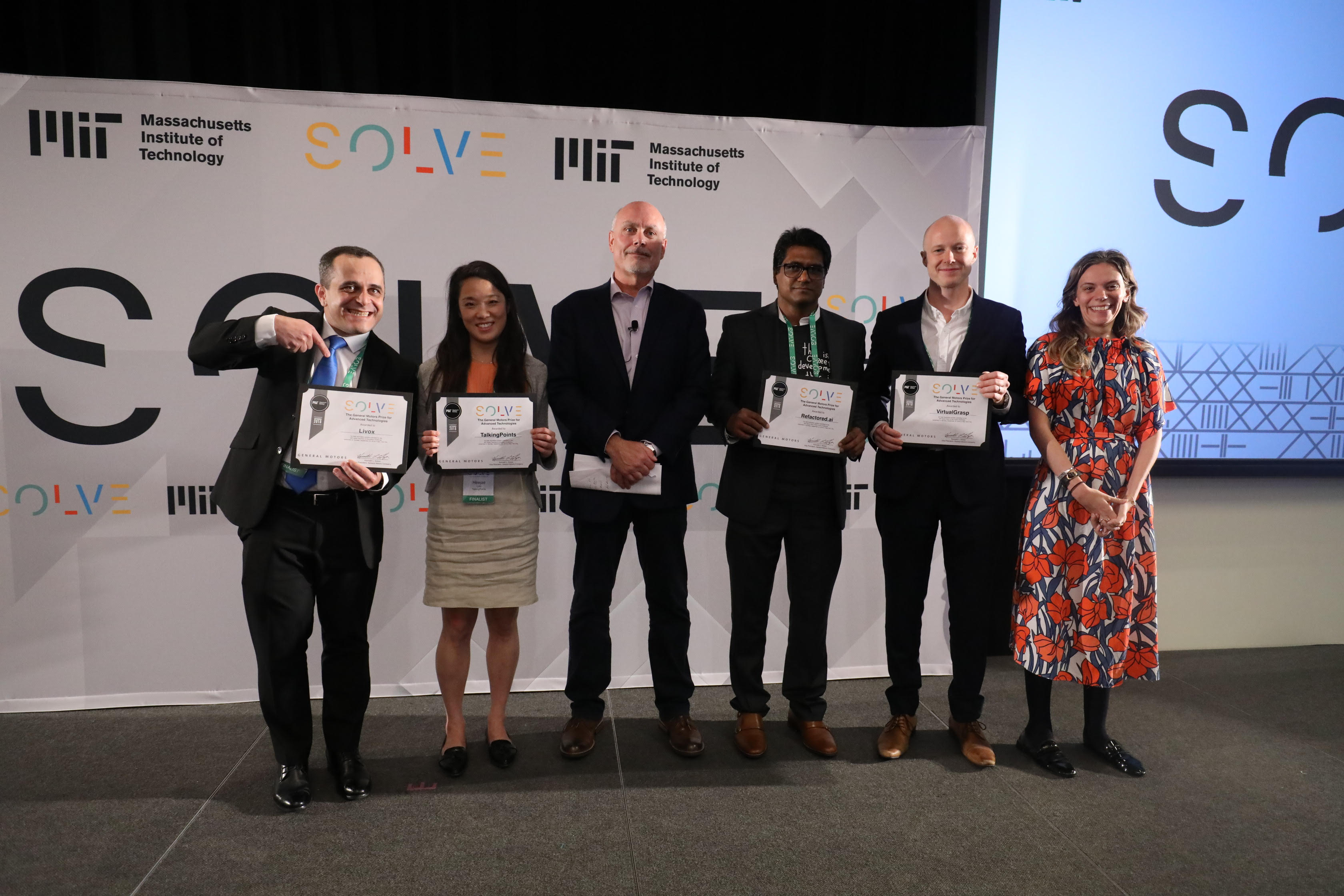
The prize recipients of the GM Prize for Advanced Technology. Photo: Adam Schultz | MIT Solve
To qualify, though, participants need to have more than just an idea. They must have a prototype that works, be either in the growth, pilot or scale stage, and be tech-driven. Submissions are then evaluated by judges from across industry, intergovernmental organizations and academia to get to 15 finalists for each of the four challenge questions. These 60 finalists get a full day with judges to be asked in-depth questions and have their ideas evaluated.
The day after, with all the preparations completed, the finalists get three minutes apiece to present on stage. Crucially, instead of one winner, eight finalists are chosen for each of the challenge questions.
Each finalist receives an initial $10,000 prize, plus a pool of hundreds of thousands of dollars provided by partners including General Motors, the Patrick J. McGovern Foundation, Consensys, and RISE.
This year, for example, Ugandan health care startup Neopenda brought in an additional $30,000 in funding through Solve, from a UN program sponsored by Citi. An intelligent messaging app called TalkingPoints, meanwhile, received backing from General Motors and Save the Children to develop its personalized coaching technology for parents and educators. (You can see more details on this year’s winners and prizes here.)
As opposed to being a “one and done competition” where winning the prize money marks the end of the competition, managing director of community Hala Hanna tells me that the real work begins once the Solver teams are selected. Each qualifying Solver team gets 12 months of engagement and support from the organization. “Our value-add is providing a network, from MIT and beyond, and then brokering partnerships,” she explains.
Solve also produces a series of co-branded programs with other educational and nonprofit organizations around the world. As a result, the Australian government uses the platform to run a smaller-scale challenge focused on issues in APAC, while the Mohammed Bin Rashid Foundation is using it for a larger scale Global Maker Challenge.
Perhaps the biggest testament to the Solve method getting traction is its funders putting in even more cash in support. At the closing event on Sunday, an upbeat Matthew Minor, Solve’s director for international programs, took to the stage decked out in Solve-branded socks and a broad smile. He announced the winning finalists—and more funding opportunities. Two of Solve’s original backers, the Atlassian Foundation and the Australian government, are continuing to invest out of a standing $2.6 million budget for companies in the workforce track. RISE, a global impact investing fund, is putting an additional $1 million into companies focused on coastal communities.
The Australians have already put in funding to help past winners scale after the program. One of them is Ruangguru, a digital boot camp in Indonesia that gives youth dropouts resources they need to earn graduation certificates. The startup had reached nearly a million Indonesians prior to participating in Solve; through the program and the additional funding, it assisted more than 3 million Indonesian youth by the end of last year. Iman Usman, one of Ruangguru’s founders, tells me that Solve enabled them to enter into partnerships that helped them scale across Indonesia in a way they would have never been able to do on their own.
Solve has also been unequivocally good at ensuring diversity, both in its own staffing and—perhaps for related reasons—in those that are chosen as finalists. Of Solve’s 20 full-time staff, 14 are women, as are six out of the seven leadership team members and—by my count—at least seven nationalities from four continents are represented on staff.
The 33 Solver teams selected at the finals this year hail from 28 different countries, with 61 percent of them being women-led. At a time when the tech industry is struggling to increase diversity, Solve’s emphasis on diversity in challenge design and promotion has led to applicants and finalists that reflect the world Solve aims to help.
Hanna noted that increasing diversity is not as difficult as it’s made out to be. “Honestly, we’re not even trying that hard,” she explained. “So whoever says there are no women in tech, I say, crazy talk.”

The view from the Apella at Solve Challenge Finals on Sept. 23. Photo: Adam Schulz | MIT Solve
Still, Solve does have a few kinks to work out. By taking on extremely broad topics, the competition can sometimes lack focus. Lofty questions mean you can get very disparate answers, making it hard to compare them in a way that feels fair. The work of the future challenge, for example, had one team pitching on adding jobs related to knitting in Brazil, while another managed to fit in every possible buzzword (artificial intelligence, crypto and automation) in three minutes without quite explaining what it does.
And while it’s great that the award monies are not all given to a single winner, it is not quite clear how funders pick the teams that do get funding. 15 qualifying finalists this year ended up winning money awards, some winning more than one, while the remaining 18 qualifying teams went home with the minimum amount. This is because Solve funders get to pick which of the teams that qualify at the finals get their respective monetary prizes. Of course, all 33 qualifying teams equally get to be a part of the Solve class with all the support and training that includes.
Another kink is the audience choice award—selected through open online voting prior to the finals—but not tied to any clear concrete benefit. Take the example of Science for Sharing (Sci4S), a Mexico-based startup that trains teachers to better engage students in STEM and has already reached nearly a million children across Latin America. It garnered 419 community votes in the Education Challenge, more votes than any other participant in the category, and handedly won the audience choice award, but ultimately was not selected as a Solver team. Another education startup, Kenya-based Moringa School, only got two votes but was selected. While Moringa and others were compelling and qualified in their own right, but it’s still hard not to think that Sci4S should have focused all of its time on its presentation and ignored the audience vote.
All in all, Solve does get a number of things right where other innovation challenges have failed. Instead of anointing one winner for the entire competition, it selects a class of dozens—reflecting the simple fact that the world’s most intractable problems are not going to be solved by any singular idea. Unlike many challenges put on by educational institutions and open only to their own students, Solve opens its doors wide. And winning at the finals doesn’t end your connection with MIT, it only starts it, with all qualifying finalists getting a year of individualized support, training and mentorship.
Done right, prizes can be effective at incentivizing startups to focus on pressing societal issues that can truly benefit from tech-drive solutions. But prizes for the sake of prizes can add to the noise and dissipate scarce public resources and entrepreneur attention. In the increasingly crowded world of innovation challenges promising to change the world, MIT’s Solve is a step away from the noise and towards effective prize granting.


from TechCrunch https://ift.tt/2N4ZXj3
Subscribe to:
Posts (Atom)

Follow Us
Were this world an endless plain, and by sailing eastward we could for ever reach new distances