TP-Link's Archer 8 Ultra is available to buy in the UK and Australia, along with some other countries
In the UK it's priced at £899.99 (around AU$1,700), but you can get the router for £669.99 (around AU$1,200) currently if you pre-order
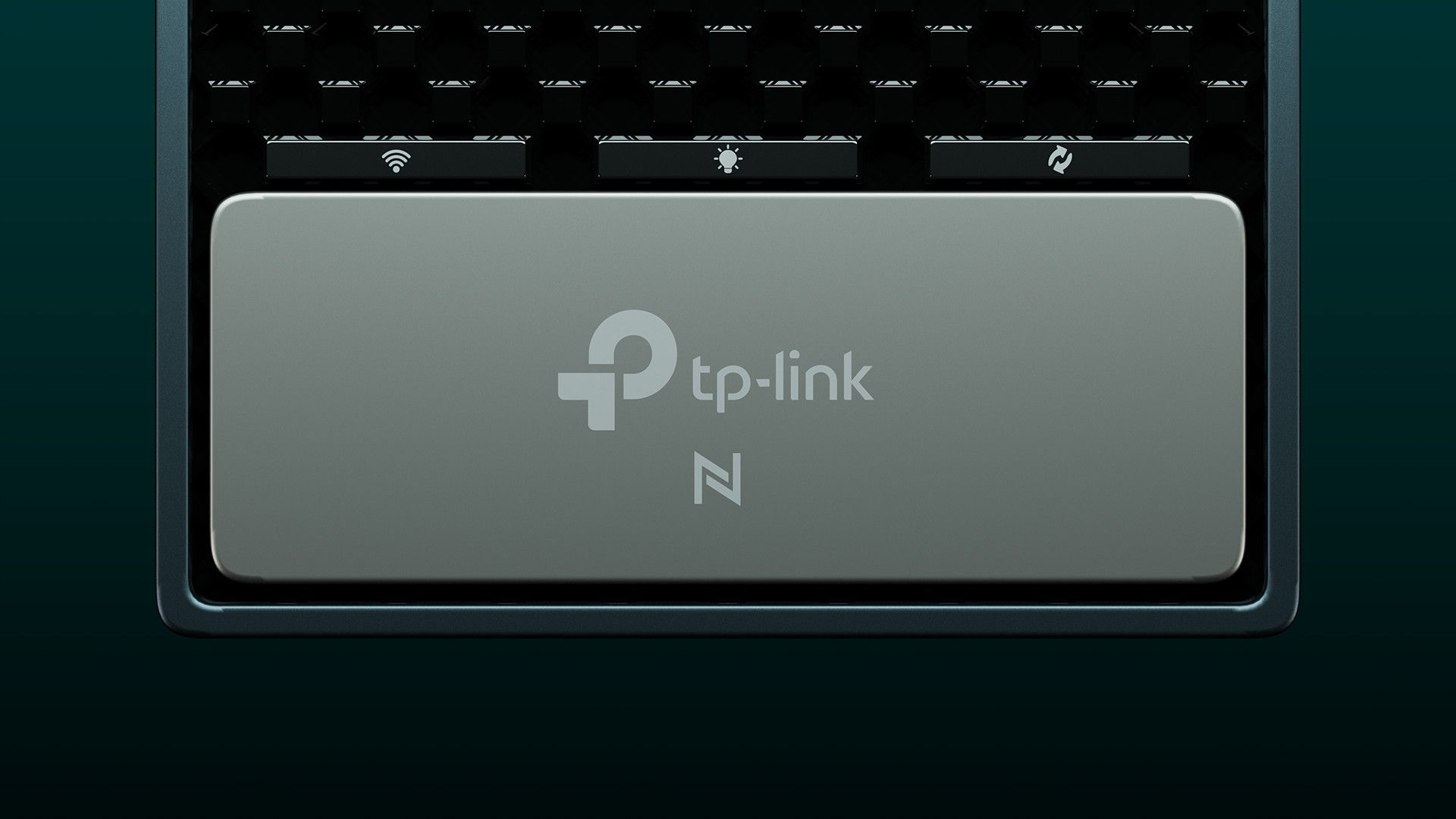
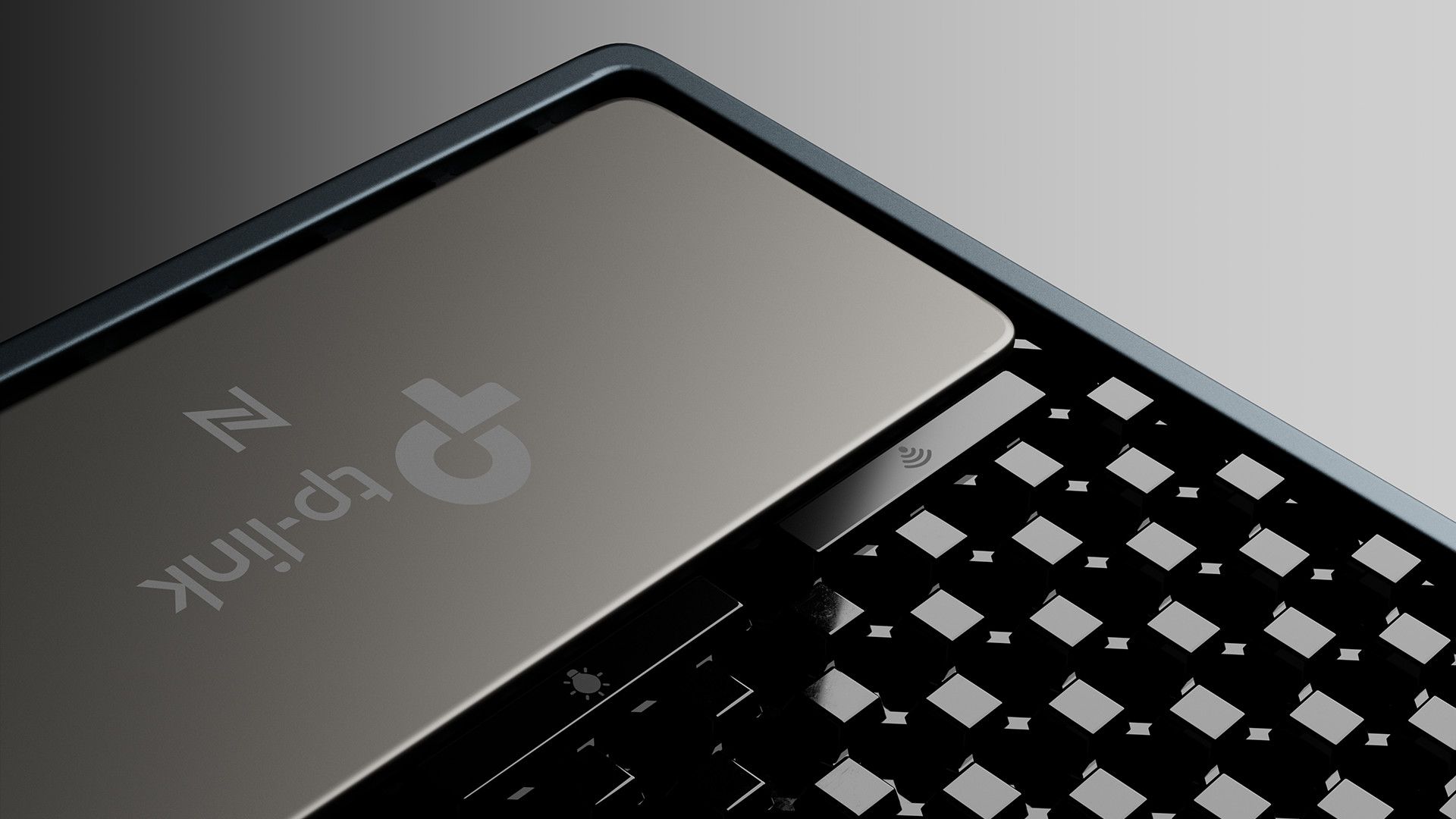
TP-Link is now selling the first Wi-Fi 8 router to come onto the market, although the very latest wireless tech won't come cheap as you might expect.
The TP-Link Archer 8 Ultra is available to buy in the UK and Australia, as well as Germany and some other countries (not yet specified by the router manufacturer).
Pricing will naturally vary by region, but the cost in the UK is £669.99 (around AU$1,200) if you place a pre-order now, although that price tag will be bumped up to £899.99 (around AU$1,700) later on.
The key advantages for Wi-Fi 8 over Wi-Fi 7 are that it deals more capably with interference in crowded signal-dense environments, and it's more reliable with a greater number of client devices connected. Wi-Fi 8 also ensures that there's a better signal at the extremities of the network.
TP-Link has told us a bit more about what its Wi-Fi 8 StabilityEngine tech achieves in the Archer 8 Ultra, noting the presence of features such as UEQM, MCS, and 2×LDPC. These are designed to "hold throughput steady in a noisy home, delivering up to 33% more consistent throughput at mid-to-long ranges and up to 24% more consistent throughput than Wi-Fi 7 under interference."
You don't really need to know the ins-and-outs of the various acronyms involved, save to say that they help the Wi-Fi signal drop off less sharply as you move further away from the router, and they cut down on dropped network packets (helping to keep a more stable connection).
TP-Link also boasts about its Multi-Floor Mode feature, which reshapes the Wi-Fi signal to take into account where devices are actually present. The firm says that this directs coverage to multiple floors when devices are spread over different levels, but it flattens to a "wide single-floor pattern" when they're not.
(Image credit: TP-Link)
TP-Link further observes that as the Wi-Fi 8 standard matures – it's still in its draft form right now – firmware updates will be applied to the Archer 8 Ultra to keep it up to speed.
The Archer 8 Ultra also comes with the Aireal AI Assistant which allows less technically inclined users to employ natural language queries to understand and tweak their Wi-Fi coverage. This AI also keeps a constant eye on how the router is performing and continuously optimizes and prioritizes wireless traffic, with other benefits such as an Eco mode to bring power usage right down at night when everyone's asleep.
(Image credit: TP-Link)
On the security front, this router has an integrated VPN at the hardware level encrypting the traffic of selected devices (it works with third-party VPNs too, if you already have one). Smart gadgets (Internet of Things devices), with their greater levels of potential security risks, are kept on their own network away from the main network (and the guest network is separate too, as you'd imagine).
There's also an optional TP-Link HomeShield service which offers real-time protection for your devices as well as parental controls.
Analysis: is it worth getting on board with the future of Wi-Fi today?
The price tag is predictably high with the Archer 8 Ultra, though, albeit pre-ordering does get you a pretty chunky discount. (The same will doubtless be true of the Deco 8 Ultra when it pitches up – the price of that will also depend on how many units you need based on the size of your home).
At any rate, now the Archer 8 Ultra can be yours, should you rush to pre-order to benefit from all the mentioned Wi-Fi 8 goodies? Well, no, because there isn't any consumer hardware (phones, tablets, laptops) that supports Wi-Fi 8 yet, and you need those client devices as well as the actual router. They won't arrive until next year, and they'll be thin on the ground even then.
So buying this TP-Link router right now is more about being future-proofed than anything else (though you will get some slight benefits from the Archer 8 Ultra with current Wi-Fi 7 or earlier devices). The thing is that if you're prepared to wait, the hefty early adopter premium on the Archer 8 Ultra (or other Wi-Fi 8 routers) will lessen, and really, that's your best bet as I've previously discussed at length.
If you do fancy grabbing the Archer 8 Ultra, though, definitely make sure you get that cheaper pre-order price.
from Latest from TechRadar https://ift.tt/W6nDRb8
For the past several years, the enterprise AI con...
For the past several years, the enterprise AI conversation has been dominated by models. Every week has seemed to bring a new benchmark, a new leader board, or a new debate about which model is smartest. Organizations often made technology decisions based on incremental improvements in model performance, assuming that the model itself was the primary source of competitive advantage, but that assumption is rapidly becoming outdated.
As foundation models continue to improve, they are also converging in capability. At the same time, the cost of deploying AI at scale is becoming a more pressing concern for enterprises than squeezing out marginal gains in benchmark performance.
As a result, the focus is shifting from the model itself to everything surrounding it: the systems that make AI useful, governable, and economically viable in real-world business environments.
The question enterprises are increasingly asking is not, "Which model should we use?" Instead, they are asking, "How do we turn AI into reliable work?"
The rise of the AI harness
The answer begins with what can be described as the harness. An AI model on its own is powerful, but incomplete. To deliver business value, it needs context, access to enterprise tools and data, memory, controls, and guardrails. Together, these elements form the scaffolding that transforms a general-purpose model into a system capable of performing useful work, determining how effective an AI system becomes.
Two organizations might deploy the same underlying model yet achieve dramatically different results. One may struggle with inconsistency, high costs, and poor outcomes. The other may produce reliable, measurable business value. The difference often lies in the quality of the harness surrounding the model rather than the model itself.
That reality becomes more significant as models continue to commoditize. In many cases, organizations will have access to the same leading AI capabilities. What will differentiate them will be their ability to operationalize those capabilities efficiently and safely, and move from intelligence creation to intelligence application.
Why loops matter more than prompts
A related concept is what might be called the loop. Many organizations still approach AI interactions as isolated prompts and responses. But enterprise work rarely operates that way. Real business processes involve objectives, verification, correction, and completion criteria. A loop defines a governed unit of work.
Rather than simply generating an answer, the system performs a task, validates progress against the objective, corrects mistakes when necessary, and stops when the outcome is achieved. This seemingly subtle distinction has enormous implications.
When AI systems operate through loops instead of one-off prompts, they generate operational traces and performance records. Those traces can be used to evaluate outcomes, improve workflows, and refine future execution. Over time, this creates a learning system that grows more effective through use rather than requiring constant manual intervention.
In practice, this means enterprises are no longer deploying isolated AI tools. They are building repeatable learning systems — ones that improve the more they do the work.
The orchestration challenge
As AI adoption expands, organizations encounter another reality: there is rarely a single harness. Most enterprises operate across multiple functions, business units, and regulatory environments. Each domain may require different tools, data sources, workflows, and governance requirements.
A harness optimized for software development is unlikely to be the same one used for finance, healthcare, customer service, or compliance. This creates a new challenge: orchestration.
The orchestration layer acts as the traffic controller for enterprise AI. It routes tasks to the right harness, determines when human oversight is required, and coordinates work across multiple systems. Rather than treating AI as a standalone capability, orchestration allows organizations to manage AI as an enterprise-wide operational platform.
This capability becomes particularly important in regulated industries, where workflows often cross organizational boundaries and require strong accountability. As AI moves deeper into critical operations, orchestration will become a defining architectural requirement rather than a technical afterthought.
Governance and assurance as strategic differentiator
If orchestration determines where work goes, governance determines whether that work can happen safely and assurance determines whether we can trust it was done as intended. Many organizations initially viewed AI governance and assurance as a compliance exercise rather than a core operational requirement.
Effective governance and assurance encompasses policy enforcement, authorization controls, asset management, cost monitoring, evaluation and audit services, observability, guardrails, and risk management. These capabilities must function consistently whether work occurs within a single AI system or across multiple interconnected workflows.
The need is especially acute as enterprises deploy autonomous and semi-autonomous systems. A model generating an inaccurate answer may be inconvenient. An AI agent taking action in a regulated business process without adequate oversight can be more problematic. Organizations that treat governance and assurance as an integral component of their AI architecture rather than a bolt-on feature will be better positioned to scale adoption while maintaining trust.
Thinking in ecosystems, not products
Collectively, the harness, orchestration capabilities, and governance and assurance layers form what can be viewed as a governed operating environment for AI. Combined with models, data, and compute infrastructure, they become an ecosystem that functions as a single accountable system.
This shift in perspective is important because no single vendor currently delivers every component of that ecosystem. The future of enterprise AI is therefore unlikely to be dominated by one model provider or one platform vendor. Instead, success will depend on how effectively organizations integrate and operate a diverse collection of technologies.
For enterprises, particularly those operating under regulatory, security, or sovereignty requirements, this integration challenge is not optional. AI must operate within boundaries defined by business policy and organizational control. The ability to combine frontier models with protected enterprise data while maintaining accountability will become a critical capability.
The next AI battleground
The model layer will continue to improve. It will also become increasingly interchangeable, but that does not diminish the importance of AI innovation. Instead, it changes where value is created.
The next battleground is the layer surrounding the model: the harnesses that make work reliable, the loops that make systems learn, the orchestration platforms that coordinate activity, and the governance and assurance frameworks that make scale enterprise ready. Together, they will determine whether AI remains an impressive technology demonstration or becomes a sustainable enterprise capability.
In the years ahead, the organizations that gain lasting advantage are likely to be those that stop asking which model is best and start focusing on how to integrate, govern, and operate AI as an accountable business system. The future of enterprise AI belongs not just to the model alone, but to everything around it.
This article was produced as part of TechRadar Pro Perspectives, our channel to feature the best and brightest minds in the technology industry today.
The views expressed here are those of the author and are not necessarily those of TechRadarPro or Future plc. If you are interested in contributing find out more here: https://www.techradar.com/pro/perspectives-how-to-submit
If you're under the age of 30 and think of the name Celia Imrie, you likely think of the woman who farted in a log cabin during an episode of The Celebrity Traitors season 1.
Obviously you'd be factually correct, but this doesn't even begin to scratch the surface of just how iconic Imrie actually is. From Acorn Antiques and Dinnerladies to Calendar Girls and The Best Exotic Marigold Hotel, if there's been a worthwhile British drama, she's been there to improve it.
Now, the same can be said for War on HBO Max (international) and Sky TV (UK). Following two legal firms as they represent a spouse in a high-profile divorce trial, Imrie plays Budgie, a freelance barrister working for the newly established Taylor & Byrne.
From watching the trailer below, you might have assumed, like me, that Imrie was to play the High Court Judge overseeing the trial. According to Taylor and Byrne themselves, James McArdle and Phoebe Fox, Imrie had those onset so fooled by her power, that their opening scene in episode 1 had to be entirely reshot.
'She has such inherent power'
"She is such an incredibly charismatic woman and has such an inherent power," Fox tells me. "Originally, she just turns up and is in the office with us having a scene — but they actually had to reshoot her entering the office because everyone who watched it thought that she ran the company.
"We're the bosses, but that wasn't clear, apparently. She's a dream woman to work with."
And water is wet. This news doesn't surprise me in the slightest... but what I didn't realise is that Celebrity Traitors was airing at the same time as War was being filmed, which must have been like striking gold for any other cast members with a penchant for reality TV.
"While we were filming, Traitors was on," McArdle adds. "It was really hard for the director to get me to concentrate because I just kept trying to get spoilers out of Celia and Nick (Mohammed). Celia and I knew each other from way before, so I thought she would tell me... but she never did."
Oh, didn't I mention that there's also a Celebrity Traitors reunion within the cast too? More on that later this week. For now, set your clocks ready to watch War this Friday (October 2).
That's according to the ever-reliable WhenToStream website, whose sources have indicated that the record-breaking Marvel movie will be available to rent or buy on October 6, 2026.
Currently, digital stores, such as Amazon, Fandango, and Apple TV, have placeholder webpages for the latest Spider-Man film, but they make no mention of an impending release date, or simply say that its digital launch is "coming soon".
Nonetheless, WhenToStream has a fantastic track record when it comes to movie-based PVOD launch date announcements, so there's no reason to doubt the aforementioned at-home release date for Brand New Day.
I've approached Marvel and Sony Pictures for comment on what WhenToStream has reported, and I'll update this article if I receive a response.
SPIDER-MAN: BRAND NEW DAY (2026)Streaming: October 6, 2026PVOD (Apple, Amazon, Fandango, etc.)#SpiderManBrandNewDaywhentostream.com/spider-man-b...
Whenever Spider-Man 4 makes its PVOD debut, every rental or permanent purchase will only add to the eye-watering amount of money it's already made.
At the time of writing, the Marvel Phase 6 flick has made a staggering $2.495 billion at the global box office. $950 million of that figure has been in the US alone, which is enough to make it that nation's highest-grossing movie of all-time. Star Wars: The Force Awakens had been the holder of that particular mantle, with the seventh Star Wars film making $936.6 million in the US between December 2015 and early 2016.
How long will that record last? It's hard to say. The iconic webslinger's latest big-screen adventure, which sees A-listers (and married couple) Tom Holland and Zendaya star in their fourth Spidey movie, has been lauded by pretty much everyone.
I wasn't as big on it as many others were — read my Spider-Man: Brand New Day review to find out why. Nevertheless, there's no denying that the aforementioned pair's star power, plus Spider-Man's enduring popularity, helped it to swing to unprecedented new heights.
Still, with the Marvel Cinematic Universe's (MCU) highly-anticipated next team-up film in Avengers: Doomsday set to hit theaters on December 17, it'll be fascinating to see if Spider-Man 4 can hold of its fellow comic book-inspired flick and retain its position as the biggest money-spinning movie in US history.
When might Spider-Man: Brand New Day be released on Netflix?
Spider-Man 4 won't swing onto Netflix and other SVOD platforms for a while yet (Image credit: Sony Pictures/Marvel Entertainment)
Currently, Sony-developed movies typically premiere on one of the world's best streaming services around four months after their initial theatrical release. Using that as a barometer, Brand New Day wouldn't come out on Netflix until late November, which would be an incredibly timely, well, time to arrive, as it coincides with Thanksgiving in the US.
However, things are more complicated than that. For one thing, Sony has various licensing agreements with numerous streamers that means its films have different streaming homes in different parts of the world.
For instance, Spider-Man: No Way Home, aka Brand New Day's predecessor, has regularly been available on Starz in the US. Overseas, the Spider-Man movies have come to Sky and Prime Video in the UK, and Stan and Binge in Australia. Further complicating matters is that the live-action Spidey flicks have occasionally joined Disney+ in multiple territories.
Things won't be that way for much longer, mind you. As I mentioned above, a new 'Pay-1' deal between Netflix and Sony means the latter's films will exclusively stream worldwide on Netflix following their theatrical and digital releases.
Per Netflix's blog announcing the agreement, the streaming titan said that "the new global Pay-1 arrangement will roll out gradually starting later this year as individual territory rights become available, with full global availability on Netflix in early 2029."
What does that mean for Spider-Man: Brand New Day? Theoretically, it could make its Netflix debut in the US and other countries before the end of the year.
Sure, much will depend on when Sony's current licensing deals with other streamers expires in certain parts of the world. Given Netflix's wording above, though, I wouldn't be surprised if Netflix users in multiple nations suddenly see Spider-Man 4 appear on their home page before 2026 is over, whenever that date will be.
The Voice AI Agents market is growing exponentially. The industry is projected to grow from $2.4 billion in 2024 to $47.5 billion by 2034, while Gartner predicts that by 2028, 70% of customer service journeys will begin with a conversational AI interface.
For global brands, the appeal is obvious. Voice AI offers the potential to deliver consistent, scalable customer support across markets, languages and time zones.
But there is a risk that voice AI will face the same issue faced by outsourced customer service centers, where differences in language and culture create a disconnect and frustration between the brand and customer.
As voice AI advances, language may become less of a barrier. But speaking the same language is not the same as understanding someone.
It’s just one part of the puzzle. Customers bring accents, habits and cultural expectations to every interaction, and they expect support to reflect their reality.
For that reason, localization needs to become a core test of voice AI performance, rather than a translation exercise that happens at the end of development.
What does it mean for voice AI to be ‘local’?
Accents, dialects, terminology and cultural norms can vary considerable even when speaking the same language. In Scotland, for example, a customer might say “aye”, rather than “yes”, refer to something small as “wee”, or talk about “getting the messages” when they mean going shopping. The language is English but understanding the interaction requires familiarity with how that language is used locally.
Cultures also differ in their expectations around directness or politeness. Even something as simple as how a customer is addressed can matter. In some cultures, using titles and surnames is an important sign of respect, while in others, addressing someone by their first name is the norm. A voice agent that is too informal could come across overly familiar, while one that is too formal might feel distant or unnatural.
All this to say that just because an AI might sound like me, it doesn’t necessarily mean it understands me or is equipped to serve someone in my market.
These aren't cosmetic details. They shape an AI agent’s ability to understand intent and respond appropriately and, ultimately, determine whether customers trust the experience it provides.
It doesn’t sound like a robot anymore
This isn’t to say there haven’t been huge advances in AI. There’s a reason why so many brands are investing in voice AI for CX, and that’s because it's becoming so convincing. Just look at ElevenLabs, for example.
The organization has built its success on AI-generated voices that can reproduce not just speech, but the pacing, intonation and emotion that make a voice sound human. Its technology not only spans voice cloning, multilingual speech and conversational agents, helping take synthetic voice from a novelty to something businesses can realistically deploy at scale.
The days when synthetic speech was instantly recognizable as robotic are fading. Early digital voices such as ‘Microsoft Sam’ left little doubt that you were listening to a machine. Today, the line is becoming much harder to distinguish. As voice AI becomes more convincing, our interactions with it can start to feel less like using a piece of technology and more like engaging with another person.
The technology's ability to create a sense of social presence is already apparent beyond customer service. Even actors such as Matthew McConaughey are getting behind AI voice technology, where it can match their performance without requiring them to change the way they sound, demonstrating just how powerful voice and conversational cues can be in shaping our perception.
But the most advanced experiences aren’t universally available, meaning many people may still be exposed to underdeveloped AI voices. What’s more, humans are remarkably good at noticing when something is slightly off. This is what creates the uncanny valley effect.
An unnatural pause, misplaced emphasis or strangely enthusiastic response can quickly break the illusion. Local context adds another layer to that challenge. A voice can sound perfectly human while still sounding culturally out of place. That said, the closer AI gets to human speech, the more conspicuous those moments can become.
Global brands can’t rely on one global answer
This is where global brands need to resist the temptation to treat voice AI as a single product that can be rolled out everywhere.
A frontier model might provide the foundation, but its performance needs to be tested against local data and real customer interactions so it can capture what ‘good’ looks like in terms of:
- The empathy that de-escalates a frustrated customer
- The specific terminology a market actually uses
- The intonation that reads as natural
All of these can't be inferred by a frontier model; it has to be learned market by market, brand by brand. Successful voice AI models will have an ongoing feedback loop which monitors interactions within individual markets, identifies where misunderstanding or friction occurs, refines the experience and tests again.
Local teams can play an active role in this process as well, bringing market expertise into development rather than simply receiving the “finished product”.
It can’t be treated as a job that is ever truly finished. Language and slang changes, customer expectations shift and new trends introduce expressions and behaviors that may not have appeared in the original training data.
Final summary
Getting this wrong can have an impact on a brand’s reputation. As voice AI becomes more human, customers will naturally expect more from it.
Derby City Council recently experienced this with its AI assistant, Darcie, which struggled to understand a presenter with a strong Derbyshire accent who used local expressions such as “mardy” and “duck,” despite having been upgraded to support nine additional languages.
It is a useful reminder that multilingual does not necessarily mean localized. If a system repeatedly misunderstands an accent or fails to recognize local expressions and expectations, customers will not experience it as a technology problem.
Instead, it will shape their perception of the organization behind it. The brands that get real value out of the voice AI boom won’t be the ones whose technology can speak all 7,170 languages in existence today. They will be those whose customers feel the most understood.
This article was produced as part of TechRadar Pro Perspectives, our channel to feature the best and brightest minds in the technology industry today.
The views expressed here are those of the author and are not necessarily those of TechRadarPro or Future plc. If you are interested in contributing find out more here: https://www.techradar.com/pro/perspectives-how-to-submit
from Latest from TechRadar https://ift.tt/s7On83S
Watch Australia vs South Africa free on 9Now (AU...
Australia vs South Africa kicks-off at 10:45am BST / 7:45pm AEST
Watch a one-off rugby Test match between Australia and South Africa today as the Wallabies look to overturn the Springboks on home soil.
The Aussies have now won four of their last five games, but their toughest test yet comes against a South Africa side fresh from a historic series win.
The Springboks cruised to a 3-1 Test series win over New Zealand and, while they might not have all their key players available to face the Wallabies, Rassie Erasmus will still be confident he has enough quality on the pitch to get the win.
The best part about this game? We've found a sneaky way to watch the it all completely FREE, from wherever you are!
The hack: 9Now in Australia is showing the Australia vs South Africa game at no cost!
But what if you're traveling outside the country? Can you still watch the Australia vs South Africa game for free - from the US, UK or Canada? Yes, you can! Read on to find out how.
How to watch Australia vs South Africa for free
9Now are streaming Australia vs South Africa for free in Australia.
All you need to do is sign up for an account and you'll be able to watch the game for no cost at all.
Do note: you will need an Aussie postcode to create an account (e.g. 2002)
Use a VPN to watch Australia vs South Africa free from anywhere
A VPN is handy piece of software that can make your device appear as if it's back in your home country, so you can unlock your usual service. The best VPN right now? We recommend NordVPN – it does everything and comes with a 75% discount, and three months for free.
Not having a VPN is like leaving your front door wide open in a busy city – anyone can walk right in and take a peek.
TechRadar regularly reviews all the biggest and best VPN providers and NordVPN is our #1 choice.
✅ Up to 75% off today ✅ 3 extra months free ✅ Unlocks 9Now
Get NordVPN and stream Australia vs South Africa from anywhere, for free.View Deal
Quick start: Using a VPN to watch Australia vs South Africa for free
Using a VPN is incredibly simple, just follow these steps.
1. Install the VPN of your choice. As we've said, NordVPN is our favorite.
2. Choose the location you wish to connect to in the VPN app. For instance if you're visiting the U.S. and want to view an Aussie streaming service, you'd select a location from Australia (like Perth) from the server list.
3. Sit back and enjoy the action. Head to 9Now and watch the Wallabies vs Springboks just like you would at home.
Which devices can I watch 9Now for free with?
You can use 9Now on a range of devices:
Amazon Fire TV Android phones and tablets (Android OS 5 and newer) Android TV Apple iPhones and iPads (iOS 12 or later) Apple TV (including Apple TV 4K and Apple TV HD) Chromecast (including Chromecast with Google TV) Chrome (latest two versions) Fetch TV (Gen 3 or newer) Firefox (latest two versions) Foxtel iQ Freeview Hisense TV LG Smart TV (webOS 4 or higher) Mobile apps – download the 9Now app on your phone or tablet (iOS/Android) Mozilla (latest two versions) Roku (including Roku 2, Roku 3, Roku Express, Roku Express+, Roku Premiere, Roku Premiere+, Roku Streaming Stick, Roku Streaming Stick+ and Roku Streambar) Safari (latest two versions)
We test and review VPN services in the context of legal recreational uses. For example:1. Accessing a service from another country (subject to the terms and conditions of that service).2. Protecting your online security and strengthening your online privacy when abroad.We do not support or condone the illegal or malicious use of VPN services. Consuming pirated content that is paid-for is neither endorsed nor approved by Future Publishing.
from Latest from TechRadar https://ift.tt/MakceYC
INNOCN E49M1R: 30-second review The 49-inch ultra...
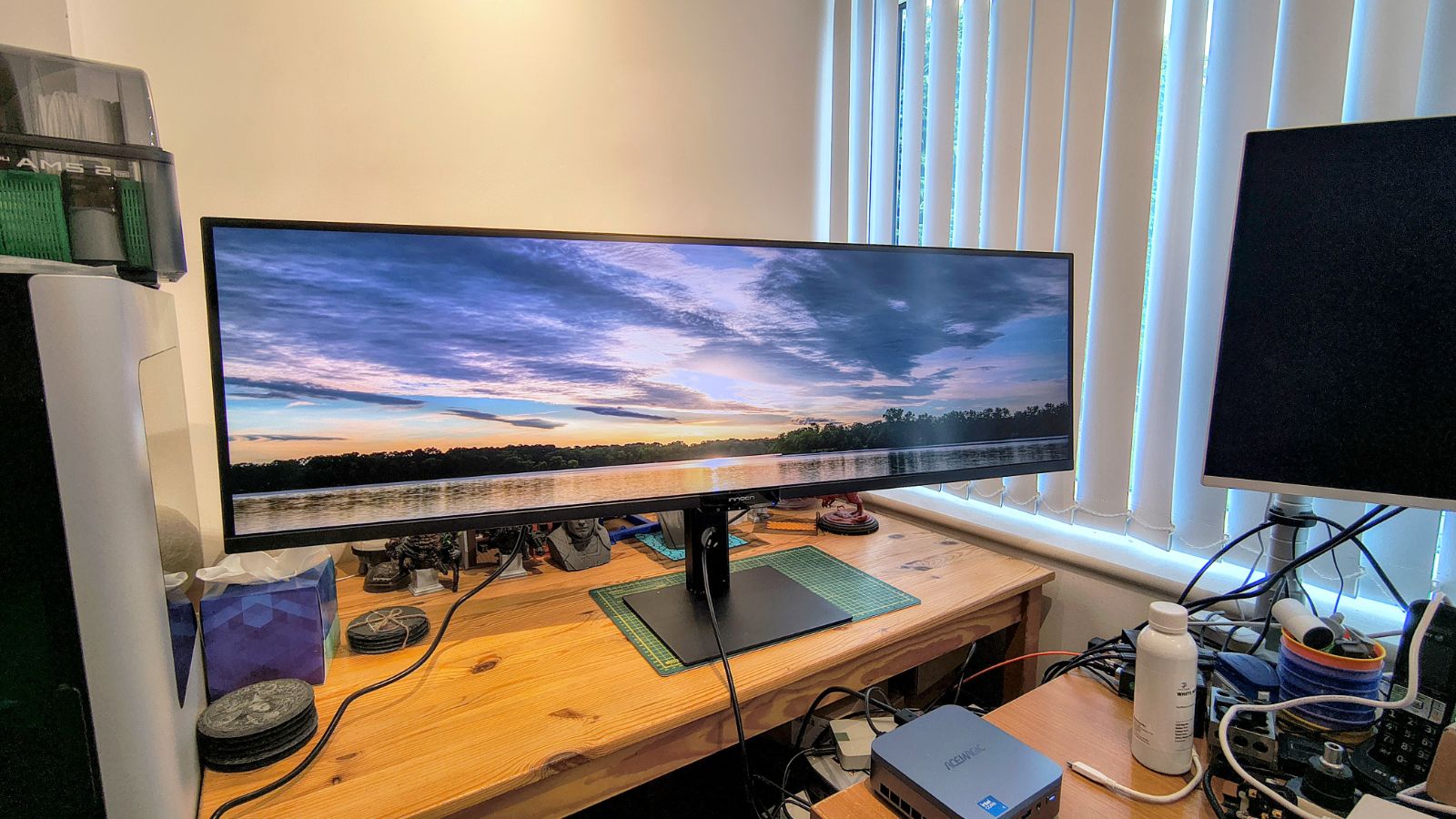
The 49-inch ultrawide market has always demanded a compromise. Curve the panel, and you gain immersion but lose straight lines along your windows' edges. Keep it flat, and those two features simply swap places. Innocn has decided that trade-off is no longer guaranteed, and the E49M1R is the result.
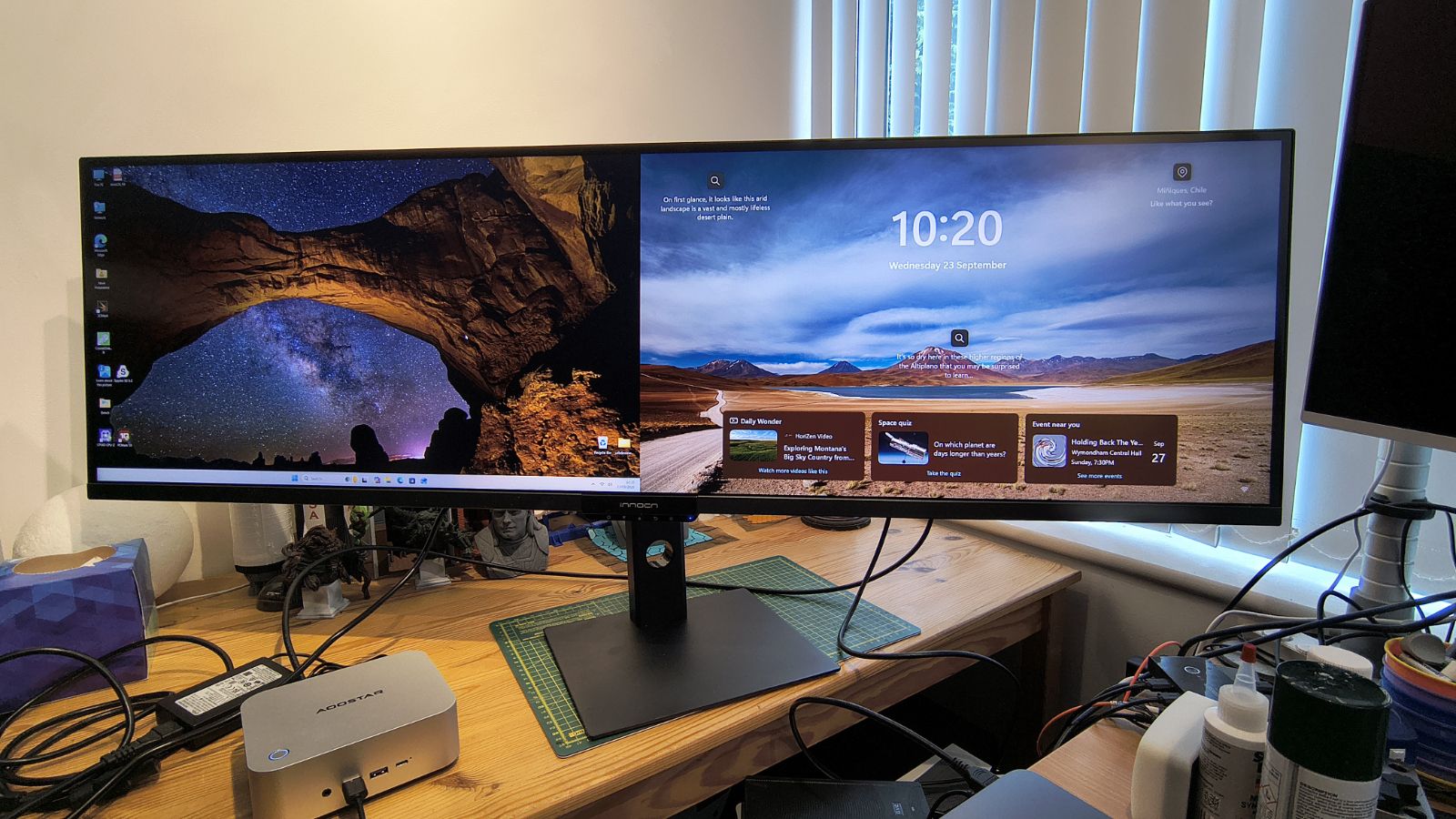
By the maker's own description, this is the world's first 49-inch flat Mini LED ultrawide monitor. That single design choice sets it apart from almost every other super ultrawide currently on sale, since curved panels have dominated this size class for years. Traders, video editors, developers and anyone who values straight lines over cinematic curvature now have a genuine flat alternative at this scale.
Underneath that flat glass sits a 5120 x 1440 VA panel, often marketed as DQHD, which is effectively two 27-inch QHD monitors joined without a centre bezel. Add a 165Hz refresh rate and a 2ms overdrive response time, and you have a display built to appeal equally to people juggling financial dashboards, editors scrubbing long timelines, and gamers who want peripheral vision without warped geometry.
Backlighting comes from 1760 local dimming zones, a genuinely high number for a monitor at this size and this price. INNOCN pairs that with HDR1000 certification, a typical brightness of 450 nits, and a claimed peak that reaches four figures in HDR content. On paper, that combination should deliver punchy highlights alongside properly dark shadows, rather than the washed-out grey blacks that cheaper Mini LED panels sometimes produce.
Colour coverage looks strong too, with sRGB essentially maxed out and comfortable coverage claimed of the wider Adobe RGB and DCI-P3 spaces. Either way, the combination suggests this panel was built with more than gaming in mind, rather than for design work.
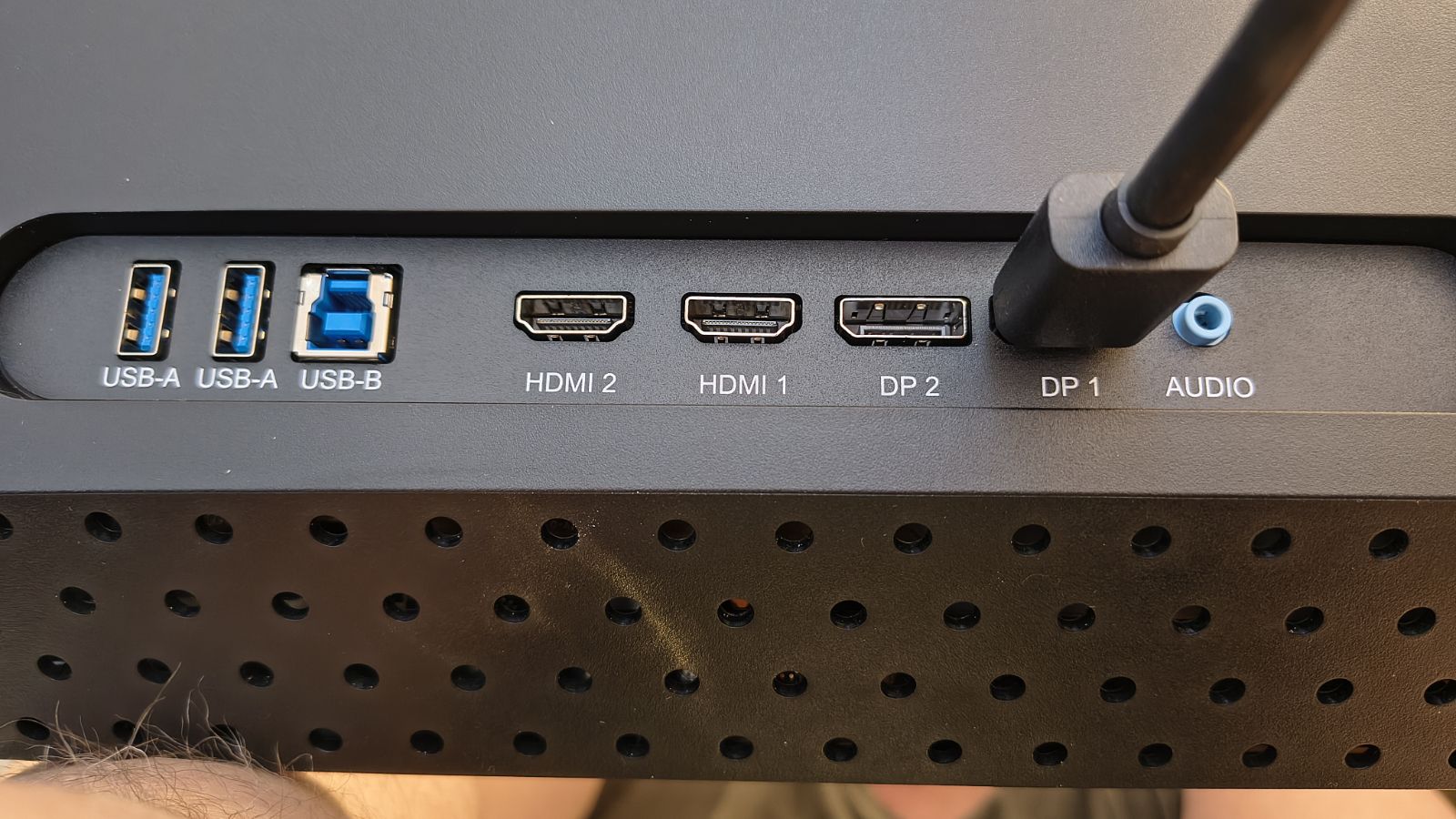
Connectivity runs to two HDMI 2.1 ports and two DisplayPort 1.4 inputs, a sensible spread for switching between a desktop and a laptop, or a work machine and a console, without reaching for an adapter. You can display all four inputs at once, or use a range of picture-in-picture options.
A USB hub, twin 5W speakers and support for AMD FreeSync round out the feature list.
The stand offers 120mm of height adjustment along with tilt from minus five to plus fifteen degrees and a modest fifteen degrees of swivel. There is no mention of pivot, which is hardly surprising given the sheer width involved. At 13.3kg with the stand attached, this design rewards a permanent spot on a desk rather than regular repositioning.
Pricing in the US sits at $999.99, which places the E49M1R against established 49-inch rivals from Samsung and LG, several of which still rely on curved panels at similar or higher price points.
The core promise here, a genuinely flat super ultrawide with Mini LED backlighting and a proper refresh rate, is compelling enough that INNOCN deserves the benefit of the doubt until testing confirms whether the numbers hold up on a desk rather than on a spec sheet.
INNOCN E49M1R: Price and availability
(Image credit: Mark Pickavance)
How much does it cost? $999
When is it out? Available now in the US and Japan
Where can you get it? Direct from Innocn
Innocn lists the E49M1R at $999.99 on its US store, with free shipping, a 30-day return window and a standard 12-month warranty. Orders placed before 1 October 2026 qualify for an extended three-year warranty as a launch promotion.
The monitor also launched in Japan on 10 September 2026 at 159,999 yen, roughly $1,044, with an introductory price of 135,990 yen, roughly $887, running for a limited period around launch.
Is this a good price? It’s hard to say, since no other monitor brand has anything like this available to compare.
Value: 5 / 5
INNOCN E49M1R: Specs
Specification
Detail
Model
E49M1R
Panel size
49 inches, flat
Panel type
VA, Mini LED backlit
Resolution
5120 x 1440 (5K DQHD)
Aspect ratio
32:9
Refresh rate
165Hz
Response time
8ms GtG, 2ms with overdrive
Local dimming zones
1760
HDR
HDR1000
Brightness
450 nits quoted
Contrast ratio
3000:1
Colour depth
8bit
Colour coverage
100% sRGB claimed, 98% tested
Connectivity
2x HDMI 2.1, 2x DisplayPort 1.4, USB hub, 1x audio out
Adaptive sync
AMD FreeSync
Speakers
2x 5W
Stand adjustment
120mm height, tilt -5 to +15 degrees, 15 degree swivel
VESA mount
100 x 100mm
Power consumption
95W typical, 240W maximum
Weight with stand
13.3kg
Warranty
3-year (launch offer)
INNOCN E49M1R: Design
(Image credit: Mark Pickavance)
Flat panel, not curved
Minimal bezel across a 32:9 frame
Height-adjustable stand but modest rotation
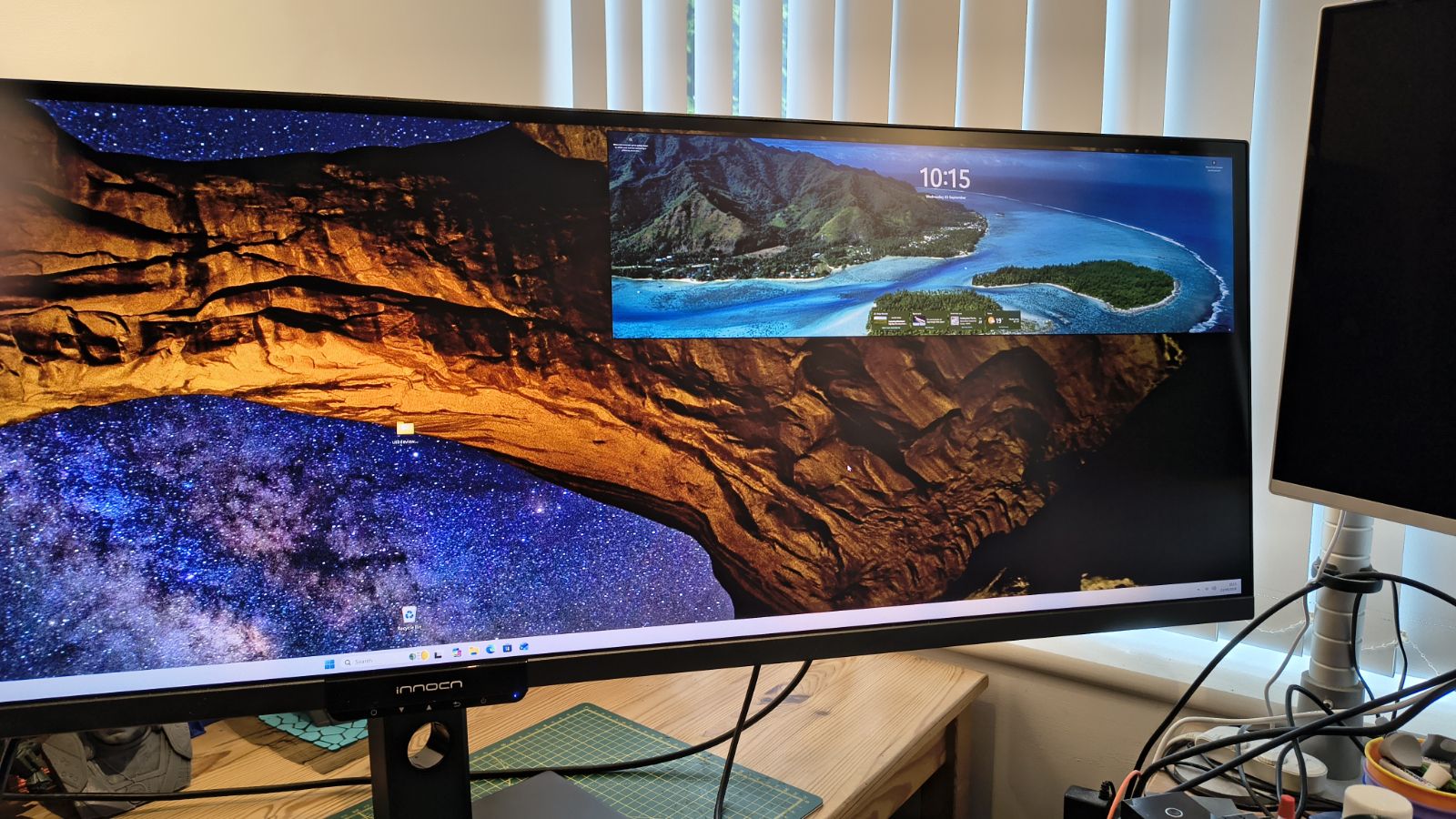
Where most 49-inch ultrawides curve their panel to keep the far edges within easy view, the E49M1R stays flat.
Innocn calls it the first monitor of its kind at this size, and it is a genuine point of difference rather than a marketing flourish. A flat panel keeps straight lines straight, which matters for anyone lining up spreadsheet columns, CAD drawings or video timelines across the full width of the screen.
You can get the same 5120 x 1440 resolution at this scale by combining two 27-inch 1440p displays, and that would be cheaper. But for those who want a single seamless experience, this is the way.
However, that creates an entirely different issue: the sides of the screen are significantly farther from a centrally placed viewer than the middle.
How much further? Well, if you are 75cm from the middle of the panel then the left and right edges are another 20cm away.
Depending on the flexibility of your eyesight, this is either not a problem or a major snag.
You might want to consider a desk you can slide sideways so that, if you are working at one side, you can bring it nearer, then roll your chair to the other when needed. This might seem silly, but if you are using this panel to monitor things, you'll need to make some adjustments.
What’s impressive is how narrow the bezel is on the top and sides, making the display the predominant aspect of this screen.
(Image credit: Mark Pickavance)
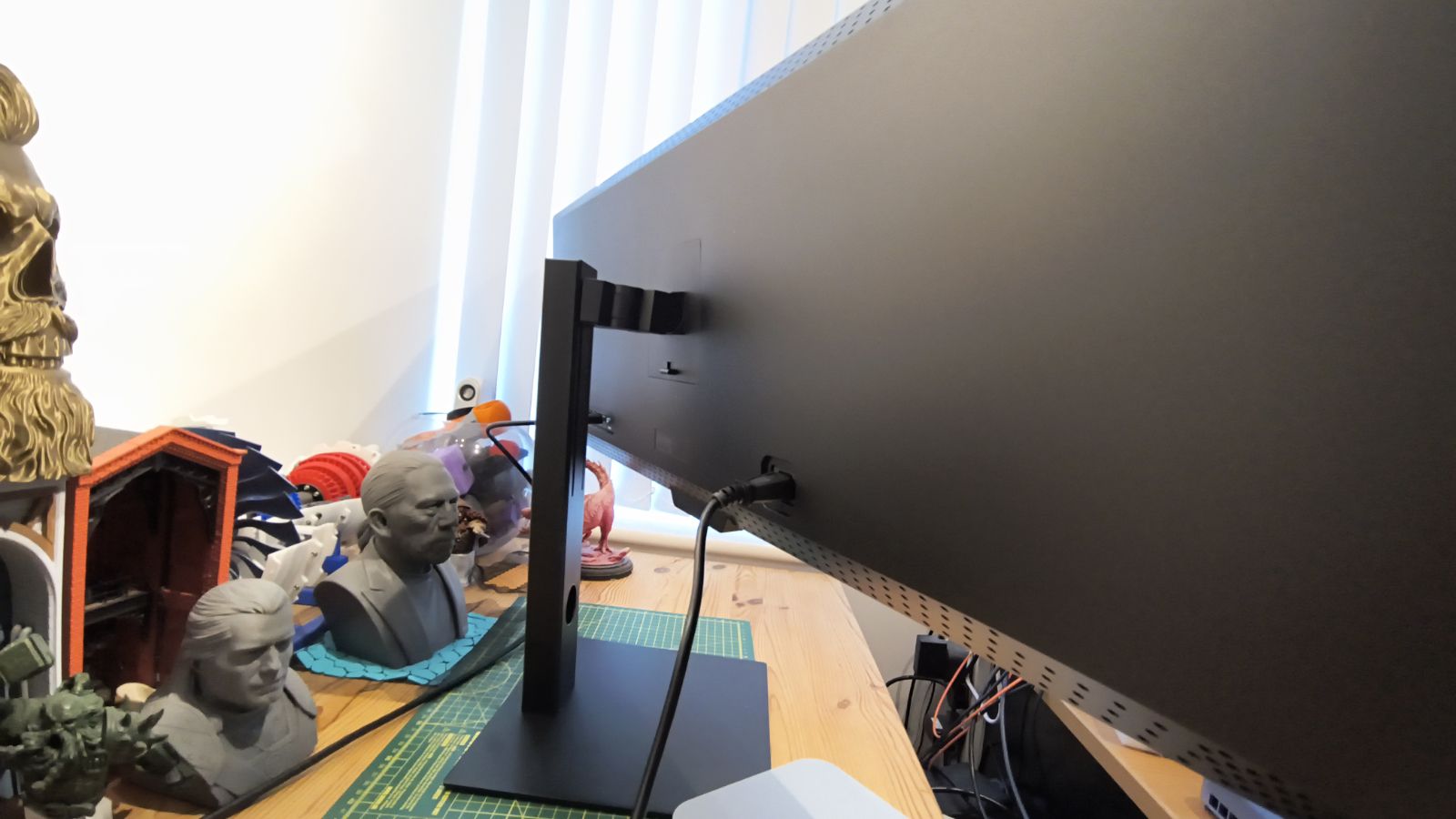
The stand provides 120mm of height travel, a tilt range from minus five to fifteen degrees, and also fifteen degrees of swivel. No pivot option is listed, which makes sense given the panel's width. It has a VESA 100 mounting point in the centre, but you need to consider that any support will need to handle the not insignificant weight of the E49M1R.
At 13.3kg with the stand fitted, this is not a monitor you will want to move often, or possibly without some help.
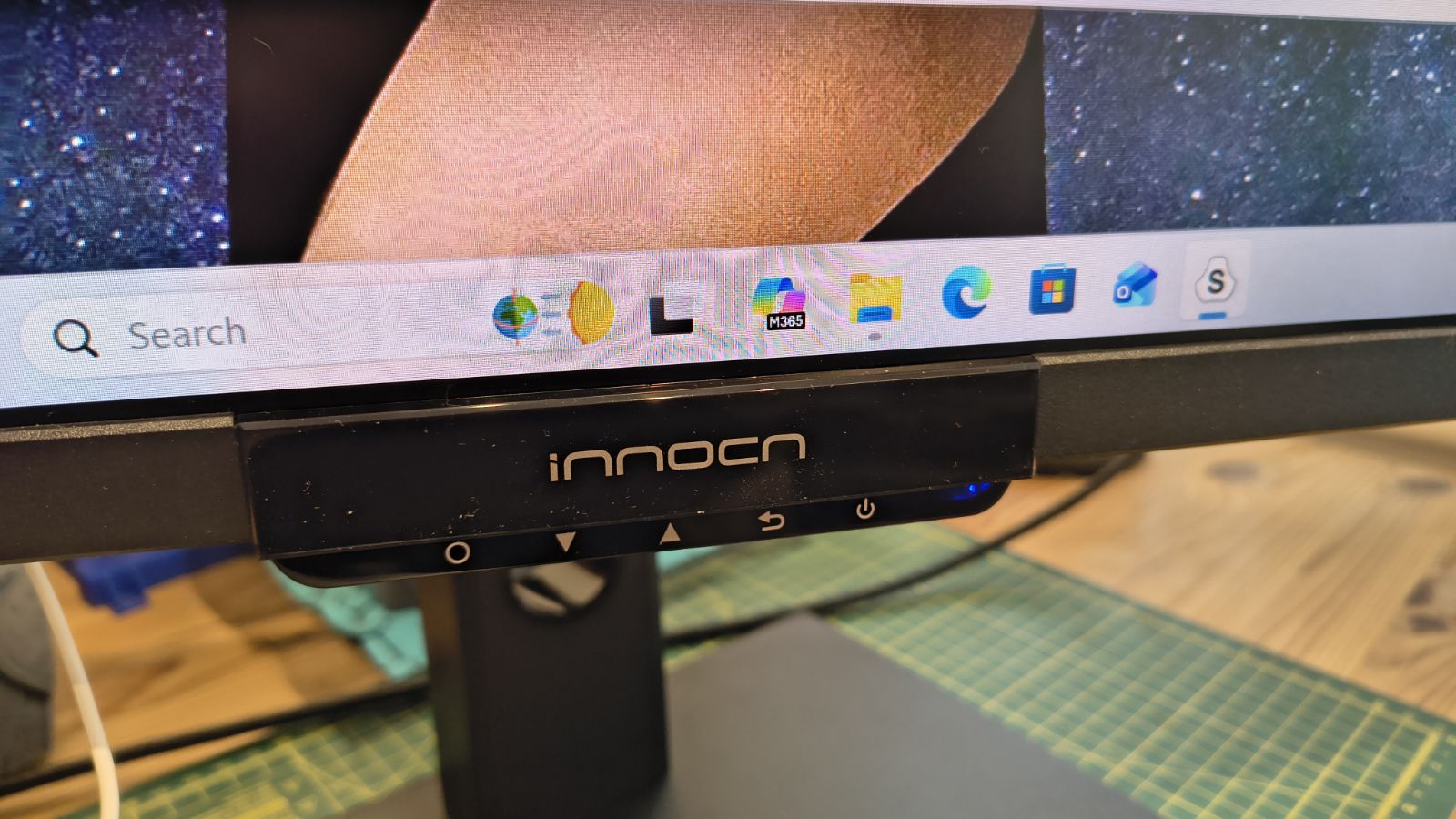
Settings on this monitor are slightly old-school, with five buttons under the central Innocn logo being used to control an on-screen menu.
I’ll be honest and say I hate these menus, because six clicks to make a change when it would be one with a mouse and an app seems bonkers. However, all the interesting features are on this menu, if you can be bothered to click through them.
Overall, there isn’t much that’s revolutionary here in the design; most of that showboating is reserved for the underlying technology.
However, despite the obvious awkwardness of having a monitor this large, in most respects it works as intended, and for some applications is something of a joy.
The trick I think Innocn missed is that this screen is perfect for controlling multiple systems, since you can display each input simultaneously. What’s required to make this perfect is a KVM, and since Innocn put a USB hub into the monitor, why did they not make this a KVM?
Even if it only supported two computers, splitting the screen for two systems, and tracking a hotkey switch (like a SCRL LOCK double tap) to flip the USB port over for mouse and keyboard, this would be terrific. Yes, you can get the same effect with a separate KVM, as I have, but if it were all in one package, it would be brilliant.
The key weaknesses are the lack of motion on the stand and the lack of a software control panel, which forces you to use tiny buttons to change modes.
But these flaws don’t undermine what is a solid product in most respects.
Design: 4 / 5
(Image credit: Mark Pickavance)
INNOCN E49M1R: Performance
Up to 480 nits
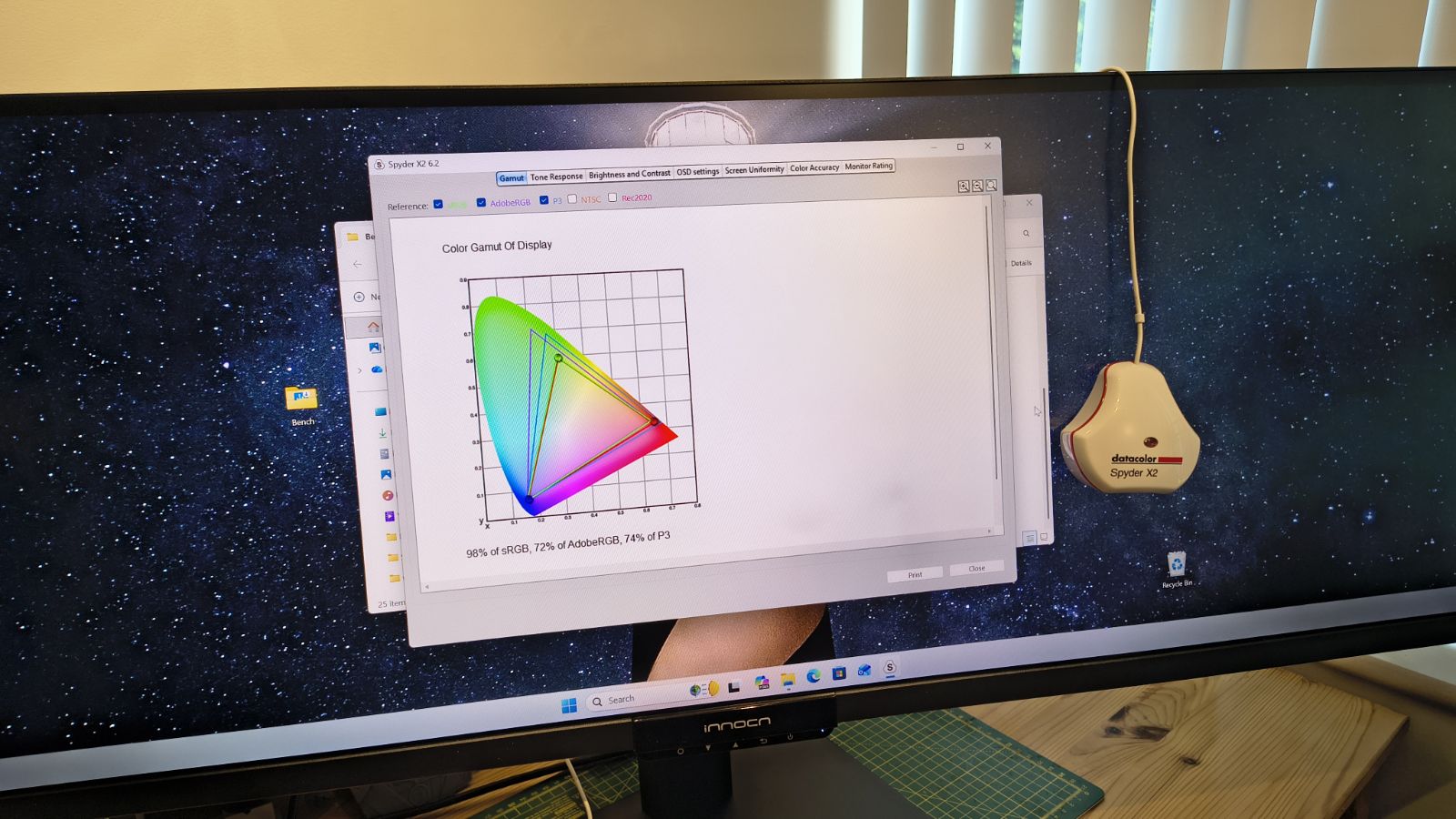
98% sRGB
72% AdobeRGB
Colour Gamut
Percentage
sRGB
98%
AdobeRGB
72%
P3
74%
NTSC
68%
Rec2020
53%
Gamma
1.8
Maximum Brightness
481.5
Maximum Contrast
4180 : 1
This design has a weird dichotomy I’ve never seen before: some of it comes from the design choices, and some from the panel's technology.
But first, let’s talk about what’s good about this screen, because in many respects the positive aspects outweigh the negative ones.
Two aspects are 5/5 in my opinion: color gamut and contrast. Being able to display lots of colours and a decent contrast between the brightest and darkest makes this an extremely readable display, and a punchy chromatic experience. I’m not sure how that fits with the Innocn specification that this is an 8-bit VA panel underneath.
The brightness is also greater than the 450nits that the maker quotes, and typically that number is overstated.
On paper, the E49M1R's performance case rests on three pillars. The first is contrast, delivered by 1760 local dimming zones feeding a VA panel with a quoted 3000:1 native contrast ratio. That is a considerably more granular backlight than the edge-lit arrangements found on cheaper ultrawides, and it should translate into deeper blacks alongside bright highlights in HDR content, rather than the obvious blooming that coarser dimming grids produce.
The second is color. Innocn claims essentially full sRGB coverage, with wide claimed coverage of Adobe RGB and DCI-P3 as well, alongside a Delta E accuracy target below two. Those numbers would put the E49M1R comfortably ahead of most gaming-focused ultrawides for colour-critical work, but it’s more nuanced than that.
While the gamut is great, color accuracy isn’t wonderful, making this design less than ideal for designers working with color. You might be able to tweak settings to improve colour accuracy, but this screen will never compete with an OLED panel.
The third pillar is motion. A 165Hz refresh rate, 2ms overdrive response time, and AMD FreeSync support should keep fast-moving content smooth, though the product page makes no G-Sync compatibility claim, which is worth noting for Nvidia users who rely on that certification.
In conclusion, if you need an ultrawide display for monitoring multiple systems, huge spreadsheets, motion graphics, a flight or racing simulator, then this is an excellent choice.
The lack of accuracy here is an issue for color-critical jobs, but that’s not something most people buy an ultrawide monitor for.
(Image credit: Mark Pickavance)
Performance: 4 / 5
INNOCN E49M1R: Final verdict
On specification alone, the E49M1R makes a compelling case. Innocn has combined a genuinely novel flat panel with a dense Mini LED backlight, a proper 165Hz refresh rate and colour coverage that reaches well beyond sRGB.
For traders, editors, developers and anyone tired of curved screens distorting their straight lines, this looks like the ultrawide the category has been missing.
I do wonder if Innocn has another E49M1 design in development that uses OLED and would address the color accuracy issues I detected, but for now this VA design with Mini LED backlighting is a dramatic improvement over any single-source backlight hardware.
With the hardware available today, the E49M1R could be one of the year's most significant ultrawide launches. And, at less than $1000, this is a huge monitor for a modest asking price. If you don’t need such a high resolution, Innocn also offers the slightly cheaper E49M1G with a 3840 x 1080 resolution and a 144Hz refresh rate.
On a personal note, I’ve been using this panel this week, and having my PC desktop on one side and a mini PC I’m benchmarking on the other makes for a great workflow. Similarly, when I transfer my work from Word to the publishing system, being able to extend my desktop is equally helpful.
While the E49M1R isn’t for everyone, for those who can use its abilities, it's genuinely revolutionary.
(Image credit: Mark Pickavance)
InnoCN GA27S1Q: Report card
Value
When only a company makes something, the price is the price
5 / 5
Design
Massive display with a restrictive stand, but plenty of good features
4 / 5
Performance
Large gamut and incredible contrast, but not color accurate
4 / 5
Total
Easily worth what the maker is asking for an Mini LED this big
4.5 / 5
Should you buy a INNOCN E49M1R?
(Image credit: Mark Pickavance)
Buy it if...
You need screen space Having the equivalent of two 1440p monitors in a single 49-inch wide panel provides plenty of space for multiple apps to share that area comfortably. Yes, you can get the same space or even more with multiple monitors, but this allows you to have them without the separation of a bezel.
You monitor multiple computers Each of the four inputs can be displayed simultaneously, either using PiP or by splitting the screen zonally. This has security and system uses, and you can change the arrangement to give a single or two sources larger displays when needed.
Don’t buy if...
You have limited space A monitor this large needs space to be installed and adjusted for optimal viewing. And not every desk has that much space. If you work with limited space, the E49M1R isn’t for you.
You need colour accuracy While it has a great colour gamut, having plenty of colours doesn’t guarantee that they’re the right ones. And on this design, the colour accuracy isn’t high, so it wouldn’t be suitable for picking the colours for your new spring collection.
Doorbell brands usually sell you the hardware cheap and charge you monthly for the privilege of seeing the footage. Aosu has gone the other way, and for that alone the R1 Ultra is worth your attention.
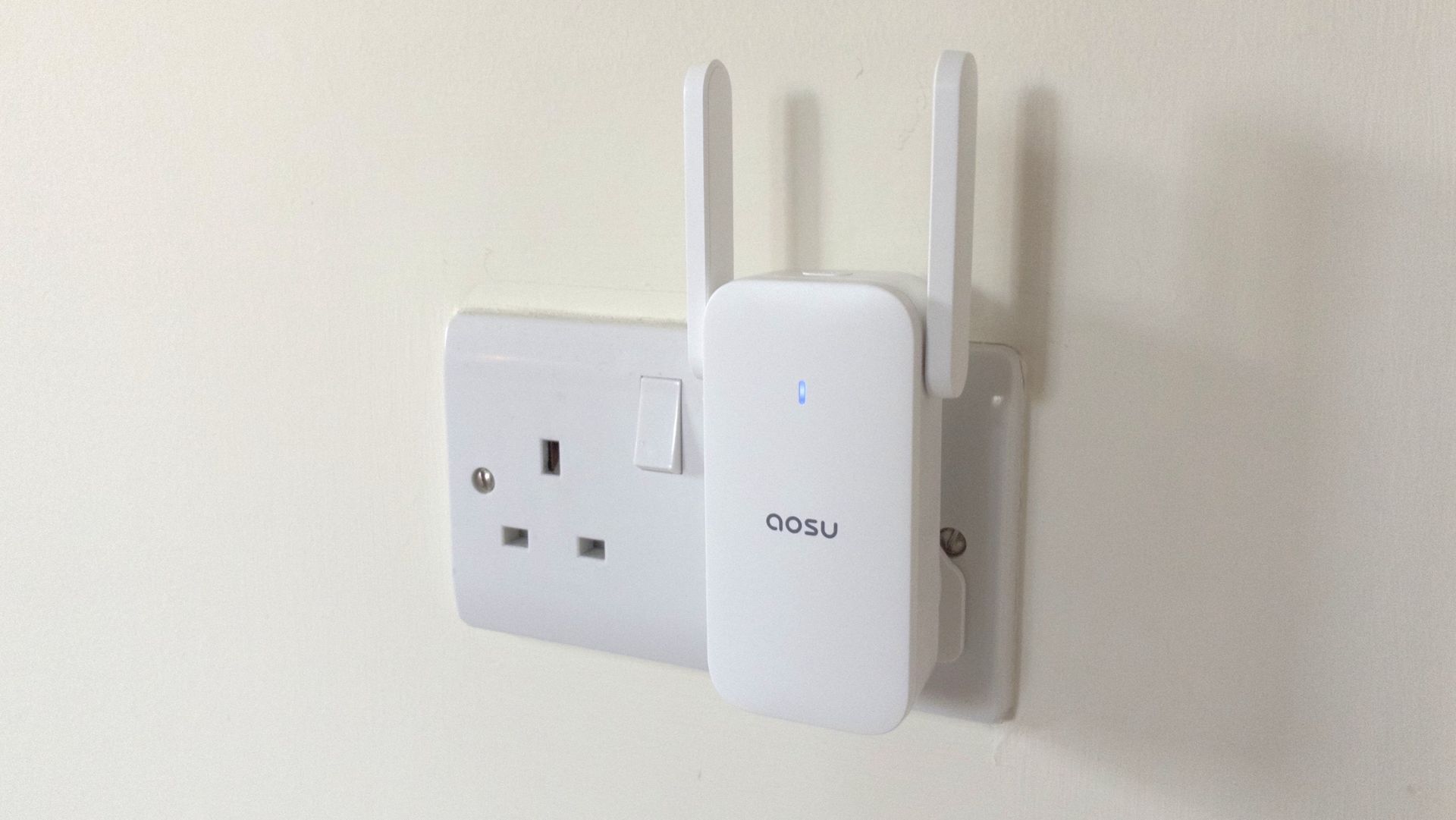
Video clips go to the AosuBase Mini, a small plug-in box that lives inside your house and does three jobs at once — Wi-Fi bridge, indoor chime, and storage. It holds 8GB and keeps a rolling 60 days of footage.
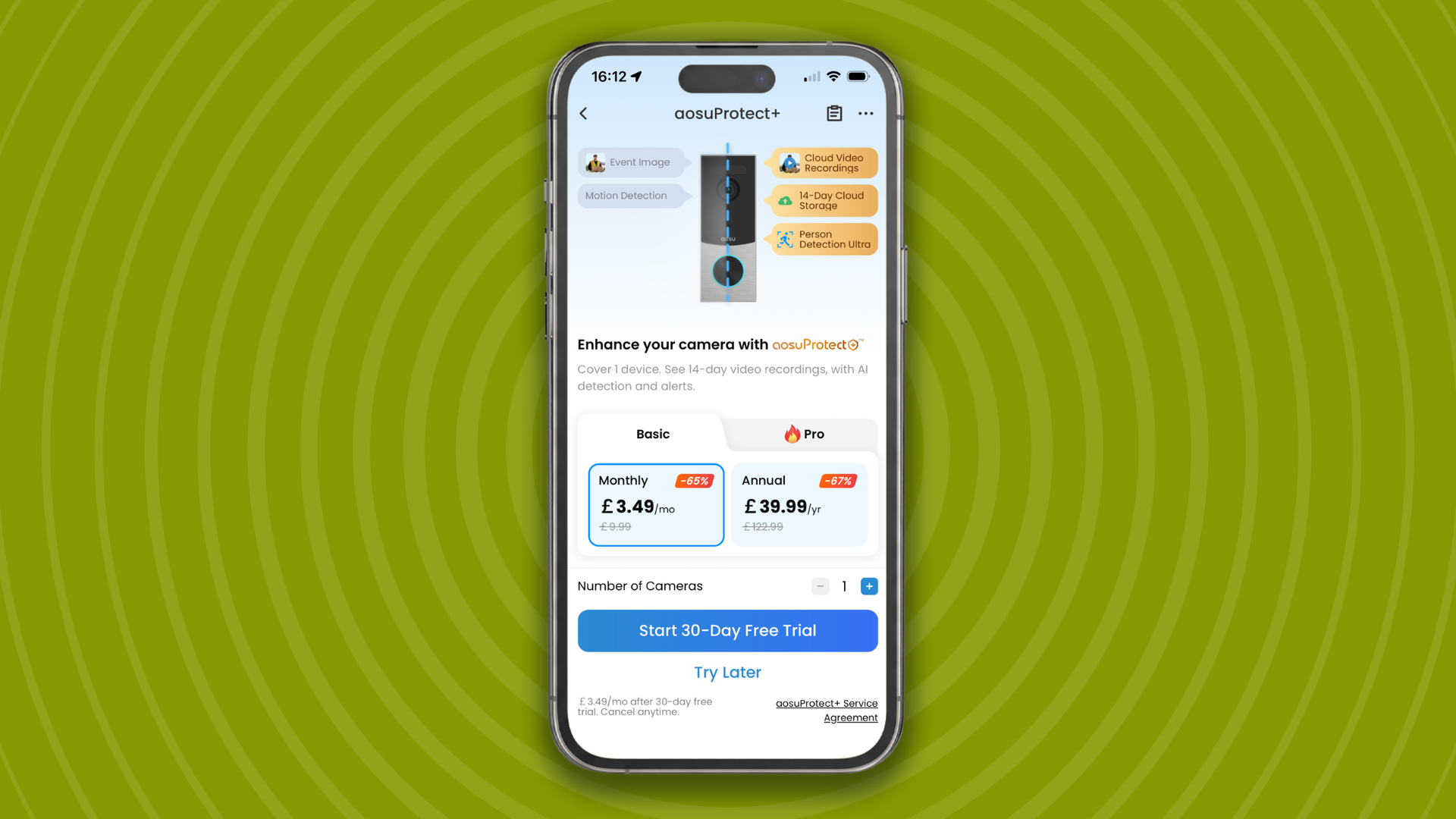
There is an optional cloud subscription, AosuProtect+, but unlike Ring's arrangement, the doorbell isn't hobbled without it. You get alerts, live view, two-way talk, custom detection zones, and full playback for nothing other than the purchase price.
(Image credit: Future)
Detection is another strength. Rather than relying on a passive infrared sensor and hoping, Aosu layers radar and AI human recognition on top, which lets it judge distance and intent — approaching versus passing, lingering versus walking through.
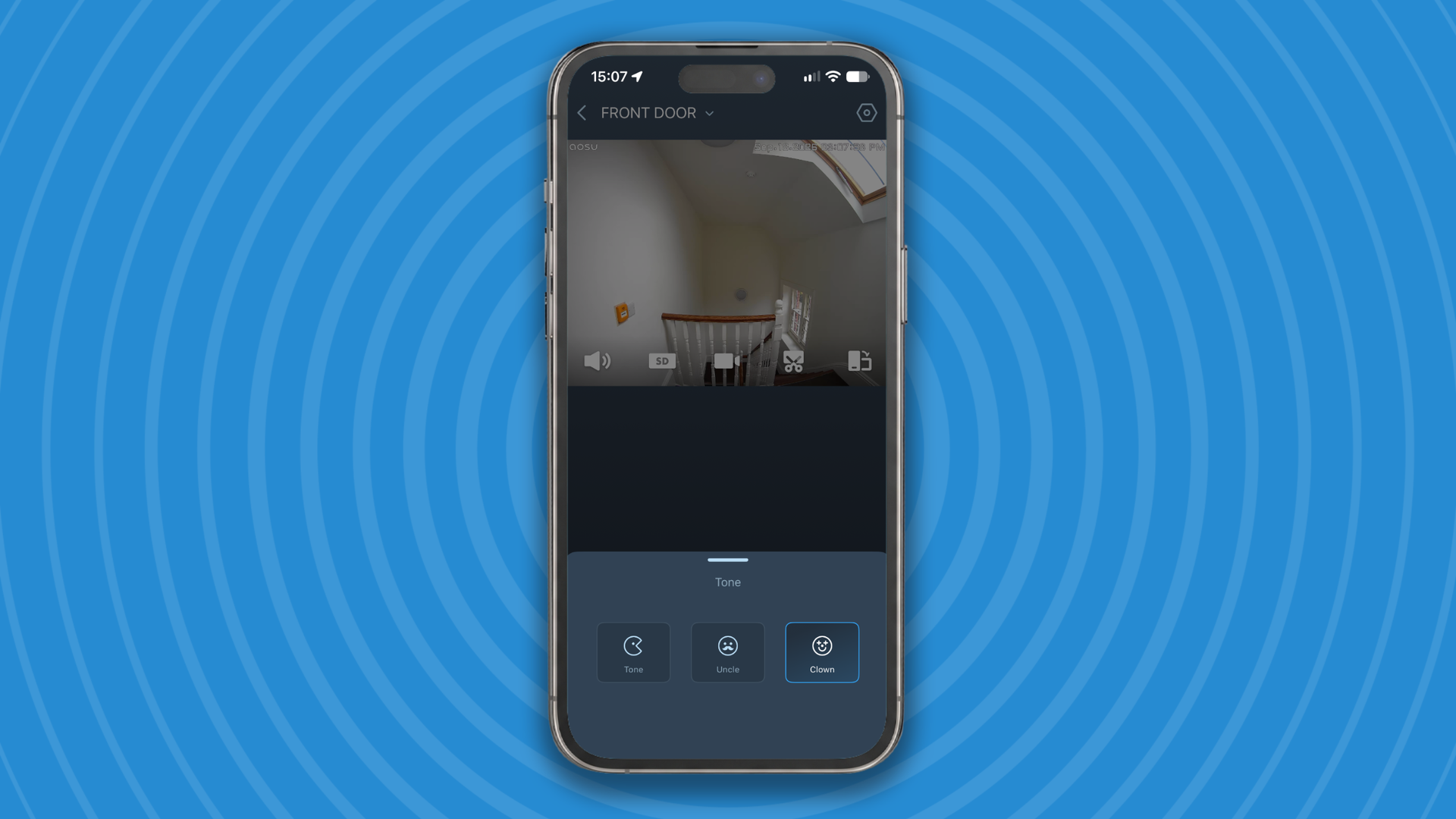
There's also a Tone button hiding in the two-way talk screen. Tap it, and you can answer the door as either 'uncle' or 'clown', with Aosu's straight-faced explanation that this disguises your voice for privacy.
The uncle setting artificially deepens voices, transitioning women and children to something resembling a man to deter would-be intruders. Clown goes all high-pitched and distorted to mask your identity.
(Image credit: Future)
Fortunately, the latter falls on the right side of sinister, so you can forget scaring off trick-or-treaters with imitations of South Park’s Mickey Mouse.
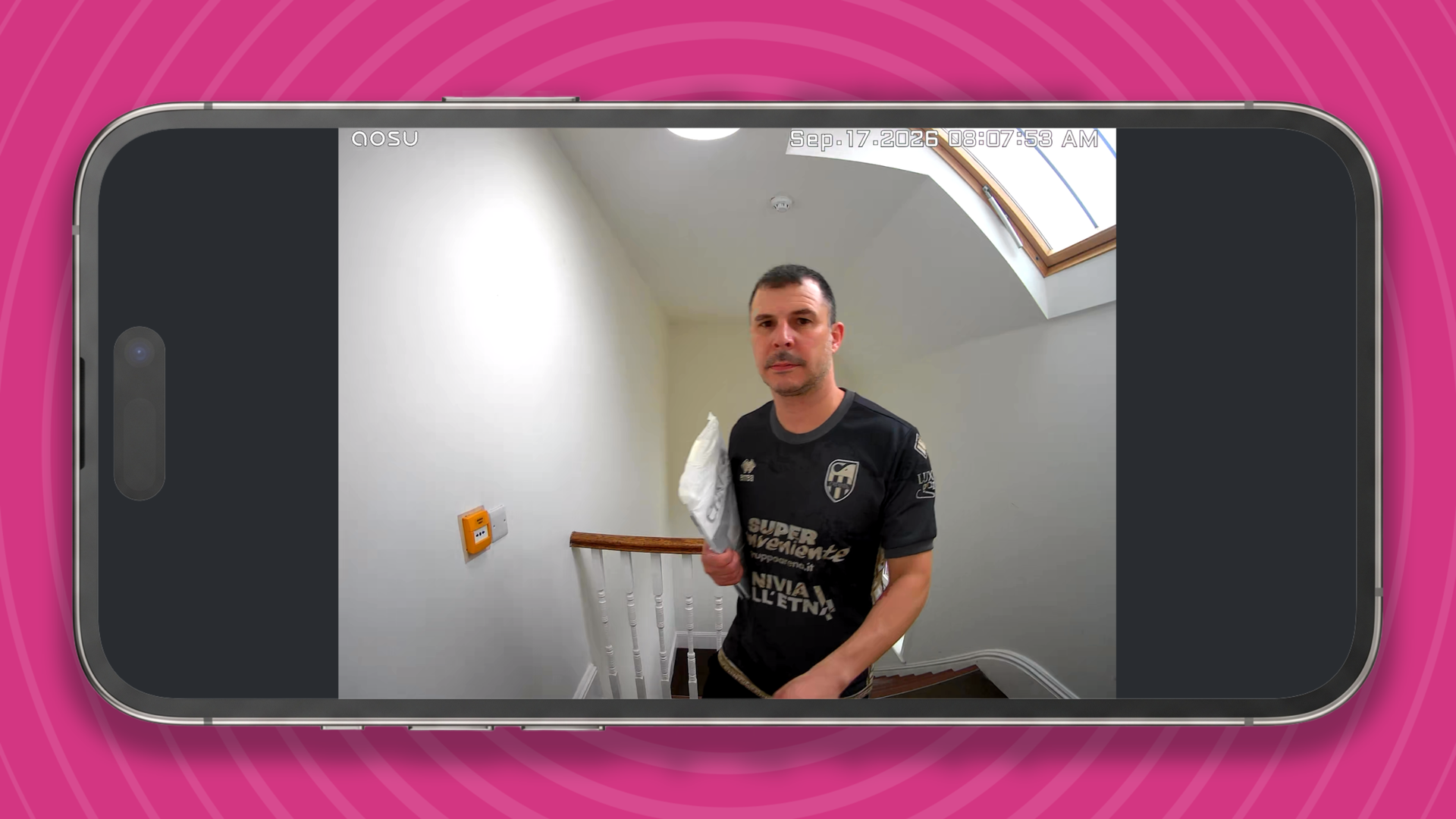
Where Aosu gets ahead of itself is resolution and framing. The sensor is 2560 x 1920, which is 4.9 megapixels in a 4:3 frame. That’s sharp, and a step up from 2K doorbells at this price, but not the claimed ‘UHD’, which would be 3,840 x 2,160.
The asserted 60% improvement over standard 2K only holds if the 2K you're comparing against is Aosu's own 3MP doorbell. An earlier version of the identical claim, on the identical camera, said 40%.
(Image credit: Future)
Field of view should be taken with a pinch of salt, too. Aosu says 166 degrees, but that's the corner-to-corner measurement. In reality, it's 133 horizontal by 103 vertical, shot in a shallow 4:3 aspect ratio and no head-to-toe image tricks.
With realistic use, the battery should last six months between charges. The kicker is the cell isn’t quick-release, and juicing it from flat to full takes six hours. So that means unclipping the entire doorbell and going without it for quite a while.
Aosu Video Doorbell R1 Ultra: price & availability
With a list price of $135.99 / £139.99 (about AU$190), but usually discounted, the R1 Ultra is filed under ‘affordable’ and veers towards bargain territory if you find one hovering around the £100 mark.
At that price, the value case is strong, because the base station is in the box rather than a £50 upsell, and the 60 days of local recording would cost you a subscription almost anywhere else.
Over three years, that's the difference between a hundred pounds and several hundred more.
Value score: 4/5
Aosu Video Doorbell R1 Ultra: subscription costs
The R1 Ultra is fully functional without a subscription. Alerts, live view, two-way talk, detection zones, and 60 days of local playback are all included.
AosuProtect+ is the optional cloud add-on. In the UK, it's advertised at £9.99 (about $10 / AU$20) a month or £122.99 (about $160 / AU$230) a year, currently discounted to £3.49 (about $5 / AU$10) and £39.99 (about $50 / AU$80). Treat the higher figures with the same suspicion as the hardware list price.
The annual price is simply the monthly rate multiplied by twelve, so there's no built-in saving for paying up front, and £3.49 lands within pennies of what Aosu charges in dollars in the US. There’s a 30-day free trial if you wish to dip your toe.
(Image credit: Future)
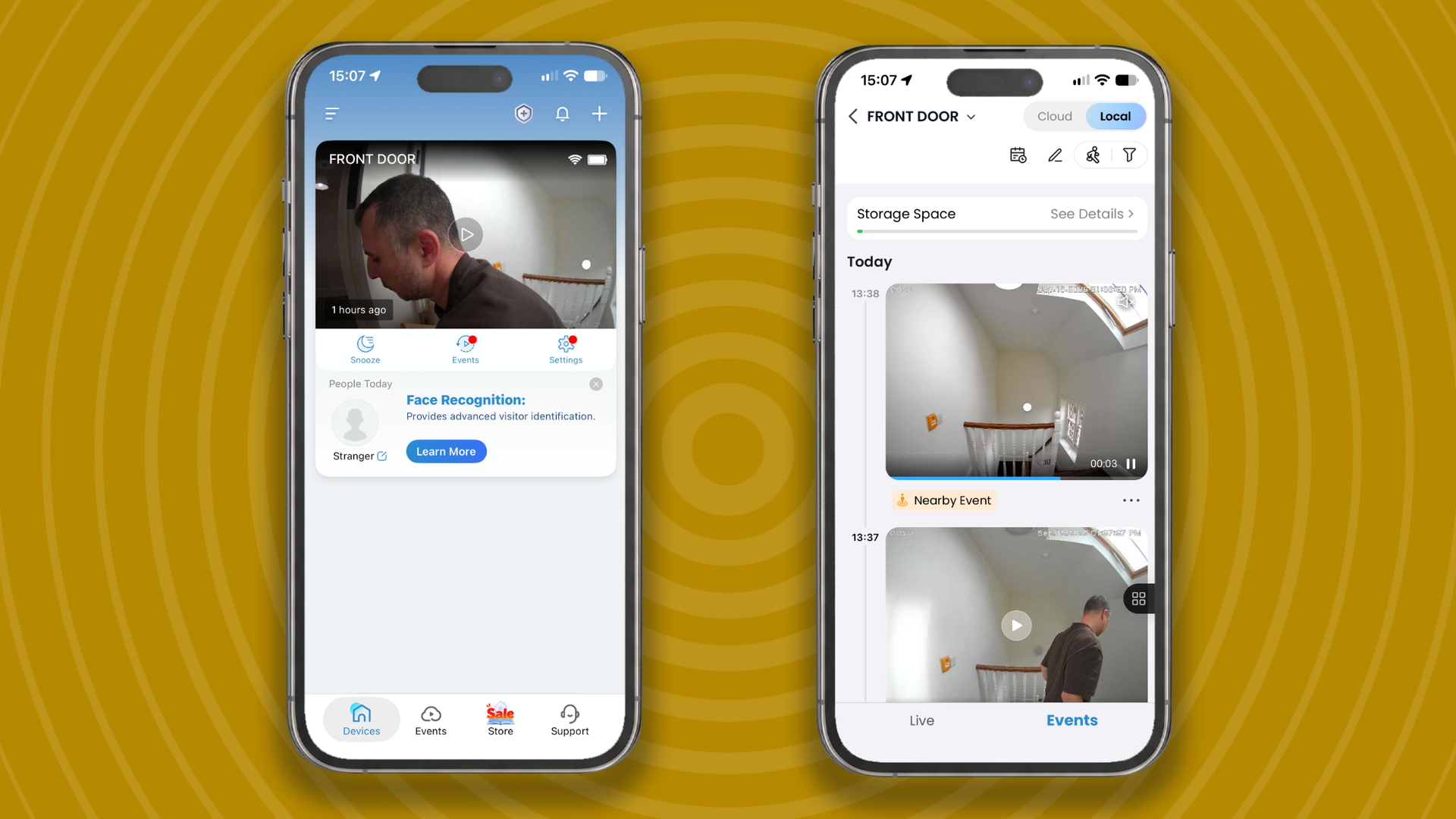
What it buys you is cloud backup rather than capability: 14 or 30 days of event recordings, playback from anywhere, faster scrubbing, and bulk downloads. AI facial recognition sits on the top tier and is offered for video doorbells only.
The argument for paying is that local storage is bound to the base station like Bilbo Baggins is bound to the ring in The Lord of The Rings. If it fails, someone takes it, or you inexplicably drop it in the fires of Mount Doom, your footage dies with it.
Aosu Video Doorbell R1 Ultra: specs
Feature
Specification
Type
Battery-powered or hardwired video doorbell; base station required
Resolution
5MP (2560 x 1920) with WDR
Zoom
6 x digital
View
4:3 aspect ratio
Field of view
166 degrees diagonal [133 x 103 degrees]
Night vision
Infrared up to 6 feet / 10m
Audio
Two-way talk with voice disguise features
Motion detection
Radar, PIR and AI human recognition; customizable zones
Doorbell 2.4GHz only; AosuBase Mini dual-band 2.4GHz / 5GHz
Smart detection
AI human recognition; facial recognition requires AosuProtect+
Storage
Local, 8GB on AosuBase Mini, 60-day loop, no subscription; optional cloud with AosuProtect+
Smart home
Amazon Alexa, Google Assistant
Tamper protection
Pry detection with chime alert; footage retained locally
Weather
IP65
Finish
Black/silver
Dimensions
5 x 2 x 3 inches / 12.7 x 5.1 x 7.6cm
Aosu Video Doorbell R1 Ultra: design and installation
Plain but solid
Hub required indoors
Battery or existing wiring
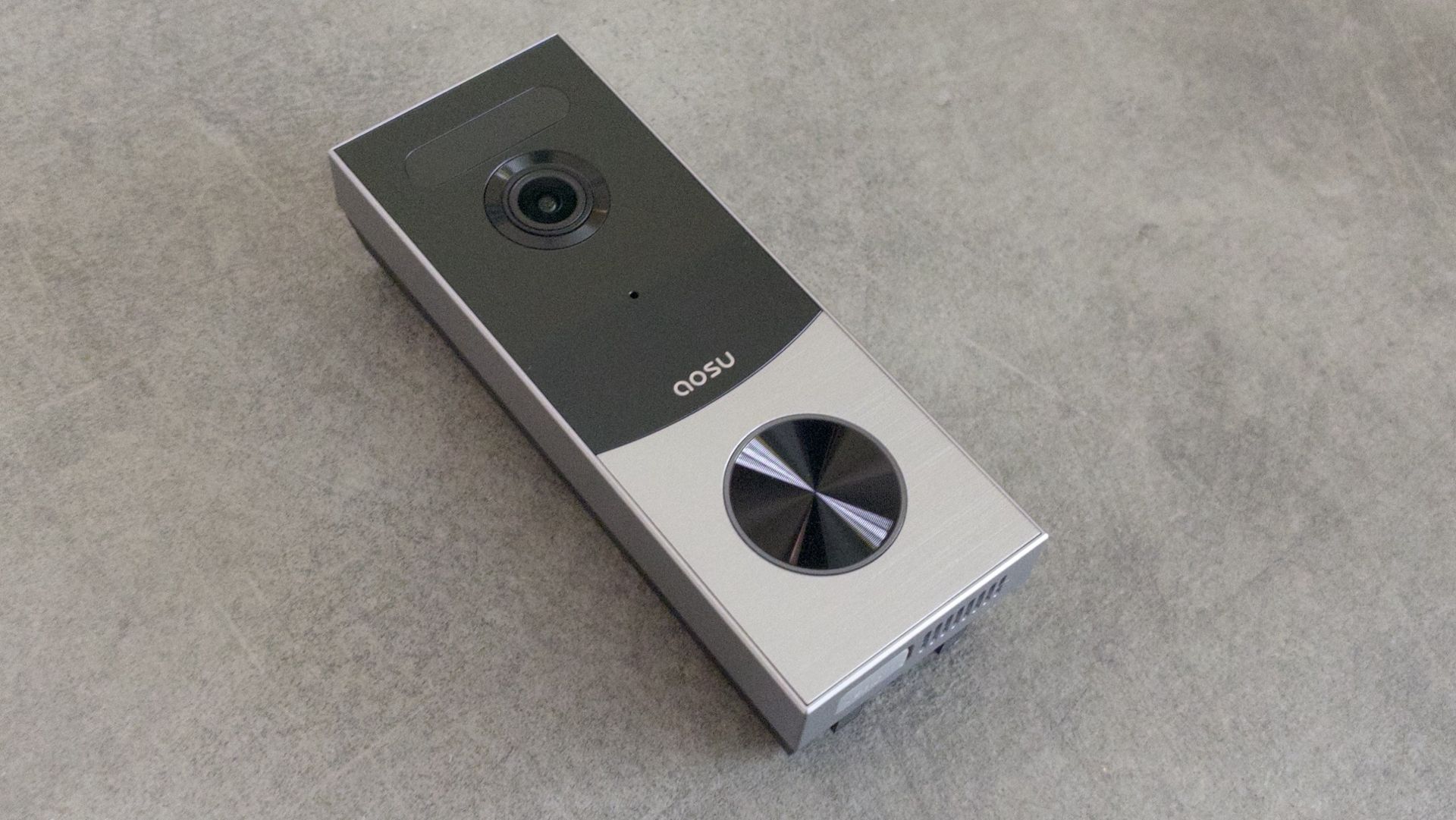
The R1 Ultra is a black plastic slab with silver flourishes similar to a Ring, and very little design ambition beyond flattering imitation.
Installation is straightforward and takes about half an hour all in. Bracket on the wall, doorbell clipped on top, base station plugged in somewhere central.
(Image credit: Future)
Aosu recommends mounting at 4 feet / 1.2 meters rather than eye-level, which is lower than instinct suggests but necessary if you want the frame to reach the doorstep. Worth getting right the first time rather than re-drilling.
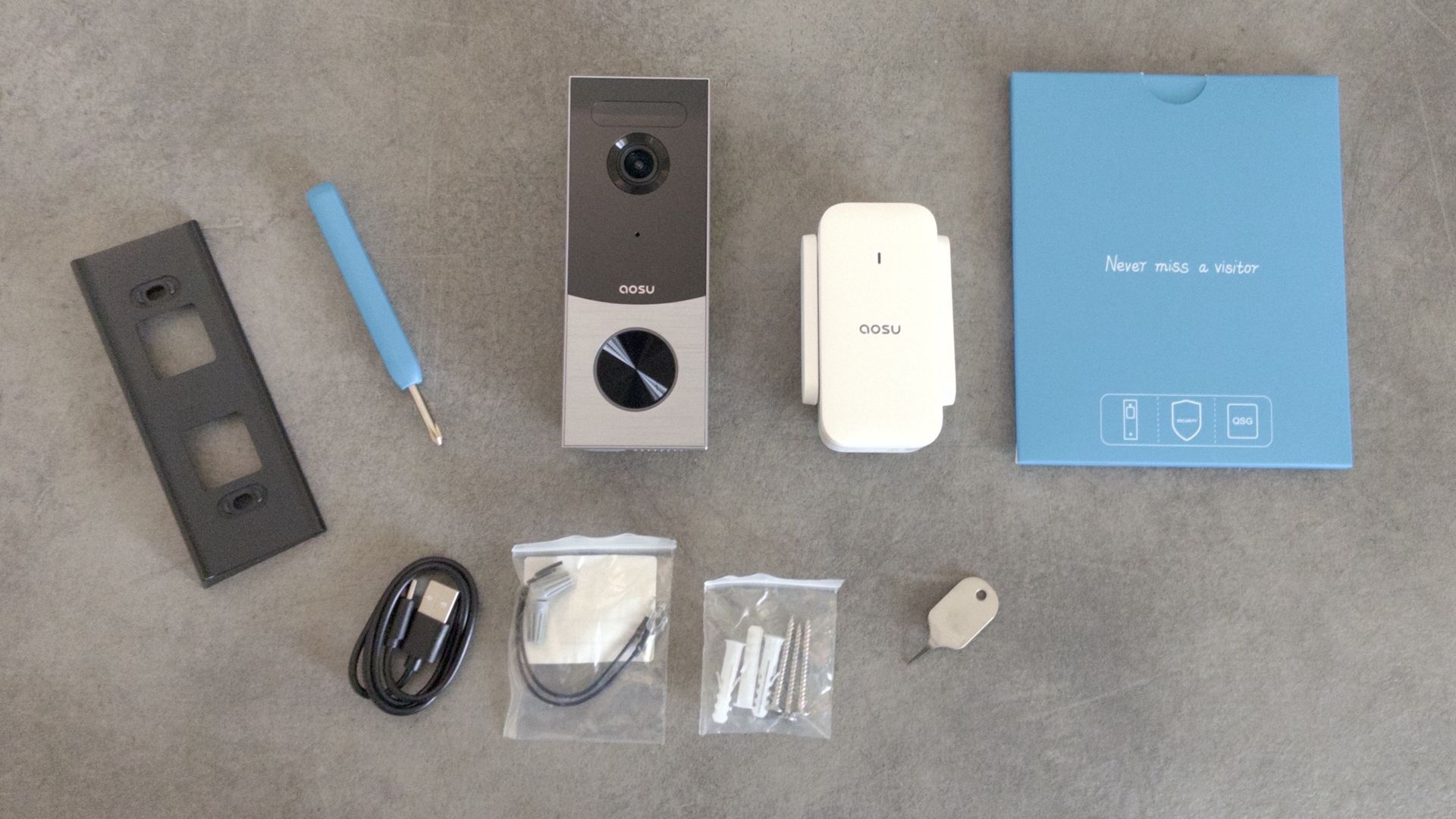
A 15-degree wedge is included if you need to angle it towards a path or a gate, along with a screwdriver, extension wires and wire nuts for anyone hardwiring to existing 8–24V doorbell wiring.
The base station isn't optional, and it isn't outdoors-rated. It's the storage, the chime, and the Wi-Fi bridge in one. It needs a mains socket permanently, and it's rated only to 14°F / −10°C, so it lives in the hall or the cupboard under the stairs and stays there.
(Image credit: Future)
Detaching the whole unit from the wall for a full six-hour recharge via USB-C is a weak point, but a cable is bundled in the box.
A neat addition is pry detection. Try to lever the unit off its bracket, and it sounds a chime and pushes an alert, with footage on the base station indoors rather than on what’s being stolen.
Design score: 3.5/5
Aosu Video Doorbell R1 Ultra: performance
Sharp in daylight
Strong multi-sensor detection
Infrared-only after dark
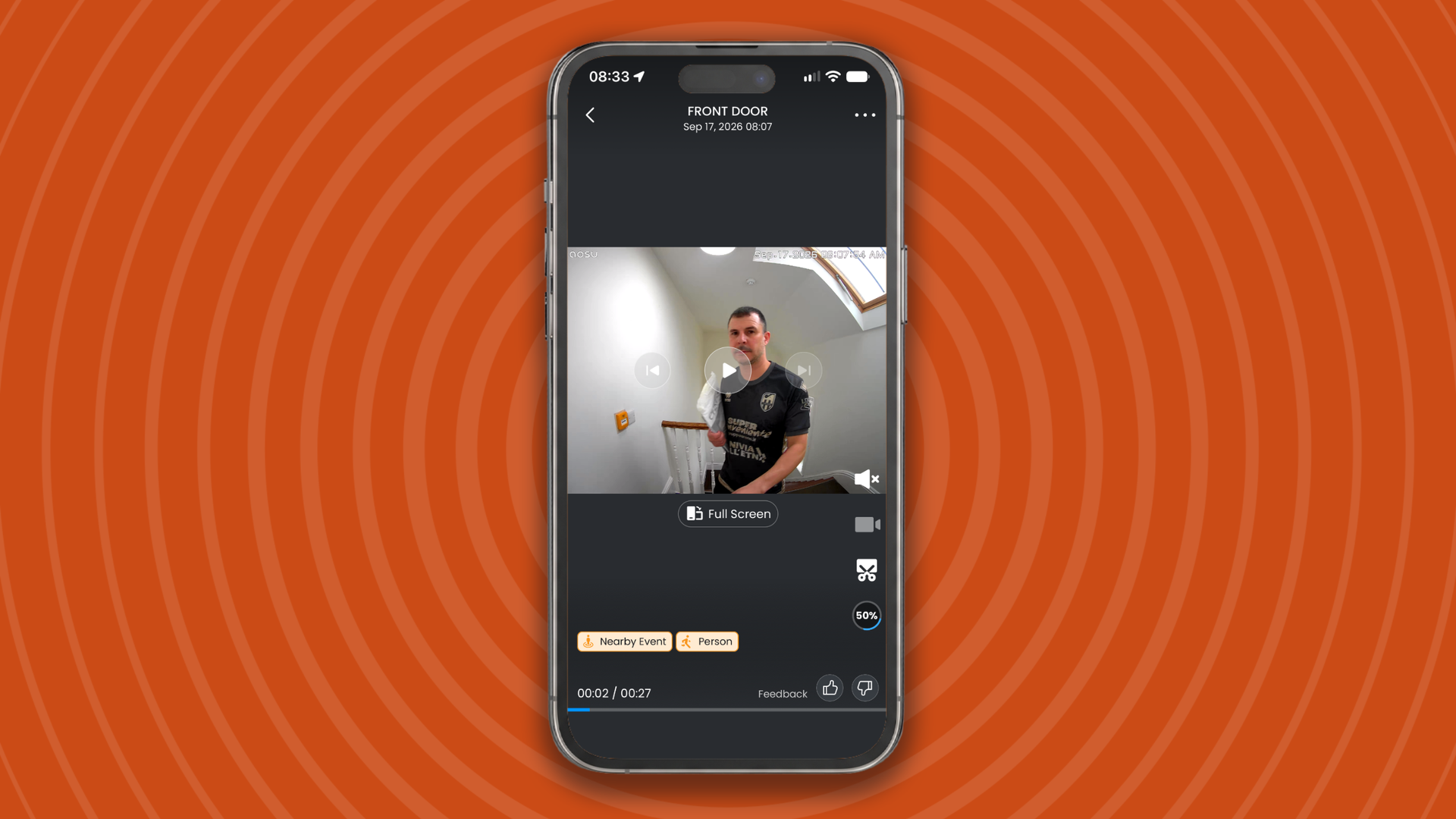
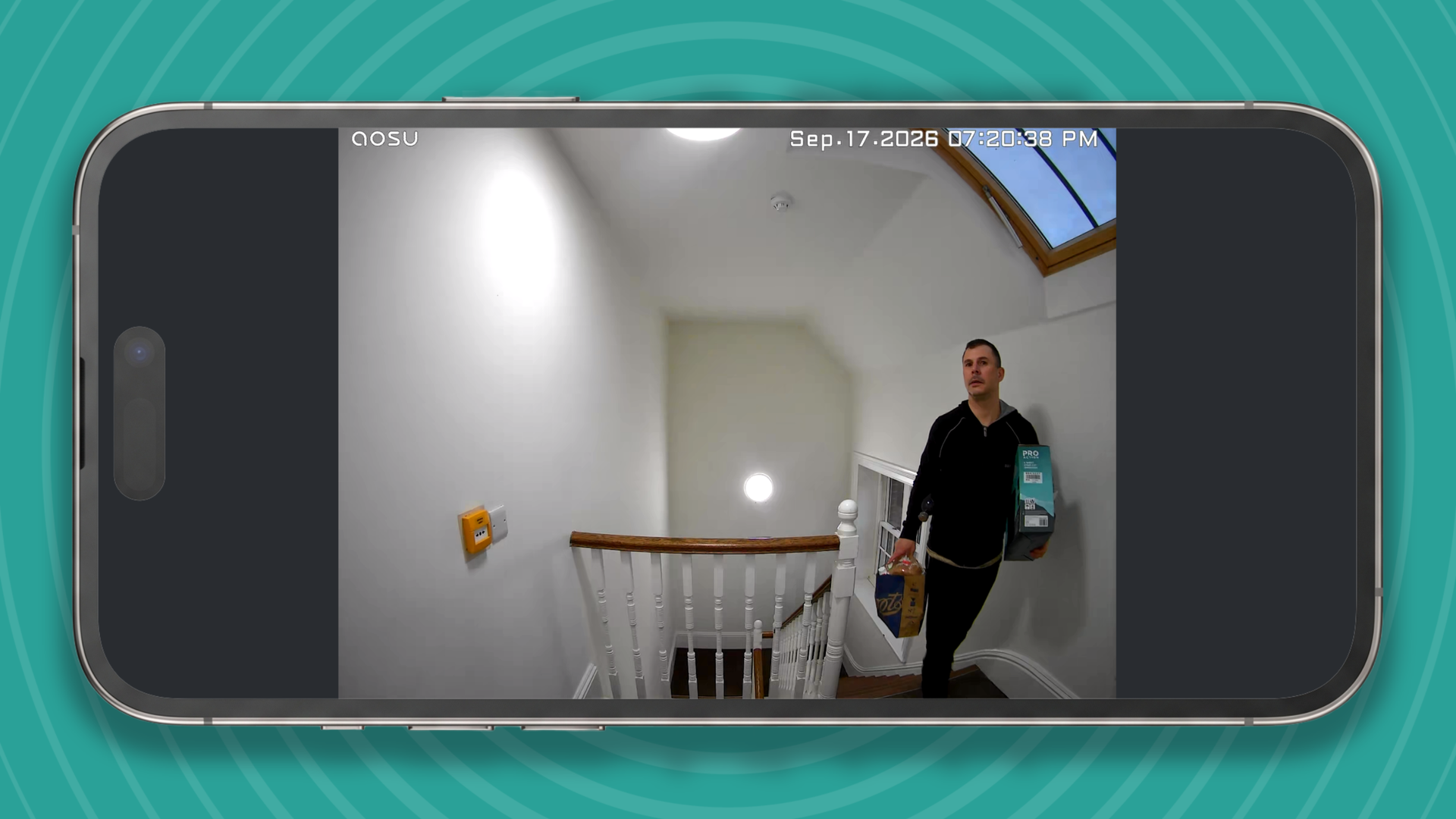
Daylight is this doorbell’s happy place, with 5MP more than most similarly-priced rivals offer. Faces, delivery uniforms and parcel labels are legible rather than merely present.
Radar handles distance and movement, PIR picks up body heat, and the AI layer decides whether what it's looking at is a person. During testing, alerts felt instantaneous once someone reached the door.
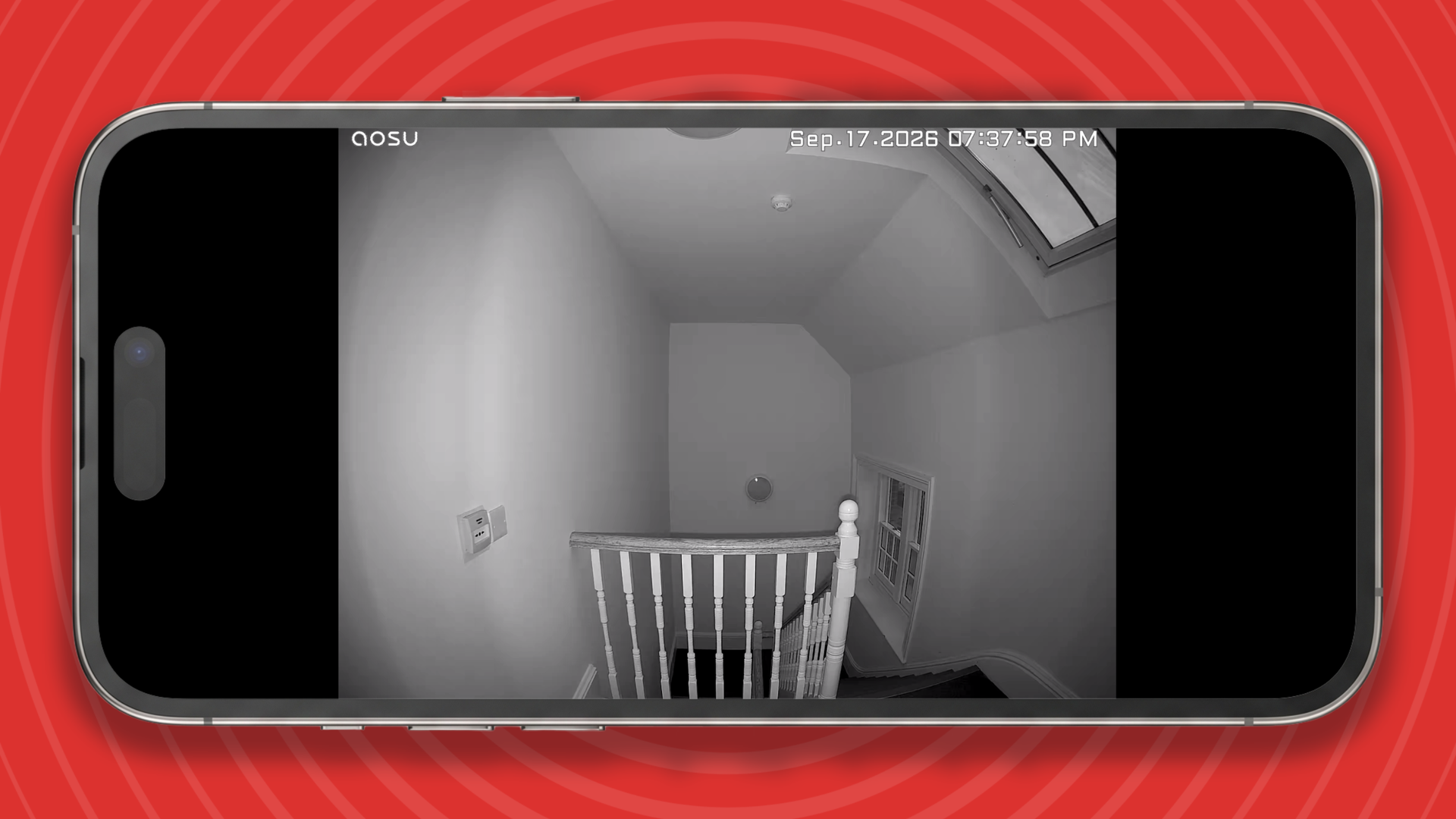
After dark, expectations need managing. There is no color night vision and no spotlight.
FutureFutureFuture
Eight 850nm infrared LEDs offer monochrome up to 33 feet / 10 meters, and the manual warns mounting too close to a side wall will bounce IR back into the lens and fog the image. I’d pair the R1 Ultra with an outdoor light to make up for the shortfall.
Answering the door is well handled. Notifications arrive with a thumbnail of whatever triggered them, so you can tell a courier from a cat without opening the app, and tapping through starts a proper two-way video call rather than a one-way stream.
The 6x digital zoom lets you crop into a face or a label, though at 15fps and with a wide lens, it softens quickly.
FutureFuture
Quick Reply issues an audible preset message when you can't talk. Somewhat boringly, they’re fixed, so you can’t edit the wording or add your own.
On connectivity, the doorbell itself is 2.4GHz only; the dual-band capability belongs to the AosuBase Mini, which talks to your router on 2.4 or 5GHz.
That's a sensible design for a battery device, but it means the camera-to-base link is on the crowded band and placement of the base matters more than usual. Plugged in 33 feet / 10 meters from my front door with the broadband router halfway, all was fine.
Live view includes a UHD/SD toggle to drop the quality when the connection struggles, and you can save a clip or a still straight to your phone's camera roll if you ever need to hand something to a neighbor or the police.
The six-month battery figure assumes up to ten events a day at 20 seconds each — about three-and-a-half minutes of recording daily. On a busy porch with a path or pavement in frame, expect considerably less.
Performance score: 3/5
Should you buy the Aosu Video Doorbell R1 Ultra?
Attribute
Notes
Score
Value
Local storage, included base station, and no monthly fee at around £100 make the maths hard to argue with.
4/5
Design
Solid and easy to install, but the base station needs a permanent socket, and recharging equals doorbell removal.
3.5/5
Performance
Sharp daylight video and excellent multi-sensor detection, let down by infrared-only night vision and overstated specs.
3/5
Buy it if
You're sick of subscriptions
Sixty days of local recording on the included base, with nothing important behind a paywall, is undoubtedly attractive.
You'd rather not be yourself
Uncle and clown voice settings let anyone home alone answer the door sounding like someone else.
You want fewer useless alerts
The radar, PIR, and AI combination is a real step up from the single-sensor budget crowd, and it shows in your notification tray.
You have existing doorbell wiring
Hardwiring to 8–24V takes the recharging problem off the table entirely, and this is one of the cheaper doorbells that supports it.
Don't buy it if
You need to see faces after dark
Infrared monochrome to 33 feet / 10 meters is all you get. There's no spotlight and no color low-light mode, so a night clip tells you someone was there, but not necessarily who.
You don’t want to remove the doorbell
No quick-release battery means every recharge is a six-hour outage with the unit off the wall and on your kitchen counter.
Aosu Video Doorbell R1 Ultra: also consider
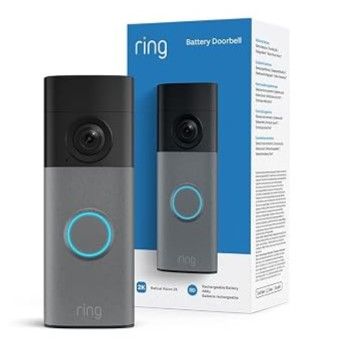
Ring Battery Video Doorbell (2nd Gen)
Cheaper, shoots Retinal 2K with a genuine head-to-toe 1:1 view and color night vision, and installs without a hub. The trade-off is Ring's subscription model and Amazon's data record.
Eufy Video Doorbell C31
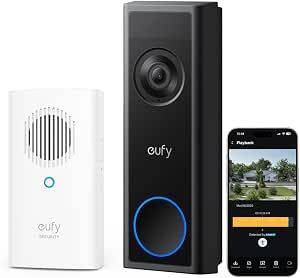
The closest like-for-like on the no-monthly-fee promise, with 2K video and a quick-release battery, though you'll want a HomeBase to get the most from it.
How I tested the Aosu Video Doorbell R1 Ultra
Fitted to a domestic front door
Assessed daylight and infrared video, detection accuracy, and audio
Ran entirely without a subscription
I mounted the R1 Ultra on my own front door and used it as the household's main entry camera for a fortnight, deliberately running it on local storage alone so the no-subscription claim could be tested as most buyers will experience it.
I checked live-view responsiveness and alert latency, reviewed clips in daylight and after dark, and tracked battery drain against Aosu's 180-day claim.
First reviewed September 2026
from Latest from TechRadar https://ift.tt/5CjMzS1
Monzo Business report finds UK SMBs are spending,...
Monzo Business report finds UK SMBs are spending, despite economic headwinds
More than half (56%) of UK SMEs are confident about growth over the next year
Yet businesses are now losing an average 53 minutes every working day on financial admin
Despite the economic headwinds plauging the UK in recent years, new research has claimed the country's small and medium businesses (SMBs) are still willing to splash the cash on new technology.
A report from Monzo Business found spending on software is up 15% over the past year, showing an encouraging upswing in belief across the industry.
Overall, more than half (56%) of SMEs said they were confident about their growth prospects over the next year, and nearly two-thirds (62%) reporting that they plan, or hope to grow their teams over the coming year.
Growth vs admin
Monzo Business' Money Moves Report surveyed a thousand SMBs across the UK, finding businesses are investing in the tools they need to grow.
However challenges remain: almost half (46%) naming rising costs as one of their biggest barriers to growth over the next year, followed by economic uncertainty (33%) and the tax burden (26%).
Financial admin was also revealed as another major headache, with UK SMBs currently spend on average around 53 minutes every working day on tasks such as processing invoices and expenses.
The frustration was clear to see, as nearly half of businesses (49%) said financial admin takes too long, with 39% saying it actively holds their business back from growing. This even stretches to some missing opportunities to invest in tech, equipment or premises (21%), pursuing new markets (20%), and hiring staff (18%).
Overall, nearly two-thirds (63%) of SMBs said simpler financial admin would free up time to focus on the things that matter most to their business, such as strategy, sales and building customer relationships. With extra time, one in three (33%) would pursue new customers or markets, 31% would invest in equipment, technology or premises and 26% would hire new staff.
“Small businesses are confident about the year ahead and thinking about how they can grow," noted Jordan Shwide, General Manager at Monzo Business.
"However, running a business still comes with far too much financial admin, and our research shows that this isn’t simply an inconvenience - it can take time away from growth."
from Latest from TechRadar https://ift.tt/yIZm0kX
Watch Dolphins vs Roosters NRL Preliminary Final ...
Watch Dolphins vs Roosters in the first NRL 2026 preliminary final of the weekend, as the Phins face the side based in the Sydney suburbs for a spot in the Grand Final. In just their fourth year of existence, the Dolphins host the team they played in their first-ever NRL game in 2023, at Suncorp Stadium.
The Dolphins have all the confidence heading into this after beating the Warriors 26-16 in their own backyard in the qualifying final two weeks ago. That win came after a 66-0 humbling by the Sharks in July that had threatened to derail the Phins' season but Kristian Woolf's side are now many people's team to beat. Led by impressive English center Herbie Farnworth and the superb halfback Isaiya Katoa, they have August's 26-12 victory over the Roosters in recent memory, too.
Playing in their 13th Finals Series in the past 14 seasons, the Roosters have all the experience that the Dolphins lack. The side from the Sydney suburbs were last premiership champions in 2019 and James Tedesco, Daniel Tupou, Victor Radley, Angus Crichton and Nat Butcher are all still squad members seven years on, with Crichton back from injury in last week's 46-10 victory over the Sharks. Mark Nawaqanitawase will be desperate to extend his farewell NRL campaign by one more game before switching codes to Japan, while Daly Cherry-Evans moves back to five-eighth after Sam Walker returns at halfback.
Here's how to watch Dolphins vs Roosters from anywhere in the world.
Can you watch Dolphins vs Roosters for free?
Yes! 9Now are showing the Dolphins vs Roosters game for free to those in Australia.
Every game of the NRL finals series is being broadcasted on free Australian streaming service, 9Now. That includes this massive Preliminary final between Dolphins and Roosters.
Use a VPN to watch Dolphins vs Roosters live streams
A VPN is a handy piece of software that can make your device appear as if it's back in your home country, so you can unlock your usual streaming services. The best VPN right now? We recommend NordVPN – it does everything and comes with up to 75% off.
Not having a VPN is like leaving your front door wide open in a busy city – anyone can walk right in and take a peek.
TechRadar regularly reviews all the biggest and best VPN providers and NordVPN is our #1 choice.
✅ Up to 75% off today ✅ 3 extra months free ✅ Unlocks 9Now
Get NordVPN and stream Dolphins vs Roosters live from anywhere.View Deal
How to watch Dolphins vs Roosters live streams in the USA
NRL fans in the US can watch Dolphins vs Roosters in the NRL Preliminary Final 2026 on either FS2 or Fox One.
Dedicated streaming service Fox One costs $19.99 per month after a 3-day FREE trial.
If you want a more comprehensive cable alternative, access to the Fox One app is also available through a Sling TV plan. It comes with the provider's Select ($29.99 a month) and Blue plans ($54.99 a month).
FS2 is carried by several other OTT streaming platforms as well, including YouTube TV and Fubo – both of which offer new customers a free trial.
One further way to watch this and the rest of the 2026 NRL finals is through the dedicated Watch NRL streaming platform. It costs $72 for an NRL Finals Pass that includes all the remaining games.
Outside of the US? Use a VPN whilst you're traveling away from home to unlock your stream.
How to watch Dolphins vs Roosters live streams in Australia
In Australia, the Dolphins vs Roosters preliminary final is on the free-to-air Channel 9 and via the 9Now streaming service.
If you're out of Australia but still want to tune in, explore the VPN route set out above, which will help you access your accounts from anywhere.
How to watch Dolphins vs Roosters live streams in New Zealand
Sky Sport NZ is the NRL rights holder in New Zealand. The action from Brisbane will go out on Sky Sport 1 on TV.
You can access Sky Sport through satellite TV or get a live stream with the Sky Sport Now subscription service starting at $29.99 per day or $59.99 per month.
Overseas?NordVPN will give you access to your home streaming service.
How to watch Dolphins vs Roosters live streams in the UK
Dolphins vs Roosters is being shown on Sky Sports in the UK, via the Sky Sports Mix channel.
Sky Sports plans start from £35 a month or £20 if you're an existing Sky television subscriber. Alternatively, grab a Now Sports subscription from £14.99 a day or £34.99 a month.
NRL obsessives can also watch this and every other game of the season with on the dedicated Watch NRL platform. It costs £57 for the remainder of the season.
Outside the UK right now? Use NordVPN to access your preferred coverage of the NRL Finals Series 2026.
How to watch Dolphins vs Roosters live streams in Canada
Dolphins vs Roosters coverage in the NRL is going out online via Sportsnet in Canada. Log in with your cable details or, of you're a cord cutter, grab a Sportsnet+ streaming service subscription (from $29.99 a month / $249.99 a year).
The Watch NRL platform will also show the fixture – click through for pricing.
If you already subscribe to one of these services but find yourself outside Canada this weekend, download a VPN and watch NRL Preliminary Finals 2026 as if you were back at home.
How to watch Dolphins vs Roosters live streams in Rest of World
Every single match of the 2026 NRL Premiership season, including the Preliminary Finals, will be shown on the dedicated Watch NRL streaming platform, which is available in all territories except for Australia, New Zealand, the Pacific Islands and other selected sanctioned jurisdictions (e.g. Russia, Belarus, Cuba, Iran, North Korea).
Check the website for pricing in your region. Once subscribed, you can stream Watch NRL on phones, tablets, laptops, or the Apple TV app.
Many countries also show games on TV and online through their domestic broadcasters.
What is the Dolphins vs Roosters start time?
Friday, September 25 at 7.50pm AEST local time. That's 5.50am ET in the US, 10.50am BST in the UK.
What are the Dolphins vs Roosters teams?
Dolphins
1. Hamiso Tabuai-Fidow, 2. Jamayne Isaako, 3. Jack Bostock, 4. Herbie Farnworth, 5. Selwyn Cobbo, 6. Kodi Nikorima, 7. Isaiya Katoa, 8. Thomas Flegler, 9. Jeremy Marshall-King, 10. Tom Gilbert, 11. Max Plath, 12. Kulikefu Finefeuiaki, 13. Morgan Knowles
Replacements: 14. Kurt Donoghoe, 15. Ray Stone, 16. Francis Molo, 17. Connelly Lemuelu, 18. Felise Kaufusi, 19. Bradley Schneider
Roosters
1. James Tedesco, 2. Daniel Tupou, 3. Billy Smith, 4. Robert Toia, 5. Mark Nawaquanitawase 6. Daly Cherry-Evans, 7. Sam Walker, 8. Naufahu Whyte, 9. Reece Robson, 10. Lindsay Collins, 11. Salesi Foketi, 12. Siua Wong, 13. Victor Radley
We test and review VPN services in the context of legal recreational uses. For example:1. Accessing a service from another country (subject to the terms and conditions of that service).2. Protecting your online security and strengthening your online privacy when abroad.We do not support or condone the illegal or malicious use of VPN services. Consuming pirated content that is paid-for is neither endorsed nor approved by Future Publishing.










Follow Us
Were this world an endless plain, and by sailing eastward we could for ever reach new distances