At CES 2023 Acer unveiled new models in the Predator Helios range that boast behemoth screen sizes, with the new gaming laptops sitting at 16-inches and 18-inches respectively. The laptop comes equipped with a mini-LED display and a trove of new features and performance updates that are super impressive, but there are bigger things to discuss before we dive into that.
The 18-inch Helios 18 gaming laptop is huge. It doesn’t sound like a lot on paper (as someone who uses the metric system it didn’t mean a lot to me at first) but the 16:10 display is nothing to scoff at.
The bezels are super-thin so you can take full advantage of the big screen whether you're gaming or watching films. It does make you wonder who exactly needs that much screen real estate. While the screen size is a plus if you’re looking to plonk the laptop down on your desk and use it as a desktop replacement, if you’re going to spend $2,500+ on a gaming laptop you might want to consider simply springing for a full desktop setup. The bigger the laptop, the harder it’ll be to carry around with you if you need to.
(Image credit: Future)
New specs as well
Size aside, the Predator Helios 18 is fully loaded with up to 13th-gen Intel Core i9 processor coupled with Nvidia RTX 4000 mobile series, one of the first instances of Lovelace architecture in a laptop. The Helios 18 will come with Nvidia Advanced Optimus, Nvidia’s graphics-switching technology which allows the laptop to switch between integrated graphics to discrete graphics seamlessly, so you won’t have to reboot or suffer through a sudden black screen as that switch happens.
Helios will also introduce an upgraded version of Acer’s PredatorSense, the utility app that will serve as the control centre for the laptop. The per-key RGB backlit keyboard comes with two extra function keys: a PredatorSense key that takes you straight to the app, and a Mode key. The Mode key will swap between different modes such as eco, quiet, balanced, performance and turbo to meet the demands of any given scenario.
A fun little add-on is the customizable thermal deco set on top of the rear exhaust vents, which you can take off and paint to match your vibe. Spray paint, stickers and water transfer printing are all great options if you want to make this massive laptop yours.
Until we can get our hands on the new Predator Helios models, we can only anticipate the kind of performance and power they can achieve. I expect the laptops will live up to the hype and cannot wait to see Nvidia’s new Lovelace GPUs in action in a smaller package.
What is a smartphone release in 2023 without a complementary set of color-co-ordinated, fresh feature-toting set of earbuds? It would be a mistake, that's what – and it's one that OnePlus won't be making with the release of its new OnePlus 11 smartphone, unveiled today (January 4, although the official launch event won't be until February 7, as previously reported).
OnePlus tells us that it's on a "mission to provide high-quality audio through its flagship wireless earbuds", and we applaud the Chinese firm for it. The product? Why, the OnePlus Buds Pro 2, which make their debut alongside the new smartphone. Until now, we've seen only unofficial renders; now, we have the real thing…
How are these 'buds differentiating themselves, and thus seeking to become some of the best earbuds around? They're equipped with sound tailored to fit their users, thanks to a unique partnership with Danish loudspeaker manufacturer, Dynaudio.
“Dynaudio has years of experience producing exceptional sound quality,” said Kinder Liu, President of OnePlus, adding, “It’s a pleasure for us to co-create with Dynaudio, and this partnership helps fulfil our goal of bringing an immersive audio experience to our users.”
And OnePlus is supremely confident that the Buds Pro 2 hold the key to unlocking pure harmony. Built into the buds is a new MelodyBoost dual driver system, a "sophisticated technology derived from premium speakers and co-created with Dynaudio".
The 11mm woofer and 6mm tweeter promise front-row sound using a coaxial dual-driver setup (which means that the drivers share a common, although not exactly the same, axis point – something we loved in the Honor Earbuds 3 Pro and Samsung Galaxy Buds 2 Pro, although it must be noted that these ideas are similar to, rather than identical to, the OnePlus solution).
The dome of the woofer in the OnePlus Buds Pro 2 is equipped with a crystal polymer diaphragm and a separate dome and edge design, which promises to improve the connection between the low-to-mid frequencies and the high frequencies. A silicone edge is introduced to the woofer meanwhile, to enhance the flexibility and texture of the low frequencies.
OnePlus also tells us that the Buds Pro 2 now feature one default equalizer (EQ) and three customized EQs: Bold, Serenade, and Bass. All four of these EQ profiles are co-tuned with Dynaudio.
Analysis: a highly promising design, but the proof of the pudding is in the eating…
The OnePlus Buds Pro 2 will be available in green and black colors, at least…(Image credit: OnePlus)
Too soon after the festive season to talk about pudding? Apologies. What we mean is: until we hear the OnePlus Buds Pro 2 we'll have to reserve judgement, but on paper things look very good indeed.
More details of the earbuds will be unveiled at the OnePlus Cloud 11 Event on February 7, but given how well the June 2022-issue OnePlus Nord Buds performed under intense review, you're right to be interested – we certainly are.
And let's not forget the excellent OnePlus Buds Pro (announced alongside the OnePlus Nord 2 in July 2021), which we called one of our favorite options for under $150 / £140 (around AU$200).
The asking price for the OnePlus Buds Pro 2 hasn't yet been disclosed – and neither has their battery life, noise cancellation perks, color options or wireless charging benefits – but given the news that Apple is reportedly working on cheaper 'AirPods Lite' earbuds, we'd wager that the list price of mid-range 'buds can only be heading one way in 2023.
Given their Pro-suffixed status, we think it unlikely that they'll come in at under $100, so they probably won't feature in our best budget earbuds roundup any time soon – but that's okay, because our best noise-cancelling earbuds guide is ripe for a fresh contender!
How good will they be? Watch this space…
from TechRadar - All the latest technology news https://ift.tt/e3RWDdT
via TechRadar - All the latest technology news https://ift.tt/e3RWDdT
Christmas is over. The giddy days of waking at 10am and starting the morning with a handful of Celebrations and, if you're brave, a small Baileys, are done. It's time to start acting like a responsible adult once again, and that means waking up on time and getting on with things. While it's tricky to neutralise the fundamental pain of waking up when your body does not feel it's appropriate, but there are a few things that might help. We've put together this list of hacks for waking up when it's still dark, but you could also turn your attentions to your alarm tone.
A report from the music and behavioural science experts at Startle has dug into the best and worst iPhone alarms to wake up to. Its ranking is based on the findings of a scientific study into how melody and rhythm can counter the effects of sleep inertia (the tired, groggy, confused feeling you can have when you first wake up).
According to that study, for the perfect alarm is one that:
Has an easy melody you can sing or hum along to
Has a dominant frequency around 500 Hz or in the key of C5
Isn't too fast or too slow (ideally 100-120bpm)
These characteristics help you wake your mind and body up gently but effectively, rather than jolting you awake. According to Luke Cousins, Physiology Regional Lead at Nuffield Health, it's all to do with your reticular activating system (RAS). This is what restricts how your body responds to external stimuli when you're sleeping, and controls how you transition to being awake.
"An alarm clock is designed to stimulate the RAS, telling your body to wake up," he explains. "The jolt of an alarm clock can be especially strong if you’re in the deep sleep phase of sleep, leaving you with an increased heart rate and groggy feeling in the morning that can last several hours."
All of these tones have an easy melody, are played in key C, and a low frequency (400 or 500 Hz). These characteristics help the wake the mind and body gently, making you feel more alert and ready to face the day.
Instead of a consistent melody, these iPhone alarm sounds feature short and sharp bursts of noise. They also have much higher frequencies than recommended based on the study's findings, which means they're more likely to jolt you awake and leave you struggling with sleep inertia.
(Image credit: Getty)
Why is it harder to wake up in the winter?
The relative lack of sunlight hours in the winter means our bodies are producing more melatonin, which is the hormone that makes us feel sleepy. "Allowing light to filter into your room slowly is a great way to signal to your body that it’s time to wake up," says Luke. "In autumn and winter, consider using a sunrise clock which can wake you up gently with light mimicking the rising sun." (Here's our guide to the best wakeup lights for more info plus our recommendations).
There are other factors that come into it too – for example, your genes. "Understanding your genetic chronotype can help you figure out the best time for you to wake up," explains Luke. "If you’re naturally a night owl – it may be easier for you to wake up a bit later and if you’re an early bird, go to bed at a sensible time."
from TechRadar - All the latest technology news https://ift.tt/EHTUCAB
via TechRadar - All the latest technology news https://ift.tt/RC2cPY1
Let’s not mince our words: exercise can be tough. Whether you’re just getting yourself out of bed for a walk in the cold, or you're an extreme athlete with miles under your belt, the temptation to take a day off when things get tiresome is often difficult to shake.
But what if your exercise regime didn’t put you through the wringer? As part of TechRadar's Get Fit for '23 movement, we’re sharing advice on how to maintain sustainable wellbeing goals that don’t come undone at the first sign of trouble – and we’ve roped in a handful of experts to help us do so.
While promoting new Disney Plus show Limitless with Chris Hemsworth, series guest star Ross Edgley – an extreme adventurer, ultra-marathon swimmer, and chart-topping author – revealed his three top tips for improving and maintaining your bodily health and fitness goals throughout the year.
The first piece of advice is simple. “Strength training, in any form,” Edgley tells us. Whether you're doing a YouTube workout with small dumbbells or you're interested in Olympic lifting, "it does not matter," Edgley says. "Just do some strength training.”
“When looking at all modalities – atrophy, sarcopenia, everything – strength training [will help your body], however you do it," he adds. Atrophy refers to the degeneration of cells in your muscles, while sarcopenia refers to the loss of skeletal muscle mass as you get older. According to Edgley, strength training will help reduce the effects of aging on your body, literally keeping you younger and fitter for longer.
If you don't want to start lifting heavy weights, resistance bands could do the trick. They're cheaper, lighter and safer than weights, and you can replicate almost any kind of movement you would do in the gym. For example, by sitting on the floor with one end of the band around your feet, you can pull the band towards you in a rowing motion, which exercises your back and biceps. You can see Edgley and Hemsworth below practicing with the real thing.
Edgley trained Chris Hemsworth for a series of extreme challenges in Disney's Limitless show(Image credit: National Geographic for Disney Plus)
Edgley’s second piece of advice is a little more unconventional. “Think outside of the gym,” he says. “Get hot and cold [in the shower] – 30 seconds on or off. You don't have to swim in an arctic fjord wearing nothing but swim trunks [to feel the benefits of the cold]. I talk about this in the show – we atrophy these ancient, age-old mechanisms that exist in our body. Our ancestors wouldn’t have called a cold shower a cold shower: it would have just been a shower.
“People are in the gym saying, ‘I'm training my legs. I'm training my arms.’ But nobody gets in the gym and goes, ‘I’m training the vasoconstriction of my capillaries. I’m training my immune system.’ And those things can be really valuable.
We atrophy these ancient, age-old mechanisms that exist in our body.
Ross Edgley
“And then three,” Edgley continues, “don’t underestimate the power of Zone 2 aerobic training. Really slow, low-pace exercise. It’s trendy at the moment to do a lot of interval training, because it’s over in 15 minutes and you can burn fat in five minutes – nobody wants to hear, ‘get fit in 45 minutes!’ It’s not a catchy title. But that’s actually what’s going to make the difference – just doing 45 minutes, three times a week with your heart rate at about 120 beats per minute."
Taking things slow is so important, especially if you're just starting out. Doing some light exercise, whether it's a walk around the block or a low-intensity 30 minutes on an under-desk treadmill or exercise bike, is easy and enjoyable. Research says people who enjoy exercise, whether they're grinding hard in the gym or just doing some gentle cycling, are less likely to spend time on the sofa and more likely to exercise again. You have Edgley's permission to take it easy this year!
So there you have it, folks. The three biggest fitness tips you should heed in 2023, according to Edgley – who, by the way, was the first man in history to swim the entire circumference of Great Britain (2,860 km) in just 157 days – are as follows: do plenty of strength training, have cold showers and complete regular low-pace exercise.
After sitting things out last year, LG is back in full force for CES 2023, showing its latest and, according to the company, best OLED TV lineup yet. The big attention-grabber among LG’s CES announcements is a Brightness Booster Max feature for its G3 “gallery” line that ups peak light output 70% over conventional OLED models, something it achieves using a combination of hardware design and a light boosting algorithm.
Starting from the top, the new OLED lineup consists of the flagship Z3 (8K) and G3 series, the mid-range C3 series, and the entry level B3 series. (The A series, LG’s previous entry level, has been axed from the company’s 2023 OLED line.)
The Z3, G3, and C3 sets will all have OLED Dynamic Tone Mapping Pro, a new feature that intelligently distributes brightness and color mapping over 20 blocks. They will also have the new HDR Expression Enhancer, a feature that provides object-based tone mapping, along with object-based sharpness enhancing. AI Super Upscaling with genre and scene detection will be found across all models, which are specced for 100% DCI-P3 color volume coverage.
LG’s AI-based picture improving sorcery is the result of new processors found throughout the lineup, with the G3 and C3 sets getting the a9 AI processor 4K Gen6 (a9 AI processor 8K Gen6 on the Z3), and the B3 getting the a7 AI processor 4K Gen6.
All of the new OLEDs for 2023 are fully specced for gaming and feature 120Hz, VRR, FreeSync Premium, and Nvidia G-Sync. The top three series all come with four HDMI 2.1 ports, while the B2 series will have two HDMI 2.1 ports. LG's 2023 OLEDs are also the first TV to be certified for Quick Media Switching VRR (QMS-VRR), a feature that eliminates the 'black screen" that occurs when switching between different HDMI-connected sources.
Z3 and G3 models will additionally be outfitted with an ATSC 3.0 tuner for pulling in over-the-air next-gen digital broadcasts in the US.
LG’s G3 and C3 models will be lighter than their predecessors owing to a composite fiber material used for the panel housing. The decor-friendly G3 models will also feature a new Zero Gap design that LG says will allow the TV to be “perfectly harmonized with the wall to become one with it.”
Audio features, too, get an upgrade in LG’s 2023 OLED TVs. A WOW Orchestra feature allows for smooth integration between an LG soundbar and the TV’s built-in speakers, while a WOW Interface lets viewers configure soundbar audio settings on the TV’s screen. As we had predicted for LG’s next generation of OLEDs, the TVs will be capable of making a wireless lossless audio connection with the company’s soundbars, a feature LG calls WOW Cast.
LG’s C series models will further be getting an optional bracket designed to mount a soundbar beneath the set’s screen when it’s wall-mounted.
webOS: the next generation
The webOS smart TV interface will be seeing a number of changes on LG’s TVs for 2023. LG’s Home hub shows recommended content for individual profiles, which can now be customized with avatars. Support for the Matter smart home standard is being added, and an optional LG smart cam accessory will be available to work with fitness and other lifestyle apps.
Built-in mics for hands-free voice control is a new feature for 2023 (Z, G, and C series models) and LG’s multi-view feature is being enhanced to support inputs from multiple HDMI sources.
Setup features in the new TVs will include a personalized Picture Wizard that uses AI deep learning technology to learn your preferences. This will involve six steps where you select aspects of different onscreen images, and the TV will then analyze that information and apply it to picture presets.
Z3 Series
77-, 88-inch
a9 AI processor 8K Gen6
ATSC 3.0 tuner
5-year super warranty
G3 Series
55-, 65-, 77-, and 83-inch (97-inch G2 carries over from 2022)
a9 AI processor 4K Gen6
Brightness Booster Max
Zero Gap design
Composite fiber material
ATSC 3.0 tuner
5-year super warranty
C3 Series
42-, 48-, 55-, 65-, 77-, 83-inch
a9 AI processor 4K Gen6
Brightness Booster (55-, 65-, 77-, 83-inch)
Composite fiber material
B3: 55-, 65-, 77-inch
a7 AI processor 4K Gen6
B3 Series
55-, 65-, 77-inch
a7 AI processor 4K Gen6
Check out all of TechRadar's CES 2023 coverage. We're bringing you all the breaking tech news and launches, everything from 8K TVs and foldable displays to new phones, laptops and smart home gadgets.
from TechRadar - All the latest technology news https://ift.tt/icJ07Xk
One of the best exercises you can do for your legs and core is absolutely free, requires no equipment, and can be done while watching TV at...
One of the best exercises you can do for your legs and core is absolutely free, requires no equipment, and can be done while watching TV at home. What’s more, there’s no movement involved, you're not adding any extra weight, and there's no impact on your joints. This makes it perfect for beginner exercisers, seniors, and those with joint problems preventing them from doing other forms of exercise.
The wall sit is a great exercise, and very underrated in my book. People often use it in the lead-up to a skiing holiday, as it prepares your legs and glutes to adopt that crouching posture. I made great use of it during COVID, when all the gyms were closed and I was getting bored repping out bodyweight squats, so I started doing a daily wall-sit challenge: four sets of one-minute holds every day for two weeks.
It ended up making my core and legs way stronger as a result, and although you don't have to do the full four minutes a day, as I did, a week of wall sits would make for a perfect way to kick off your Get Fit for '23 fitness journey.
Wall sits are part of a family of moves called "isometric" exercises. Isometric moves are workouts that don't involve any movement: instead, you hold challenging poses to induce tension in your muscles. For example, you might hold a plank position to train your abs. In one study published in the International Journal of Sports Medicine, isometric exercises like this were found to be beneficial in improving muscle strength in people with limited mobility, perhaps even more so than traditional “dynamic” strength training.
Because it doesn’t involve your knees and hips moving at all, has no need to add extra weight onto your back, and doesn’t involve your feet impacting the floor in the way running or jumping exercises might, it’s incredibly forgiving and a great way to get started. However, it's still a tough workout, and although you might not be racking up any steps on your best fitness tracker, you'll probably still be able to see your heart rate spike after a few sets.
To get started, simply lean your back against a wall and slide down. Your feet should be out in front of you, shoulder-width apart, and your thighs should be parallel to the floor. Keep your shoulders touching the wall, and look straight ahead. The TV makes an excellent focal point (and a welcome distraction).
(Image credit: Shutterstock)
Now, here’s the tricky bit: you have to hold the position for a specific amount of time. If you’ve never tried this before, or are very new to strength training, 15-30 seconds might be an achievable goal for you. Once you get into this position, it’s quite fiddly to play with your phone and get the timer set up, so I just used the Amazon Echo Dot in my living room to ask Alexa to set a one-minute timer. Then you just hold the position for the required amount of time.
Easier said than done. Very quickly, your quads, glutes, and hamstrings are going to light up. For an added benefit, make sure you’re looking straight ahead, put your hands behind your head or extend them out in front of you, suck in your stomach slightly, and tense your abdominal muscles.
I’m not going to lie to you, it sucks. Every time I heard Alexa’s dulcet tones say “okay, one minute, starting now,” I found myself gritting my teeth in anticipation of the tough time ahead of me. The soft alarm sound at the end of that minute was a lifeline, but it felt like it took forever to get there. It had gotten to the point where I began to dislike Alexa’s voice, because I associated it with those gritty wall sits.
However, it’s still far more effective than fiddling with a timer and hurrying to assume the position, and any little hack that removes a barrier to exercise, no matter how small, is a win in my book. I found it's much easier to set timers with a simple voice command.
(Image credit: Shutterstock)
Once I was back in the gym, I found I hadn’t lost much strength in my legs and glute even after my long absence from the squat rack. All those wall sits also augmented my running: research published in the journal Medicine & Science in Sports & Exercise suggests stronger glutes and quads are a factor in top running speed. A strong core helps maintain good running posture too.
Whether it was a coincidence or not, I hit a personal half-marathon best after training with this unconventional, underrated method at home. Now I'm training for a full marathon, which takes place in April 2023, I'll be adding the wall-sit back into my regular fitness routine.
If you’re ever thinking you should really be doing some exercise while watching Netflix at home, try three sets of 30-second wall sits to get you started. Just don’t blame me if you begin to resent your smart speaker afterward.
First published: May 2022.
from TechRadar - All the latest technology news https://ift.tt/COQc4Jg
Welcome to TechRadar’s Get Fit for ‘23! All week long, we’ll be publishing insightful stories and helpful articles designed to provide you ...
Welcome to TechRadar’s Get Fit for ‘23! All week long, we’ll be publishing insightful stories and helpful articles designed to provide you with information and support to help you hit your health and fitness goals this year. If you spot a story with a green badge on it, like the one above, you'll know it’s full of advice to make sure you have a healthy, happy 2023.
If you have a health, wellness or fitness goal this year, we can help you take those crucial first steps. It doesn’t matter whether you want to run your first 5K, eat more healthily, smash a big fitness milestone or even spend less time on your phone – this week is for you.
What is Get Fit for ‘23?
Get Fit For ‘23 is a series of articles designed to help you make small, sustainable changes to your life which can help you stay healthy all year. This is not an initiative to help you lose a certain amount of weight, or hit an unachievable milestone in a very short time: this is all about small changes leading to an overall healthier life.
Research from the International Journal of Environmental Research and Public Health suggests most of us will quit our New Year’s Resolutions after just 17.8 days, and that’s why we’re doing this – to help you beat the odds. And of course, we take the time to highlight the tech which can help you along the way.
What's on the way this week?
We’ve tapped some of the most knowledgeable health and fitness professionals in the industry to help you hit your goals. Every morning, you can log onto TechRadar and find some great content designed to make you healthier and happier.
First up, our phones team has put together a comprehensive guide on how to spend less time on your phone this year, helping you use your devices rather than the other way around, and avoiding the trap of you becoming glued to social media.
However, later on this week, you can expect to find expert advice on a whole variety of topics:
Tips on exercise from Ross Edgley, an expert athlete, adventurer and co-star in the series Limitless with Chris Hemsworth
A guide on how to use the best air fryers to help you whip up some healthy, tasty recipes you'll want to eat all year
Running for beginners by legendary ultra-marathoner Scott Jurek
Yoga tips from Apple Fitness+ yoga instructor Jessica Skye
How to use free guided audio workouts to help you hit your fitness goals
Reasons and cheap ways to get into new hobbies this year, like cycling and outdoor photography
And that's just a taster: there's even more to come. We’ve taken great care to ensure these articles are accessible and helpful for everyone, whether you’re just starting out or you’re a seasoned exerciser hoping to try something new this year.
Get ready to have an amazing year. It's time to Get Fit for '23!
from TechRadar - All the latest technology news https://ift.tt/u73p2f1
via TechRadar - All the latest technology news https://ift.tt/u73p2f1
We know that the OnePlus 11 is getting a grand unveiling in China on January 4, with a global launch event scheduled for February 7. In the meantime though we've heard almost everything about the phone from official and unofficial sources.
Starting with the official news, the OnePlus Weibo feed (via Notebookcheck) continues to push out nuggets of information: it's teasing a "Bionic Motor" system for advanced haptics, and a "Picture Quality Engine" to boost frame rates on the phone display.
We also have confirmation of 100W super-fast charging from OnePlus itself, and a mention of a 5,000 mAh battery. OnePlus has also been showing off a dual port charger with both USB TypeA and Type-C ports – possibly indicating there will be no charger in the box.
Specs and design
As for the unofficial rumors and leaks, it's difficult to keep track of everything at this stage. A regulatory filing in China (via Android Police) has listed the phone as having a 6.7-inch, 120 Hz AMOLED screen with a 3126 x 1440 pixel resolution, and a Snapdragon 8 Gen 2 processor keeping everything running.
There's going to be 12GB or 16GB of RAM, and 256GB or 512GB of internal storage. As for the rear camera, we're expecting a triple-lens 50MP+48MP+32MP setup with 2x optical zoom. The front-facing camera is listed as a single-lens 16MP module.
Meanwhile over at 91mobiles we've got some real world shots of the OnePlus 11 in the hand, while tipster Abhishek Yadav has also shared multiple renders of the handset on Twitter – these go alongside the actual promo pictures that OnePlus itself has put out.
Analysis: a strong start to 2023
The OnePlus 11 is going to be the first flagship phone to get its unveiling this year, and the signs look promising: it comes with just about everything you would want in a high-end handset for 2023, from the cameras to the internal processor.
We've got the Snapdragon 8 Gen 2 processor from Qualcomm under the hood, which is expected to power a lot of premium-level Android handsets during the course of the year – it's going to be the fastest chipset option for Android manufacturers for quite some time.
There are generous portions of RAM and internal storage here, and – from the specs listing at least – the rear camera module sounds promising (and Hasselblad is once again involved). The screen sounds suitably high-end as well.
Of course we can't really judge a smartphone until we've actually tested it, but from what we know so far, it seems the OnePlus 11 is going to combine all the right ingredients. It has a strong chance of being one of the best phones we see in 2023.
Goodbye, 2022 - and hello to the shiny new world of 2023! Granted, it doesn't look much different yet, but then we are only a few hours into the new year.
So, what were our tech highlights of the past 12 months - and what can we expect to see in 2023? In short: lots. Virtually every week brought a massive new product launch or big story in one of the categories we cover, from the iPhone 14 Pro's Dynamic Island to the arrival of QD-OLED screen tech in TVs, and from ever-more-powerful graphics cards to AI-powered autofocus in cameras. And 2023 promises to be every bit as exciting, beginning right away with the tech fest that is CES 2023.
If you're subscribed to TechRadar's newsletters you'll already have seen this round up appear in your inbox in the shape of our Year in Review; if you haven't subscribed yet – well there's your new year resolution for 2022…
So, without further ado, read on for our 2022 highlights and 2023 predictions.
Phones
Fantastic foldables, and a fuss about Nothing
The Samsung Galaxy Z Fold 4 was one of the smartphone highlights of 2022(Image credit: Future)
(Image credit: Future)
2022 didn't see any great leaps forward in the smartphone space writes Lance Ulanoff, US Editor-in-Chief. We mostly got more of everything – better cameras, brighter screens, and incremental improvements in performance and battery life. But there were some innovations that made the year's best new phones significantly more interesting than what came before.
Apple officially split its handset line down the middle, finally putting the flagship model in a lower tier with slightly less-than screen technology. We’ve had better cameras on the Pro line for a while, but the iPhone 14 line pushes the distinction between Pro (premium) and regular (good enough for most) further. What this means is that the iPhone 14 and iPhone 14 Plus kept legacy screen technology (the notch!), while the iPhone 14 Pro and iPhone 14 Pro Max got the fungible Dynamic Island, which I love. Apple was also one of the first, in the US market at least, to do away with the physical SIM slot in favor of an eSIM-only setup.
While Apple reached for the stars with the first satellite SOS system on a consumer smartphone, Samsung might be offering the more fully-rounded set of updates across its handset line. It remains firmly committed to the foldable space and, while the Galaxy Z Fold 4 and Galaxy Z Flip 4 weren’t major redesigns, both handsets feel a lot less like flexible tech oddities and more like super-versatile ‘regular’ smartphones; maybe next year they’ll be a little cheaper. The company’s Galaxy S22 line was generally excellent, with the beefy and S Pen-friendly Galaxy S22 Ultra being the highlight – and its Space Zoom photography magic remains unmatched in the smartphone space.
Perhaps the most talked-about device was the – in my opinion appropriately named – Nothing Phone 1. A lot of people got very excited about a handset with a transparent chassis, but there’s, well, nothing special about this device, other than that it’s a potential competitor for Samsung, OnePlus and, much less so, Apple. I wonder if we’ll be talking about the Nothing Phone 2 next year.
Google packed the year with the Pixel 6, Pixel 6a and the refreshed and more premium-feeling Pixel 7 Pro (and 7), which has excellent cameras and some cool tricks like the Magic Eraser.
What we didn’t get this year was ultra-fast charging, battery capacity breakthroughs, thinner phones, or brand-new screen technologies. I think all of those things are possible in 2023; at the very least, expect iPhones with USB-C, and even some charging-port-free handsets.
Audio
A victorious year for vinyl
No phono stage, no amps, and no extra wires to trip on: vinyl got so much easier in 2022(Image credit: Future)
(Image credit: Ed Choo )
The humble analog record’s surprising renaissance continued in 2022, writes Becky Scarrott, Senior Audio Writer, not only with intriguing new vinyl-plus physical music formats touted by Bob Dylan himself, and inexpensive products that allow you to cut your own record (and then play it), but with ever-more innovative ways of enjoying your burgeoning collection of LPs and 45s.
The 2021-issue Rega Planar PL1 remains one of the best turntables you can buy, but setups that don’t require multiple boxes and a set of passive speakers cluttering up your den were the order of 2022 – see Victrola’s Sonos-certified deck for starters. All it needs is a Sonos wireless speaker and the Victrola companion app on your device – plus of course your lovely stacks of wax.
Now headphones: wired audiophile-grade cans got cheaper (see Sivga’s Oriole proposition), while the best true wireless earbuds and over-ears went to both extremes, with the JLab Go Air Pop costing less than a round of drinks (and being ridiculously good for the money) and the Focal Bathys setting you back a month’s rent.
In the heavy-hitter arena, the Sony WH-1000XM5 arrived, and predictably bettered their own siblings (but only just), and the Apple AirPods 2 solidified what we already knew about Apple’s talent in head-tracked Spatial Audio and active noise-cancellation – as long as you stick within the iOS bubble.
And somewhere in the melee, a new King of midrange over-ears emerged: the Sennheiser Momentum 4 Wireless. Gosh those are good…
But perhaps the most exciting development in wireless audio in 2022 wasn't the actual wireless over-ears (or buds) themselves, but the software inside them. Hi-res Bluetooth codecs are advancing at a rate of knots, but the SoC (system on chip) hardware they're built into is also under near-constant improvement. In December, Oppo went live with a new chip that's claimed to bring Bluetooth wireless resolution up to the standards audiophiles might deem acceptable – and crucially, the chip will fit into earbuds.
The promise? Wireless audio over Bluetooth that finally sounds every bit as detailed, clear and impactful as a wired listen. We await 2023 with bated breath…
Computing
New MacBooks shine amid the component wars
The Apple MacBook Pro (M2, 2022), left, and MacBook Air (M2, 2022)(Image credit: Apple / Future)
(Image credit: Christian Guyton)
It’s been a busy year for us tech-heads in the TechRadar Computing Team, with a veritable flood of new devices and components landing in our laps throughout 2022 writes Christian Guyton, Computing Editor. As much as we hate to admit it, Apple looks like the winner of this year in computing tech; its second-generation M2 silicon landed in new MacBook Pro and MacBook Air models, and proved without a doubt that Apple is taking its chip business seriously.
The other big players in the processor game haven’t been slacking off, though. AMD came out kicking with its new Zen 4 generation of CPUs, headlined by the impressive Ryzen 9 7950X. It was a short-lived victory, however, with Intel returning to reclaim its processing crown with the incredible Core i9-13900K flagship chip.
AMD has been embattled elsewhere, too; the race to produce the best graphics card heated up to a fever pitch in 2022, with Nvidia releasing the phenomenally powerful GeForce RTX 4090, only to fall down spectacularly with the RTX 4080. Team Red was able to capitalize on this, releasing the excellent Radeon RX 7900 XTX, one of the best GPUs we’ve seen in recent memory. Unsurprisingly, both flagship cards sold out almost immediately, and stock is still hard to find in many regions.
This was also the year we finally got to see Intel properly step back into the GPU game, with actual desktop cards going on sale and a commitment to a long-term roadmap, despite the rocky start that Intel’s Arc graphics department endured. This is definitely something we’re excited to see more of next year; a third player in the GPU market, especially one as seemingly committed to budget products as Intel, is only a good thing for consumers. Bring on 2023!
Gaming
A big year for TRG, but a fallow year for games
This year’s biggest release, God of War Ragnarok, was among the titles hit by delays(Image credit: Sony)
(Image credit: Future)
Right at the end of 2021, we launched TechRadar Gaming – and it couldn’t have come at a stranger time writes Julian Benson, Editor-in-Chief, TechRadar Gaming.
2022 was a decidedly odd year in the video game industry. We felt the impact of the pandemic keenly in the release calendar, and while there were a few big releases earlier in the year, namely Elden Ring and Horizon Forbidden West, we endured months of AAA first-party famine before God of War Ragnarok’s release in November.
Microsoft was the main victim of delays, with both Starfield, the highly-anticipated sci-fi RPG, and Redfall, the co-op shooter from Dishonored’s Arkane Studios, slipping into 2023, leaving the Xbox Series X|S without a major first-party release this year. Nintendo, too, had to delay its biggest release, its follow-up to Breath of the Wild, The Legend of Zelda: Tears of the Kingdom, until May next year. Multiplatform releases weren’t spared either, with both Hogwarts Legacy, the open-world Harry Potter RPG, and Suicide: Kill the Justice League, pushed into 2023.
However, the gaps left by major developers created space for smaller games to gain the attention of players. In July, the most talked-about release was Stray, a game where you play as a cat wearing a backpack exploring a futuristic city populated by androids. Then in August, our own Cat (who is decidedly a human) was caught by an indie RPG called I Was A Teenage Exocolonist, where you play through a decade of a child’s life on a distant planet, trying to survive the dangers of colony life.
In 2023, we can look forward to all of those aforementioned delayed games, and a batch of big releases that were always due out next year. On top of that we have hardware releases, such as the DualSense Edge pro controller for the PS5 and PSVR 2 virtual reality headset. It’s going to be a busy time to be a gamer (and a games journalist).
Entertainment
A mixed bag for movies, shows, and streaming
Top Gun: Maverick wowed audiences and cemented itself as one of the highest-grossing movies of 2022(Image credit: Paramount Pictures)
(Image credit: Tom Power)
2022 has been a fascinating year in the world of entertainment writes Tom Power, Entertainment Reporter. The movie, TV, and streaming industries have largely put the perils of the Covid-19 pandemic behind them, but each sector has faced its fair share of challenges over the last 12 months.
First, the positives: we saw the return of true blockbuster films on the big screen. From massive superhero films, such as The Batman and Black Panther: Wakanda Forever, to somewhat surprising billion-dollar hits like Top Gun: Maverick, studios stepped up their game to deliver films that took our breath away. On the TV and streaming front, hugely popular shows returned to critical acclaim, such as Stranger Things season 4, while new hits like The Rings of Power, Wednesday, Andor, Severance, and House of the Dragon lit up our screens.
But it hasn't been plain sailing for the world's biggest studios – or for fans of movies and TV shows. Marvel faced (and continues to face) its biggest test yet, with audiences underwhelmed by some of its Phase 4 productions, and accusations of employees enduring intolerable working conditions. Netflix endured a torrid year, losing millions of subscribers and cancelling projects left, right and center, while Warner Bros' merger with Discovery has drawn plenty of criticism, with numerous shows and films inexplicably cancelled at the last minute (RIP Batgirl) or removed from HBO Max without explanation.
There's plenty to look forward to next year, with some big new movies slated for release, and highly anticipated TV series set to debut. Still, if 2022 has taught us anything, it's that the industry can't rest on its laurels, particularly as the cost of living crisis continues to bite. Dark days may be ahead but, if studios continue to pump out crowd-pleasing content for us to enjoy, 2023 should be a largely better year for fans and creators alike.
Televisions
Bigger, better, brighter, cheaper: TV tech in 2022
Samsung’s S95B, a QD-OLED model that transformed the TV landscape in 2022(Image credit: Samsung)
(Image credit: Future)
By some measures, 2022 has been a massive year for TVs writes Al Griffin, Home Entertainment Editor. And I’m not just talking about screen sizes, though the year did see the arrival of the first 97-inch OLED and 98-inch QLED models, from LG and Samsung, respectively.
The biggest TV news for 2022 was the arrival of QD-OLED sets, which easily settled in among the ranks of the best 4K TVs in a year when there was plenty of tough competition from standard OLED models like the LG C2, our top pick for the TechRadar Choice Awards. QD-OLED merges Quantum Dots with OLED tech to create brighter displays with enhanced color definition, and the results can be appreciated in TV wonders like the Samsung S95B and Sony XR-A95K.
Other important trends to emerge in 2022 were the availability of mini-LED backlight tech in a wider range of TVs, including models from budget brands like Hisense, along with a much expanded range of 120Hz 4K sets. A mini-LED backlight lets TVs achieve the high peak brightness level necessary for uncompromised display of HDR sources, while a 120Hz display supports the high-frame-rate gaming that's possible with next-gen PlayStation 5 and Xbox Series X consoles.
What will 2023 bring for TV shoppers? At the upcoming CES tech expo we expect to see companies roll out even better-performing QD-OLED models in larger screen sizes, and mini-LED will continue its expansion into more and cheaper sets. There will be better and brighter regular OLED TVs from the likes of LG, and TCL will astound us with a range of ultra-large sets at ultra-low prices. TechRadar will be reporting on all of it in-person live from Las Vegas, so make a point of following our CES 2023 coverage.
Cameras
A throwback year, with glimpses of an AI future
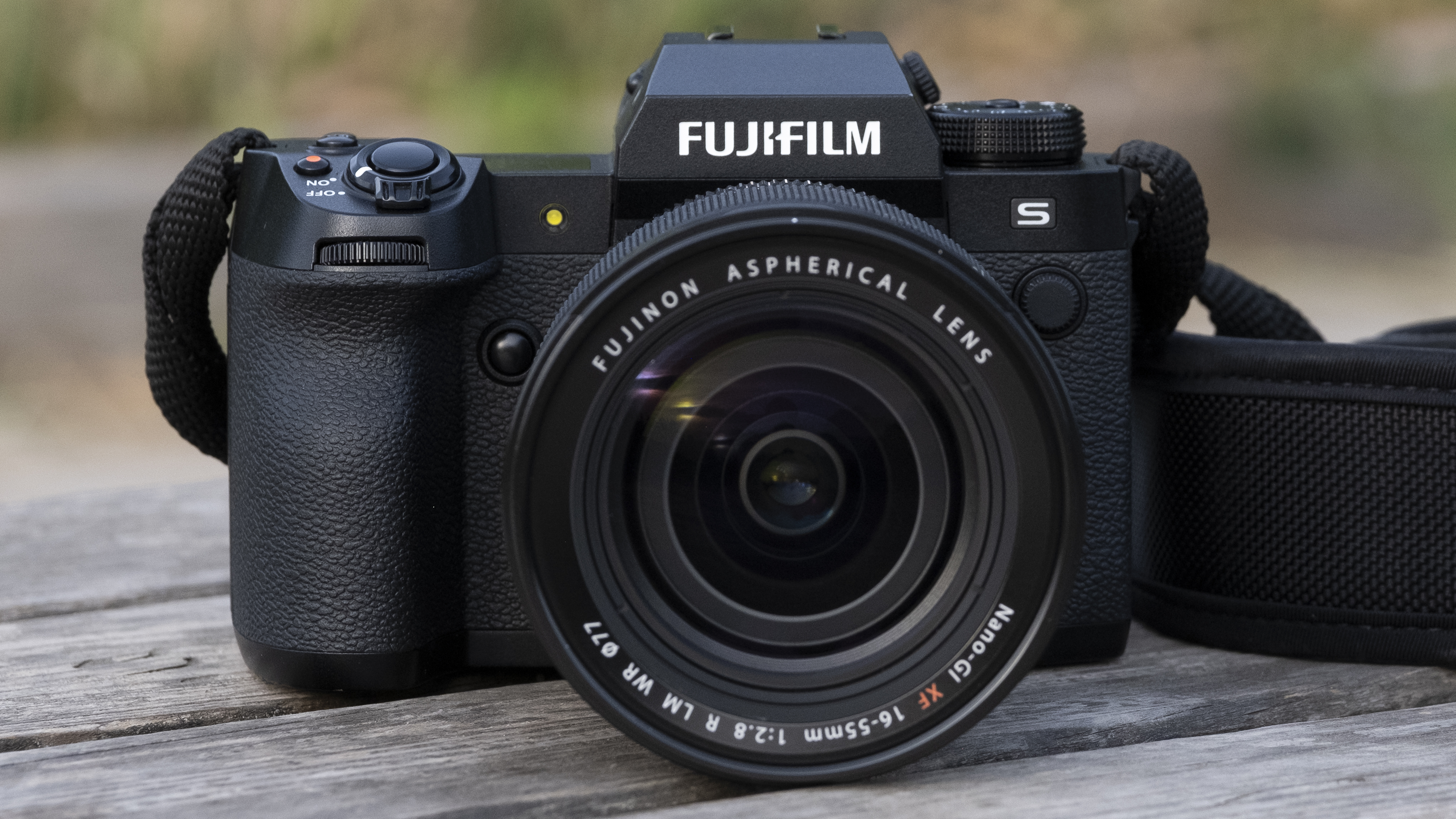
The Fujifilm X-H2S led a revival of crop-sensor cameras(Image credit: Future)
(Image credit: Mark Wilson)
2022 will go down as the year affordable cameras made a much-needed comeback writes Mark Wilson, Cameras Editor. Full-frame had dominated for the past few years, but in 2022 we saw crop-sensor systems – like Micro Four Thirds and APS-C – make an emphatic return, with a wave of launches. And that was very good news for our beleaguered wallets.
It was Fujifilm, in particular, that delivered the best alternatives to full-frame. Its new flagships, the Fujifilm X-H2S and X-H2, pack modern shooting power into small and (relatively) affordable packages. Similarly, the OM System OM-1, rising from the ashes of Olympus, rocketed to the top of our guide to the best cameras for wildlife photography.
2022 was also, finally, a great year for entry-level mirrorless cameras. The Canon EOS R10, the spiritual successor to the camera giant’s much-loved line of entry-level DSLRs (known as the Rebel series in the US), became our new best camera for beginners. For keen hobbyists, we also saw the arrival of the Fujifilm X-T5 and Canon EOS R7, two ‘sweet spot’ models that are destined to become big-sellers.
Not that pro shooters were left in the cold this year, as Canon and Sony both introduced compelling full-frame powerhouses. The Canon EOS R6 Mark II is a solid upgrade of one of its best cameras, while the Sony A7R V showcased the kind of AI-powered autofocus that we can expect to see develop at a rapid pace next year.
That’s the kind of photographic tech I’m looking forward to the most next year. The likes of Dall-E and Midjourney have given us a taste of how AI algorithms are set to revolutionize our creative lives in 2023. They could ultimately challenge the definition of photography itself; but this year, I’m excited to see what they can do for mirrorless cameras and phones like the hotly-anticipated iPhone 15.
Fitness
Apple goes Ultra, Fitbit goes wrong
The Apple Watch Ultra signaled Apple's entry into the 'rugged' smartwatch space(Image credit: TechRadar)
(Image credit: Matt Evans)
A year or two ago, we were seeing new fitness products that had been rushed into production during the pandemic, when everyone assumed that exercising at home was going to be the new norm writes Matt Evans, Fitness and Wellbeing Editor. Now, though, outdoor exercise has returned to pre-pandemic levels, and our tech is once again geared towards empowering us to get outside.
Premium smartwatches have gone rugged, with Samsung Galaxy Watch 5 Pro and the much-vaunted Apple Watch Ultra leading the charge. Both are chunkier watches designed for trails and other adventures, with more accurate GPS and reinforced cases to withstand the elements. The Watch 5 Pro has a raised bezel and improved route-tracking features, while Apple went one step further, and made the Watch Ultra a working dive computer. However, neither stole the award for our fitness device of the year: that honor goes to Garmin, king of the adventure watch space, for its excellent Forerunner 955 Solar.
Sadly, Fitbit didn’t get the memo. After a year of technical issues with its existing slate of products, the Fitbit Versa 4 and Fitbit Sense 2 enjoyed a splashy launch in September, but both failed to improve on their predecessors. The Fitbit Inspire 3 fitness tracker fared better, but we were disappointed that Fitbit slashed the Inspire 2's free Fitbit Premium subscription from one year down to just six months, removing lots of value from the device. Peloton has also suffered badly this year, with rounds of layoffs and bad press overshadowing the launch of its new rowing machine.
As for 2023,I don’t believe we’re going to see the Apple Watch Ultra 2 for a few years, but more funky stuff, like the Huawei Watch D’s on-wrist blood pressure cuff, is set to appear. As the cost of living bites, and production issues continue to plague major retailers, the philosophy of ‘health is wealth’ is going to be pushed rather heavily, with less focus on performance and a greater emphasis on wellness.
from TechRadar - All the latest technology news https://ift.tt/kxg1twm
via TechRadar - All the latest technology news https://ift.tt/RHa8SpV
You can’t escape the skyrocketing prices we‘re grappling with today. Almost everything, from your utility bills to that starter home, is costing more today than it did a year ago. To survive this era of inflation, you just have to save where you can, and upgrading some of your outdated, time- and energy-guzzling home gadgets is a big step in the right direction.
It probably isn’t a surprise that it is the best air fryers that dominate many of our energy-saving conversations. Even the local hairdressers and bakers have shared their praise for these time-saving kitchen beasts. We also have an eye out for deals on other appliances, like dehumidifiers and heated clothes airers, which can save your pocketbook in the long term.
When it comes to building a smart home, there are many ways to make your house more efficient. The best smart locks can notify you if a door has been left ajar, letting heat escape; and the best smart thermostats will activate the central heating when and where you want it.
Earlier this month, money-saving expert Martin Lewis revealed a simple equation that can help you cut your winter energy bills in the UK, which is something the rest of the world can utilize too. The math involves finding the wattage of an item, then working out how many kilowatts or what fraction of a kilowatt it’s using, then multiplying that by the cost of kw per hour. But since we can’t all run these calculations when we need to, it may be simpler to elect an appliance or smart home gadget that you know will save you money in the long run.
We've already done the Lewis calculations so you don't have to. Below, we've rounded up some of the key appliances and smart home gadgets that will help you save money on your utility bills.
The must-have appliances and smart home gadgets for 2023
There's a lot of choice out there but if you're careful about where you invest your money, you'll start to see decreasing utility bills.
Product: Air fryer | Function/s: air-fry, roast, bake, reheat, broil and dehydrate | RRP: $144.99 / £149.99
Crisp, evenly browned results
Window lets you monitor foods as they cook
Reduces cooking smells
Crisper plate falls out if basket tipped up too high
Display attracts fingerprint smudges
Air fryers are a plenty these days, coming in all sizes and shapes, but the Instant Vortex Plus 6-in-1 Air Fryer with ClearCook & OdourErase is the best one you can get. We particularly like the window, which allows us to keep an eye on food while it's cooking, as well as the smell-reducing filter — although, the scent of food wafting through the air is not always a bad thing.
Air fryers can save you money by cooking foods much more quickly than a conventional oven. You save time preparing food, but you also save time on energy used. We calculated the energy usage of an air fryer in our article, "Do Air Fryers Use a Lot of Electricity?' In the UK, a 1700W basket air fryer used for about 30 minutes per day on average will cost approximately 0.56 pence per day, £3.98 per week or £17.08 per month, which is a fraction of what it would cost to run a range cooker for that same length of time.
Air fryers also provide a healthier method for cooking food since they require less oil/fat. No one is going to chuck their conventional oven for the air fryer, but technically speaking, the latter doesn't take up as much space.
We're featuring tado° in this little round-up because we've heard so many good things about it, and it is relatively affordable from the get-go.
Research has shown that tado° smart thermostats can save users an average of 22% on their heating bills over the course of a year.
These thermostats are easy-to-use and boast a sleek and simple design. They can be used on their own or with additional radiator valves for zonal control. The tado° also works with Alexa, Google Assistant, and Apple's HomeKit, which means you're not limited to one smart system. There are, of course, other smart thermostats available that will all save you money on your heating bills, albeit in slightly different ways. Our handy widget (below) displays some of the best deals available at the moment.
Dehumidifiers
(Image credit: Best Buy)
Insignia 35-Pint Dehumidifier
Save money when drying the laundry
Product: dehumidifier | Functions: removes moisture from the air | RRP: $219
Removes up to 35-pints of moisture from the air
LED lights
Suitable for up to 2000 sq. ft.
Bulky
Will need to remember to empty the water collected
Dehumidifiers have been around for some time, but we probably think of them most often as a tool for drying out damp plaster after a DIY project. Most homes will have one of these appliances, whether it is in the house, utility room or garage, but the chances are that they are being underutilized. After all, these gadgets have so many other incredible uses for around the home.
Money-saving expert Lewis recently shared that drying your clothes with a 200w dehumidifier – instead of a large standing dryer – could cost you as little as 7p an hour (UK); 200w is a fifth of a kw (1,000w) and a fifth of 34p is about 7p. Granted, dehumidifiers don't come cheap, with some costing up to £400, but if you have a lot of laundry days in the week and rely on the tumble dryer to get bedding and garments dry, the dehumidifier could be a smart investment to make. This Insignia dehumidifier is capable of wicking away moisture from a 2000 sq. ft. room, so you're not going to be limited by which room it resides in either– you will need a standard clothes airer to hang up the washing though.
It's worth noting that in addition to removing moisture from the air, dehumidifiers kick out some heat while also purifying the air, so you're going to be effectively drying out while warming up a room in your home, and breathing in purified air. You just can't beat the versatility of a good dehumidifier!
Product: smart lock | Functions: automatically lock/unlock door and set alerts | RRP: $249.99 / £377
Sleek, discreet design
Can still be used with keys
Bundled with Wi-Fi bridge
Expensive compared to competitors in the market
Much bigger than the cheaper August lock
App can be slow to respond
You might wonder how smart locks can save you money, but we're thinking outside the box. With the ability to essentially control your front door with an app, you'll have one less thing to remember to carry around (your keys) while saving some money.
One of the things you can do with the August Smart Lock Pro is set “smart alerts,” which let you know when the door is locked or unlocked, when the door is left ajar, when the door is automatically locked or unlocked, and so on. In other words, it'll always keep tabs on the status of your lock, which is especially helpful for the many of us who can't quite remember if we locked the door or not. Now you don't have to waste your worries on this question, or time and fuel getting back home to check. You also won't be letting heat or air conditioning escape if you happened to have left a door wide open.
The August Smart Lock Pro isn't the only lock that can do this. In the UK, we (also) have the Yale Conexis L2, as an alternative. It is an expense to upgrade to a smart lock, but it can be a wise – and safe – investment.
You'll need to buy the airer cover for an additional £42.99 to benefit fully from it
Heated airers have been all the rage in 2022, and we expect to see the trend continue well into 2023. In the UK, we saw the Dry:Soon Deluxe 3-Tier Heated Airer sell out at the start of the fall season, only becoming available again around Black Friday.
Due to its popularity, there were no discounts on this airer, but the energy savings are what counts: this airers claims to have a running cost of just 10p per hour (based upon electricity unit cost of 34p per kw/h). It's capable of holding up to 15kg of washing on 21m of drying space, and it'll have all the washing dry within a matter of hours, so you're going to be looking at spending maybe 40p, rather than £2 - 3 with the tumble dryer.
Why are they so good? They dry your washing a lot quicker than the non-electrified airers, and they are miles cheaper than the tumble dryer. If you're not in the UK, our handy widget (below) will show you some of the best deals and availability.
You can save a lot of money by making some simple appliance upgrades in your home. Beyond only boiling the amount of water you need in the kettle (top tip), you can also save money by investing in products that use less time and energy. I think most of us will welcome a more affordable 2023 with open arms.
from TechRadar - All the latest technology news https://ift.tt/RHa8SpV














Follow Us
Were this world an endless plain, and by sailing eastward we could for ever reach new distances