The Exynos is a slightly less powerful option, and we’ve seen Samsung pull the same chipset-splitting tactic with the Samsung Galaxy S24 line, but typically the company’s foldables don’t have a chipset split, so this was disappointing – and surprising – news.
Now, though, we’re hearing that every Samsung Galaxy Z Flip 6 might use a Snapdragon 8 Gen 3 after all. This is according to leaker @kro_roe, posting on X (via NotebookCheck), and they’re actually one of the sources who originally claimed there would be a chipset split.
So, now that fewer sources are talking about Exynos, it seems likely that only Snapdragon will be used. Given that Samsung usually only puts a Snapdragon chipset in Z Flip models, that would certainly make sense.
That's great news! I'm glad to hear that the Flip 6 comes equipped with Snapdragon across the board, avoiding any critical issues seen in the Exynos 2400.May 12, 2024
See more
Reaching an agreement
So, why their change of mind? Well, a slightly earlier post from @kro_roe suggests that there was disagreement at Samsung over which chipset to use, which might have led to both being included, but seemingly the decision has now been made to just use the Snapdragon 8 Gen 3.
We would still take this latest claim with a pinch of salt, especially as the source doesn’t have much of a track record yet, and given that leaker @negativeonehero also claimed back in April that an Exynos chipset would be used in some models. But given that most sources now point to a Snapdragon 8 Gen 3 chipset across the board, we'd think that's the most likely choice for the phone.
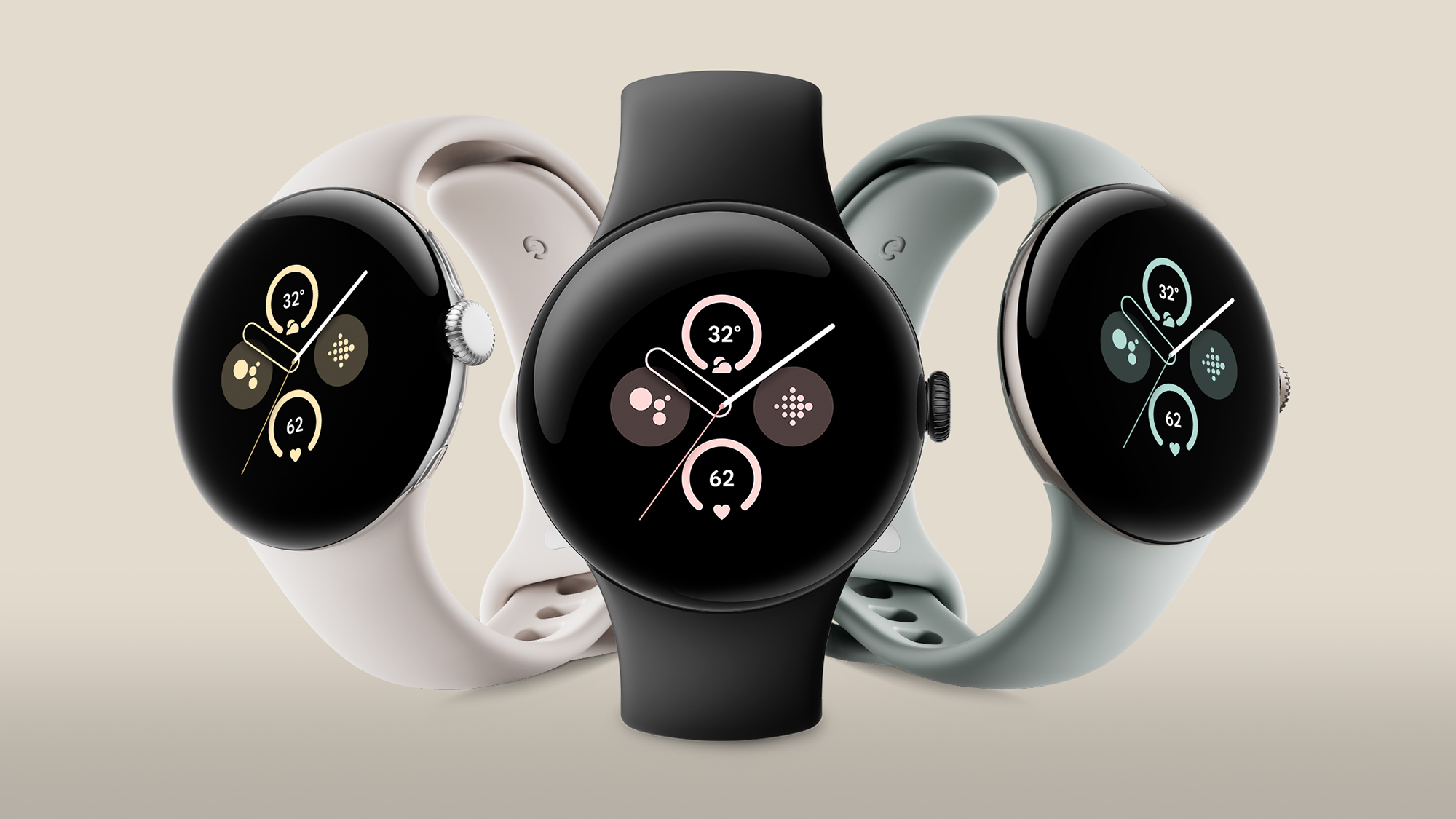
Wearables are on their way to becoming the next big tech trend for kids, and this includes the best smartwatches. In its latest update, Google is gearing up to add a new WearOS feature that will help parents manage their child’s smartwatch usage during school hours.
The Google System release notes for May 2024 share that the new ‘School Time’ feature is designed for parental use, and will allow parents to put access limitations on the apps their child uses. Parents will also have the option to silence their child’s smartwatch, limiting distractions and allowing them to focus in the classroom.
Google hasn't yet announced how School Time will work, but we imagine users will be able to change their children's School Time settings from their own Wear OS app. We also don’t yet know if the feature will be available across all WearOS devices, or if it can only be accessed on more recent WearOS devices like the Google Pixel Watch 2.
(Image credit: Google)
While it’s a new addition to the WearOS user interface, parental settings for wearable tech are far from new. Apple introduced a similar feature – also called ‘Schooltime’ with its watchOS 7 update back in 2020. It allows parents to limit certain features on their child’s Apple Watch, including setting time blocks on certain apps and watch face complications, but still allowing them to access features like Activity Rings, and it’s likely that School Time feature in WearOS will work in a similar way.
Analysis: are smartwatch makers increasingly targeting kids?
Although Google is lagging behind with its parental features for smartwatches, it’s good to see the company taking younger smartwatch users into consideration – features like School Time makes it easier for high school-aged users to focus on things like studying. However, Google’s new update could also suggest that it’s pitching its wearable devices more at younger users.
It’s understandable why high-school-aged kids would want to wear a smartwatch, especially if they’re already using Google Pixel phones and want to explore wearables that extend its functions and services. But younger children are increasingly starting to take an interest in smartwatches.
Some brands already make watches designed for younger children – we think the Fitbit Ace 3 is a solid entry-level option for a kids smartwatch. So could Google’s launching its School Time feature be an indication that a new Google kids smartwatch is on the way?
Google doesn't tend to slack off for long when it comes to Google Maps updates, and users are spotting two new tweaks that have been quietly introduced in the Android app – covering electric vehicle navigation and identifying particular roads.
First up is the EV charging, as spotted by SmartDroid (via 9to5Google): in the Android app you can see nearby charging stations with a tap on the relevant filter button underneath the main search bar, at the top of the screen.
You need to have your car set as an electric car to see it though, which you can do from the Your vehicle option in Google Maps Settings. Gas is the default vehicle type, in which case you'll see a quick link to gas stations instead.
A similar update was applied to Android Auto last year, so it now seems to have made its way to the Android app as well. Last month, Google announced some new AI-powered features for making it easier to get to an EV charging point.
Where we're going, we do need roads
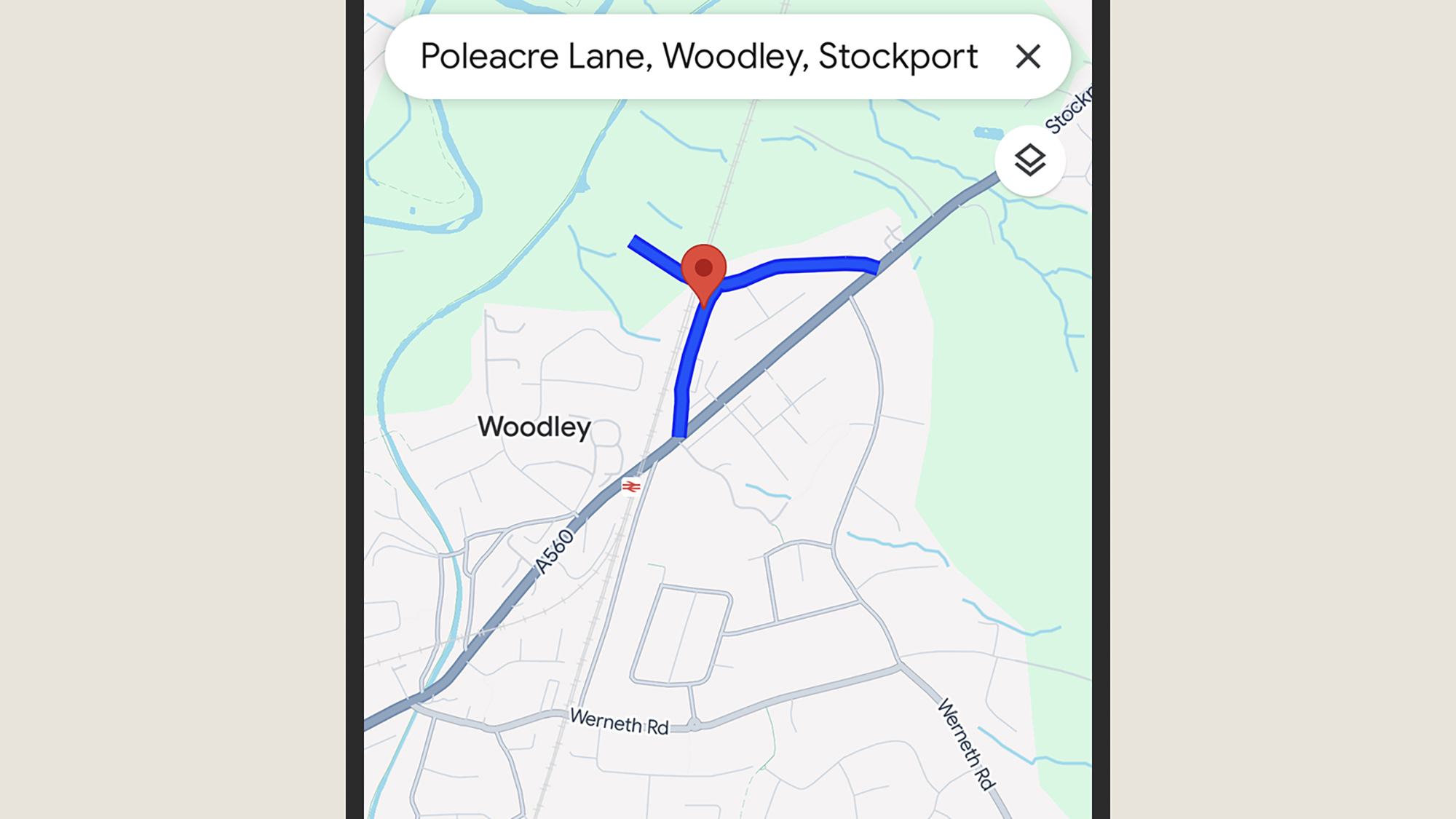
Google Maps now highlights entire roads(Image credit: Future)
The second Google Maps tweak, again via SmartDroid and 9to5Google, will show you the entire length of a road highlighted in blue when you search for it. Previously, you just got a pin stuck in the middle of the road to help you find your way to it.
This gives you a bit of a better idea of the extent of a road you're looking for – in terms of where it starts and ends, and how much space it takes up on the map. You can of course still navigate to any specific point on the road, should you need to.
Two fairly minor tweaks then, but they should both make Google Maps easier and more convenient to use. There's no word yet on whether or not iOS is getting the same updates, but we're presuming it will.
It's set to be a big week for Google, with its Google I/O 2024 software developers event getting underway on Tuesday, May 14. We may well hear more about updates heading to Google Maps then, and you can watch live from wherever you happen to be.
The all-new LG C4 was just released in March, and Amazon already has an impressive discount on the gorgeous display. For a limited time, you can get the 2024 LG 55-inch C4 OLED TV on sale for $1,796.99 (it was $1,999.99) thanks to Amazon's $200 discount. That's the first price cut we've spotted on the OLED display and the best deal you can find.
Released in March and available to ship in April, the LG C4 OLED TV is on track to be one of this year's best OLED TVs. The L4 is a successor to last year's LG C3 OLED, which has been highly praised at TechRadar. Upgrades to the LG C4 include an improved picture experience with boosted brightness, a 144hz refresh rate, and LG's latest Alpha 9 AI chip. You're also getting new gaming features and support for AI Picture Pro and AI Sound Pro technologies.
We typically don't see significant discounts on newly released TVs, which makes this $200 discount from Amazon a fantastic deal. If you want a premium 2024 OLED display, I highly recommend this rare offer on LG's 55-inch C4 OLED TV.
LG C4 OLED TV deal at Amazon
LG C4 55-inch OLED 4K TV:was $1,999.99 now $1,796.99 at Amazon LG's all-new 55-inch C4 OLED TV is getting a first-time $200 discount at Amazon, bringing the price down to $1,796.99. The C4 is a successor to the highly-rated LG C3, and we predict it will become one of this year's best OLED TVs. Upgrades include new gaming features, LG's latest Alpha 9 AI chip for improved performance and exceptional brightness.View Deal
More of today's best OLED TV deals
LG C2 42-Inch 4K OLED Smart TV (2022):was $1,549.99 now $849 at Walmart The LG C2 OLED is older now, but it's still one of the best-value buys out there right now if you don't mind missing the latest bells and whistles. The gorgeous display is praised for its decent brightness and vivid colors in our LG C2 OLED review and packs an a9 Gen5 AI Processor, Dolby Atmos, and voice control - all for under $1,000. Please note that this specific model is sold by a third-party seller but is fulfilled by Walmart.View Deal
Sony A75L series 55-inch OLED TV (2023):was $1,599.99 now $1,199.99 at Best Buy The 55-inch Sony A75L is on sale at Best Buy for $1,199.99. Next-gen gamers will love this Sony display thanks to its two HDMI 2.1 ports, 120Hz, VRR, and ALLM support. The A75L also features Sony's powerful cognitive processor XR and smart capabilities with the Google Assistant onboard.View Deal
LG C3 65-inch OLED TV (2023):was $2,499.99 now $1,599.99 at Best Buy
If you're interested in last year's best-selling LG C3 OLED TV, Best Buy has the 65-inch display on sale for $1,599.99. The stunning OLED TV features a brilliant picture with bright colors and powerful contrast thanks to LG's latest Alpha9 Gen6 chip. Plus, you get four HDMI 2.1 ports for next-gen consoles, a sleek, thin design, and an updated webOS experience - all for under $1,600, which is fantastic value for a premium OLED display.View Deal
Samsung 65-inch S90C Smart 4K OLED TV:was $2,599.99 now $1,599.99 at Samsung The Samsung S90C OLED is TechRadar's best TV of the year, and the 65-inch model is on sale for $1,599.99. That's a massive $1,000 discount and $100 more than the record-low price. Our Samsung S90C review awarded this TV five stars, praising its gorgeous picture, extensive gaming features, super slim design, and reasonable price - especially with today's $1,000 price cut.View Deal
Shop more TV offers with our list of the bestTV deals, and if you're looking for a more premium display, see the bestOLED TV deals.
from TechRadar - All the latest technology news https://ift.tt/AtWQEpV
Many cities around the world are facing a congestion crisis – and where governments and local authorities have seen fit to curb emissions f...
Many cities around the world are facing a congestion crisis – and where governments and local authorities have seen fit to curb emissions from CO2-belching tailpipes, the humble automobile is slowly being phased out of many urban areas.
Although the microcar is nothing new (the petrol-powered Peel P50 was launched in the early 1960s), it is experiencing something of a renaissance thanks to those traffic and pollution problems. Plus, because battery and electric motor technology is now seen as the 'cleaner and greener' option, most modern models have gone electric.
Renault arguably pioneered the genre with its funky Twizy, which was once the top-selling plug-in vehicle in Europe before it was phased out, while Citroen recently rekindled the microcar flame with its Ami, which remains one of the cheapest electric cars money can buy.
"In terms of mobility, we need to start thinking about how we are moving. If we think about the (modern) cars and how big and heavy they have got, this is absolutely the wrong direction. We need to be more sustainable and cars need to become smaller," co-founder of Microlino, Merlin Ouboter, told The Fully Charged Show.
Merlin isn’t wrong, as it is not uncommon for a modern electric SUV to weigh in at the three-tonne mark, while the physical footprint of today’s vehicles has ballooned to fit with customers’ action-packed lifestyles and to accommodate the large – and often very heavy – battery packs. This simply doesn’t work when parking spaces are at a premium. Enter the microcar.
(Image credit: Silence)
"In many cities in Spain, it is just not practical to try and drive and park a car, which is why we see such a high concentration of scooters and motorcycles," Pablo Barrios, business development manager at EV and mobility company Silence, told me at this year’s Geneva Motor Show.
"But we also know there is demand for something that is enclosed from the weather, features creature comforts, such as air conditioning, and has storage for shopping, which is why we developed our S04 Nanocar model. It is rapidly gaining popularity throughout Europe and is often the quickest and easiest way to get around town," he added.
Even in the US, where larger than life automobiles loom large over the landscape, microcars have started to gain traction, not least the $11,900 neighborhood electric vehicle (NEV) from start-up Eli, which now offers its Zero model in both Europe and the in the US.
With that in mind, here are some of the key players and emerging names to look out for in the microcar space…
Microlino and Microlino Lite
(Image credit: Micro)
The Microlino is very much worth its place in this guide, not least because of its utterly adorable design.
The Swiss company behind the Micro scooter, which itself has been a craze that has swept the globe, set about designing a low-powered and equally low maintenance electric vehicle that even 14-year-olds can legally drive income markets.
It comes in two flavors, with the smallest taking inspiration from the famous Isetta Bubble Car of the 1950s. The Microlino Lite features the same front-opening 'fridge door' and three-wheel layout of its retro forebear, but this thoroughly modern version is powered by batteries and electric motors.
It weighs just 435kg, which means it can manage 62 miles on a single charge and topping up the batteries takes around two hours from a domestic socket. There's also a larger 11kWh battery option (the standard is 5.5kWh) that extends the range to 180km – or 112 miles – but this takes four hours to charge.
The larger, four-wheeled Microlino has space inside for two and has a max speed of around 55mph, making it more suitable for those longer journeys. Opt for the biggest battery packs and it can cover a staggering 114 miles on a single charge.
The Microlino is already in production and on sale in a bunch of European markets, with the US the next big target. It costs €21,990 (around £19,000 / $24,000 / AU$36,500), which is expensive, but the Lite version will be offered on a lease deal in its home town of Switzerland, rather than an outright purchase. Micro suggests monthly payments of CHF149, which is about €156 / £134 or $169 / AU$259.
Silence S04 Nanocar
(Image credit: Silence)
Proudly on display at this year’s Geneva Motor Show, the Silence S04 Nanocar has rapidly been popping in markets outside of its Spanish home country, gaining popularity for its clever battery design that also works with Silence’s range of electric scooters.
These large, cuboid packs (the Nanocar requires two) boast retractable wheels, which means they can easily be removed from the vehicle in questions and dragged to a plug socket, scooter or even on the many Silence battery swap centres with ease.
The S04 costs £15,995 (around $20,000 / AU$30,000) to buy outright, but Silence is another company touting a monthly rental fee or membership package. In Spain, it’s possible to sign up and get use of both the scooters and Nanocar for one convenient price. Alternatively, Silence allows customers to buy the vehicle and then lease the battery technology to keep the cost down.
As a mode of transport, the S04 Nanocar is capable of a top speed of 52mph, can manage around 92 miles on a single charge and packs USB chargers for smartphones, enough room for luggage and operates without a key, simply requiring a smartphone app to unlock.
Eli Zero
(Image credit: Eli )
Offering a 60-mile range and top speeds of 25mph, the diminutive Eli Zero is designed to get from A-to-B with minimal fuss and replace those quick trips to town that a scooter or moped would have likely covered – albeit with better protection from the elements, air conditioning, power steering, a rear-view camera and even an optional head unit with Apple CarPlay and Android Auto functionality.
Reservations have already opened in the US, despite regulations making it difficult for the Microcar to thrive due to stringent crash safety legislation. As a result, it’s only legal to drive on roads with a 35mph speed limit, for example, hence the Neighborhood Electric Vehicle categorization.
However, that doesn’t stop Eli from throwing in Bluetooth-enabled speakers, comfortable seating for two, LED headlights and a neat keyless start system. It might look like a glorified golf cart, but it’s got more in common with proper passenger cars when it comes to equipment.
Eli says it has the capacity to produce around 4,000 Zero models per year, although it is yet to reveal how much interest it has garnered so far.
Birò
(Image credit: Biro)
Hailing from Italy, Birò takes a similar approach to small personal transport as Silence, offering quick swap battery technology in its models and highly customizable mobility solutions that range from the cheapest and simplest ways to get moving, to those that can operate in colder climates and carry more cargo.
Birò wants you to think about its products like small capacity motorcycles, with similar performance to the 50cc and 125cc scooters currently on the market.
Top speeds range from around 28mph to 40mph, but they are priced from £11,350 (around $14,000 / AU$21,500), making them far cheaper than most of the EVs currently on sale.
In Italy, there's the option to join a membership scheme and gain access to a Birò when required, with the company offering them in 'Big' (two seats) or 'Small' (room for just one), as well as 'Naked' and 'Dressed' configurations.
Where the Microlino and Microlino Lite go big on retro design and disarmingly cute good looks, the Birò is altogether more utilitarian. Although it still offers heated windshields, a digital speedo and a smartphone holder.
With Apple's WWDC 2024 event and the accompanying iOS 18 reveal fast approaching, speculation is mounting about what kind of AI features Apple might introduce – and a new report gives us a few more major clues.
This report comes from the New York Times (via MacRumors), and says that an upgraded version of Siri is going to be central to iOS 18. Efforts to make Siri a more competent competitor to ChatGPT have apparently been underway for more than a year.
The new and improved Siri is going to be "more conversational and versatile", according to the NYT – and it'll be better at keeping chats going, rather than replying to one question at a time. It's said that Apple has shifted extra resources to Siri development, which was part of the reason the Apple Car was abandoned.
However, the report says Siri won't compete with the ChatGPT chatbot directly: instead, it'll get better at what it already does, including timers, calendar appointments, and lists. The digital assistant will also be able to summarize text messages (which we've heard hints about before).
AI ins and outs
This is the Apple AI strategy:A) On-device LLM (in house)B) Cloud-powered LLM (in house)C) Chatbot (OpenAI for sure, Google maybe). Apple isn’t building its own chatbot but knows the market wants it so it’s going elsewhere for it. It’s the same playbook as search. https://t.co/XQrv57jylYMay 12, 2024
See more
It's getting a little tricky to pick through all the different AI-related Apple rumors we're hearing in the run up to the Worldwide Developers Conference. All we know for sure is that Apple is keen on AI, and has some significant announcements in store.
Bloomberg's Mark Gurman, one of the more reliable Apple tipsters, has posted on social media about how these upgrades will work: Apple is developing its own in-house LLMs (Large Language Models) for local, on-device work, and for cloud processing, Gurman says.
It'll then integrate a third-party chatbot into its software: either ChatGPT from OpenAI or Google Gemini, as we've already heard. Gurman says "it's the same playbook as search" – so while Siri can search the web, Apple has a partnership with Google for doing the actual searching work. Expect something similar with AI.
There's quite a bit of overlap there, because if Apple is developing its own LLMs, it doesn't necessarily need extra help from OpenAI or Google – so it's not exactly certain where one service will start and another will end. Hopefully all will become clear at WWDC 2024, which gets underway on June 10.
Buried in this week's flurry of Apple announcements for the iPad Pro (2024), M4 chip and Apple Pencil Pro was some fascinating news for video shooters – an updated 'Final Cut Pro for iPad 2' app and an even more intriguing app, for both Apple's tablets and the iPhone, called Final Cut Camera.
What's particularly interesting about Final Cut Camera is that it's designed to both work as a standalone app for shooting video, and also in tandem with that clunkily-named new Final Cut Pro editing app. When working with the latter, it introduces multi-cam capabilities when shooting video on iPads and iPhones.
Multi-cam functionality has been around for a little while now, with Blackmagic and LumaFusion paving the way for a new mobile way of filming and editing videos. This has represented a significant shift for the industry and it’s great to see Apple weighing in with their own solution.
After using LumaFusion, I’m really looking forward to seeing how Apple’s offering compares – the app is due out "later this spring" (in other words, sometime before the end of June) and will cost $4.99 / £4.99 / AU$7.99 a month. But it's Apple's free app Final Cut Camera, that's arguably more interesting – particularly as it's separate from the iPhone's standard Camera app.
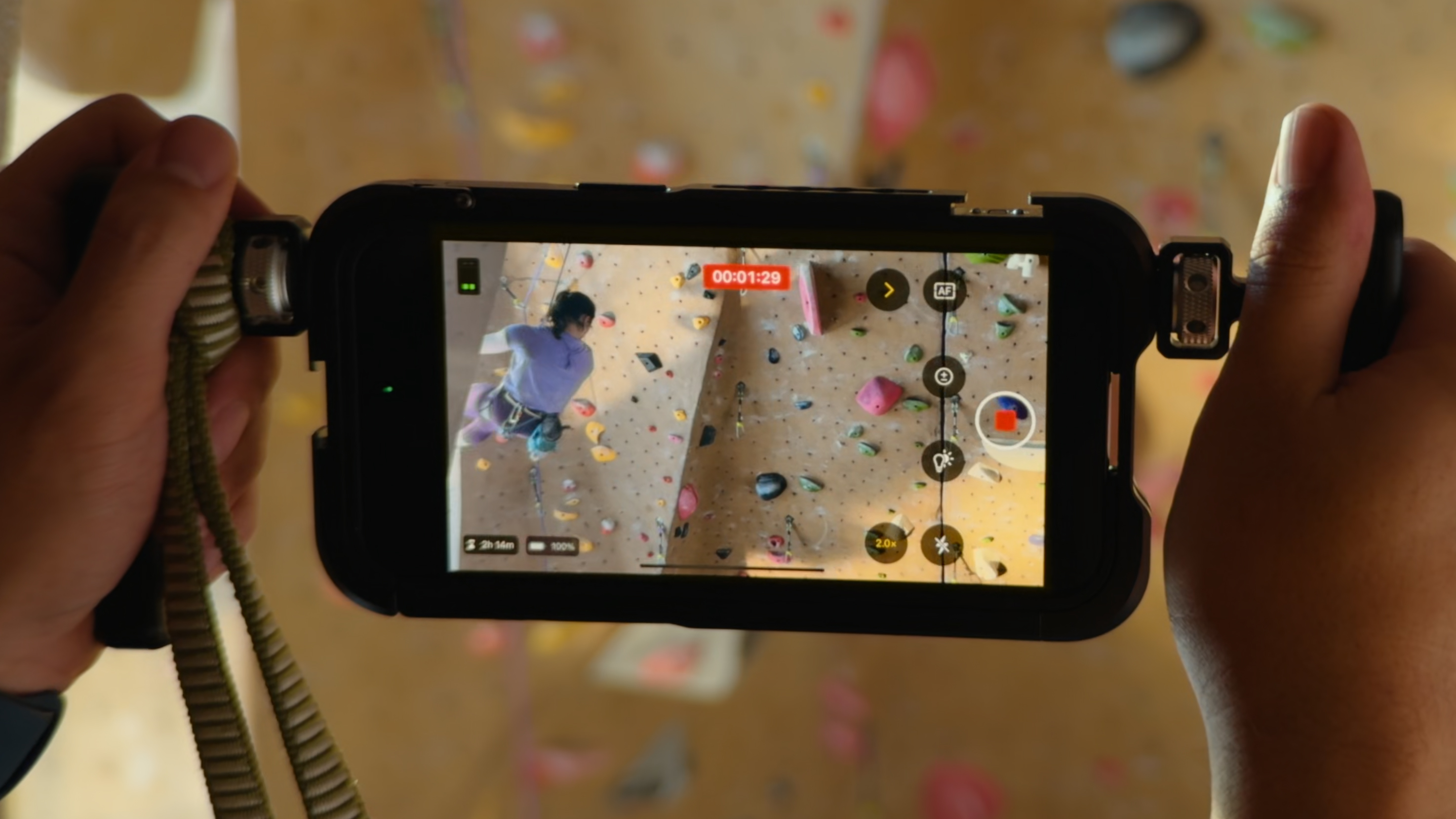
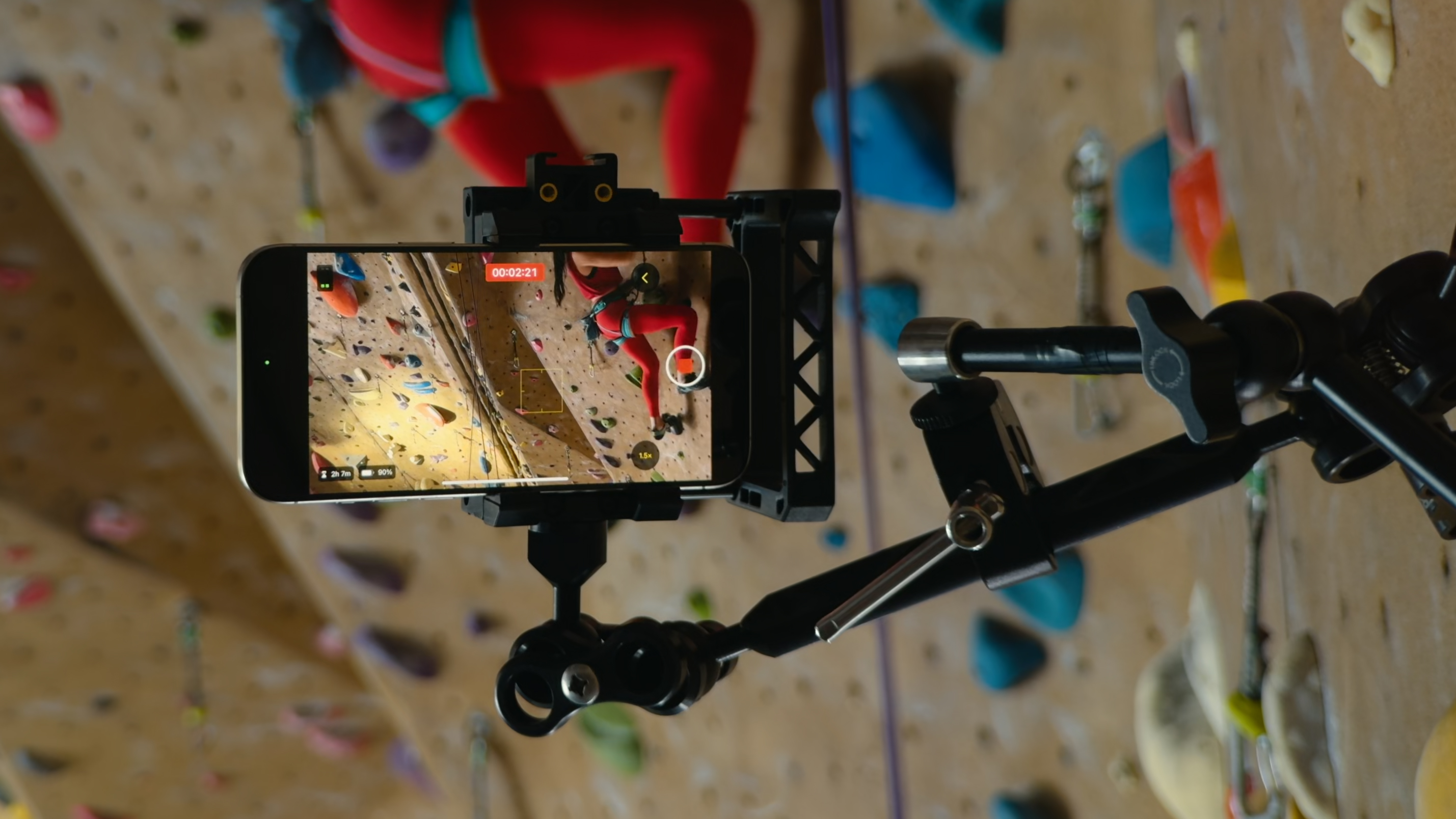
Final Cut Camera delivers pro video controls to iPhones and iPads, letting video shooters to take control of fine-tuning settings – and also combining up to four different video feeds from those devices, live-cutting between them.
Until now, Apple has left this kind of thing to third-party app makers – but if it can do it for video, there's no reason it might not also do the same for photography, too.
What does Final Cut Camera do?
Through this free standalone app, which will also land "later this spring" (sometime by mid-June), it'll be possible to adjust a whole host of pro video settings – and also sync your live video feed to an iPad running the Final Cut Pro 2 app.
Those settings include ISO, shutter speed, white balance, focus and more, to help you get professional-grade recording. The interface even lets videographers monitor incoming footage with a zebra stripe pattern tool and audio meter. Doing all this across up to four cameras would be a hassle with an iPhone – not to mention impossible without at least an M1 chip – which means a relatively recent iPad is essential for the multi-cam workflow.
(Image credit: Apple)
The multi-cam feature, which you get when using Final Cut Camera in tandem with the Final Cut Pro 2, instantly turns a group of Apple devices into a mini production studio. This makes it possible for any iPhone user to take ultimate control of their video capture and for more complex setups to all be controlled from a single device.
Everything is, of course, wireless, which makes for a super straightforward setup on the ground. The seamless syncing of both video and audio also dramatically streamlines editing workflows and allows videographers to turn projects around in a fraction of the time.
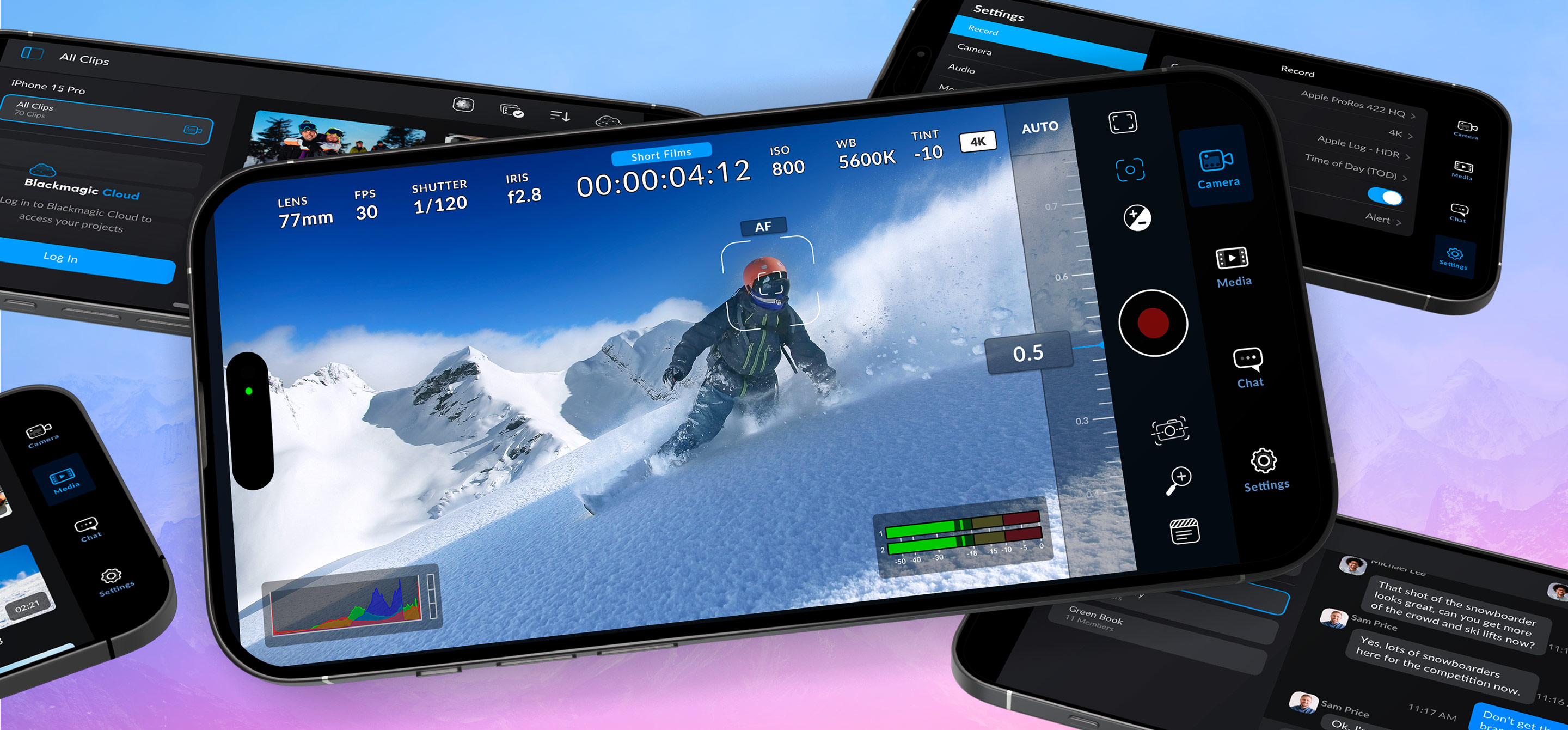
The Blackmagic Camera app offers very similar functionality to the Final Cut Camera app.(Image credit: Blackmagic)
What has been possible with the Blackmagic Camera App for a while is now possible with Final Cut Pro and Apple tech.
Looking at the two apps side by side, it’s clear how similar they are in terms of functionality. Both offer manual control over the lens but Blackmagic provides a much greater level of audio data as well as an RGB histogram.
The Final Cut Camera App follows all of Apple's design rules, which looks great but I can’t help but feel that providing a little more data to users would have been helpful. Perhaps it's filling a gap in between the stock Camera app and a truly pro option like the Blackmagic Camera app.
Will Apple make a pro photo app?
It's a shame that Apple's new Final Cut Camera app doesn't also include photography controls or functionality. But I hope this means we'll also see a photo-leaning equivalent of the app, maybe even around WWDC 2024.
The default Apple Camera app has been substandard, for keen shooters at least, for a long time now and many have turned to the likes of Halide for more pro control over their photos. But a free alternative would be a nice partner to the Final Cut Camera app.
Not everyone would need it – for most iPhone users, the point-and-shoot experience of the stock Camera app is fine. But being given full access to ISO and shutter speed settings, plus visualization tools like a histogram or zebra stripes are all very handy if you're looking to shoot in raw and maximize image quality.
(Image credit: Apple)
If Apple does decide to do something on those lines, it'd that be another app to go alongside Final Cut Camera. Final Cut has always been video-focused and Apple has been loathe to clutter its stock Camera app with new controls, even within a sub-menu.
For now, the release of multi-cam functionality and a dedicated video camera app is a great step forward. It puts Apple on a par with LumaFusion and BlackMagic and makes for a very exciting and competitive video space on iPhones and iPads. In this area at least, the best Android phones are playing catchup.
When it comes to data storage, it’s fair to say AI has had a destabilizing effect on the industry as a whole, as businesses looking to develop and deploy the technology are faced with unfathomably large amounts of data and a dizzy number of files.
It’s a problem Huawei is looking to solve with its high-performance OceanStor A800 network storage attached (NAS) device, first revealed in 2023, and this week getting a European outing at the company’s Innovative Data Infrastructure (IDI) Forum 2024 in Berlin.
Like Huawei’s Dorado and Pacific NAS devices, the focus here is on AI data storage. Huawei calls it the “new data paradigm,” and an “accelerated data awakening.” Building, processing generative AI training models from scratch, maintaining that all-important data sovereignty, ensuring system reliability, it all demands a bafflingly large amount of space and speed. That’s a big problem for big businesses – and that’s where this uncompromising black box fits into the array.
(Image credit: Huawei / Future)
Speed, space, and 'awakening data'
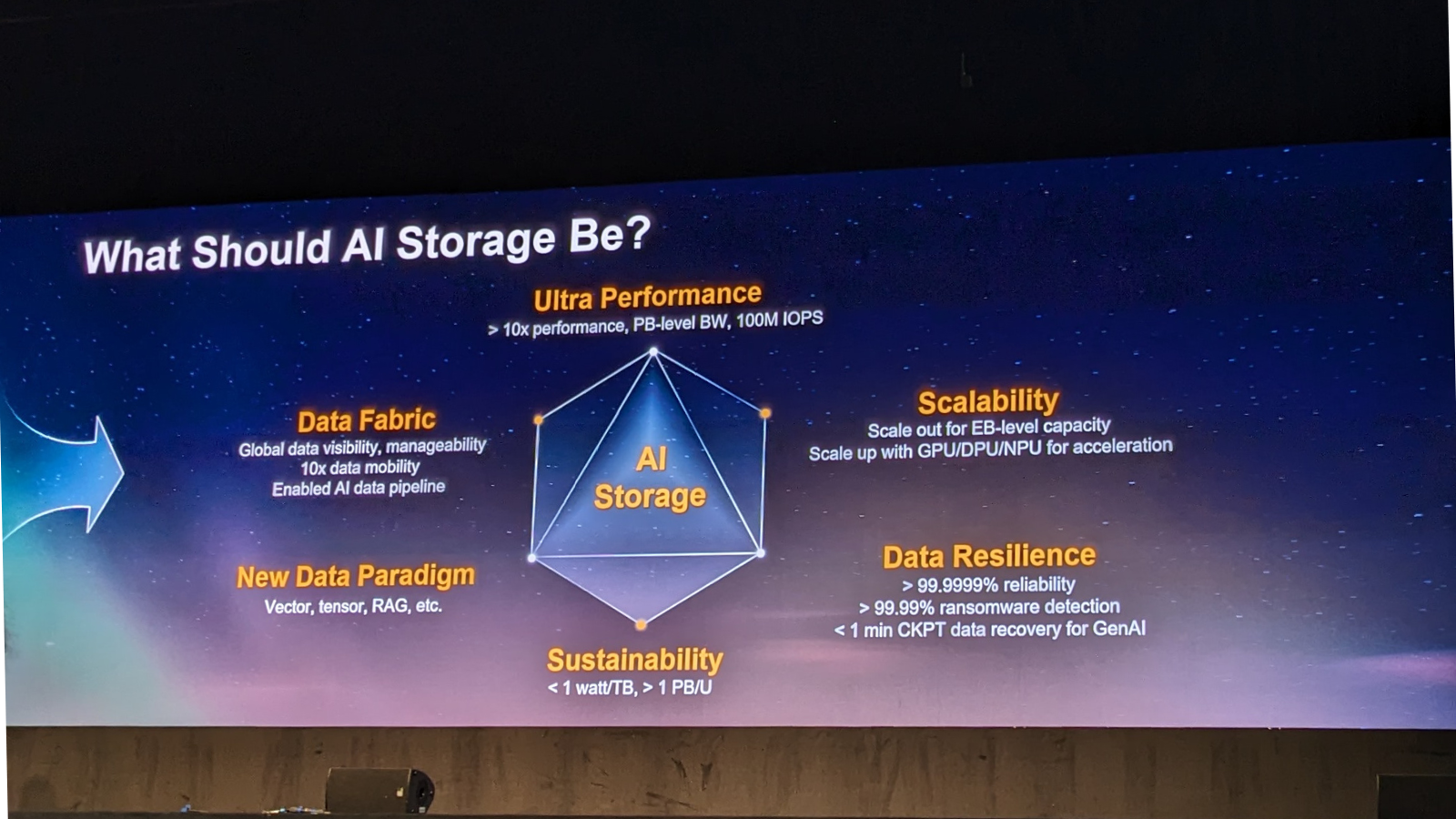
The OceanStor A800 fits into an admittedly niche enterprise market. We’re not talking storage for the masses here, however nice 500GB a second bandwidth would be. According to Huawei, the A800 is capable of 24 million IOPS per controller enclosure, delivering ten-times the performance of existing storage, ten-times the data mobility. The storage also supports bandwidth in PB/s and 100 million IOPS, and boasts data reliability of 99.9999%.
(Image credit: Huawei / Future)
At IDI 2024, the company stated the A800 “can increase AI cluster utilization by 30%, and delivers high bandwidth and IOPS, which are four and eight times better than its peer vendor. [The device] supports scaling out to EB-level capacity with up to 512 controllers, as well as scaling up to a maximum of 4,096 computing cards.”
But it’s not all impressively big numbers and high speeds. Alongside NAS, popular in the world of genAI, the company is also supporting what it calls the “new data paradigms” – tensor, Vector, retrieval-augmented generation to help prevent AI hallucinations. With an eye toward sustainability, energy efficiency being an even greater issue faced by those working with AI data storage, the A800 clocks in at 0.7watt/TB and a storage density of 1PB/U.
The OceanStor A800 wasn’t the only storage solution making an appearance at IDI, with Huawei also revealing a svelte internal128TB SSD set for release sometime next year. This drive will, Huawei said, “consume 88% less storage space and 92% less energy than the peer vendor’s SSDs when storing every one PB of data.” With the rise of content creation, gaming, and office digitalization, that’s one product we wouldn’t mind seeing come to the consumer and small-business market.
OpenAI has announced it's got news to share via a public livestream on Monday, May 13 – but, contrary to previous rumors, the developer of ChatGPT and Dall-E apparently isn't going to use the online event to launch a search engine.
In a social media post, OpenAI says that "some ChatGPT and GPT-4 updates" will be demoed at 10am PT / 1pm ET / 6pm BST on Monday May 13 (which is Tuesday, May 14 at 3am AEST for those of you in Australia). A livestream is going to be available.
OpenAI CEO Sam Altman followed up by saying the big reveal isn't going to be GPT-5 and isn't going to be a search engine, so make of that what you will. "We've been hard at work on some new stuff we think people will love," Altman says. "Feels like magic to me."
Rumors that OpenAI would be taking on Google directly with its own search engine, possibly developed in partnership with Microsoft and Bing, have been swirling for months. It sounds like it's not ready yet though – so we'll have to wait.
OpenAI, Google, and Apple
not gpt-5, not a search engine, but we’ve been hard at work on some new stuff we think people will love! feels like magic to me.monday 10am PT. https://t.co/nqftf6lRL1May 10, 2024
See more
AI chatbots such as Microsoft Copilot already do a decent job of pulling up information from the web – indeed, at their core, these Large Language Models (LLMs) are essentially training themselves on websites in a similar way to how Google indexes them.
It's possible that the future of web search is not a list of links but rather an answer from an AI, based on those links – which raises the question of how websites could carry on getting the revenue they need to supply LLMs with information in the first place. Google itself has also been experimenting with AI in its search results.
In other OpenAI news, according to Mark Gurman at Bloomberg, Apple has "closed in" on a deal to inject some ChatGPT smarts into iOS 18, due later this year. The companies are apparently now "finalizing terms" on the deal.
However, Gurman says that a deal between Apple and Google to use Google's Gemini AI engine is still on the table too. We know that Apple is planning to go big on AI this year, though it sounds as though it may need some help along the way.
It's been a long wait for Google’s Find My Device network, and while the service – which adds Bluetooth tracker compatibility and allows Android owners to track lost phones even when they’re offline – finally launched in early April, it was initially only available in the US and Canada. Now, though, it looks like it's expanding further.
As spotted by Android Authority, some X users have reported getting the service in other countries, with @willza3 claiming to have access in the UK, and @Nrnsasa5gmmwsub saying that they were able to use the Find My Device network in Japan.
Now, Google hasn’t officially said that the network has started rolling out beyond North America yet, but the company did say at launch that the rollout was simply “starting” in the US and Canada, which suggests it should be available elsewhere soon.
hey @MishaalRahman, looks like Find My Device is rolling out in the UK. just got this on my Pixel 8 pic.twitter.com/1wceUyX9tBMay 9, 2024
See more
Coming soon but slowly
So, while it’s possible that these two users were accidentally given access, there’s a good chance that Google is simply expanding the reach of the Find My Device network slowly, rather than at a pace.
As such, you probably won’t have access yet if you’re outside the US or Canada, but it’s worth keeping an eye out for it in the coming days, as you might do soon.
As for exactly when you’re likely to gain access, well, Android Authority has heard from a spokesperson for Pebblebee – one of the companies making Bluetooth trackers compatible with the network – that these trackers “will be available to ship out globally as early as May 27”, which could mean the Find My Device network will also be active globally by then.
But if Google is gradually rolling it out, then a lot of people might get access before then, and we’d wager that there’s a good chance we’ll hear more about the rollout at Google I/O 2024 on May 14.
Android 15 looks set to bring in improved video stabilization for third-party camera apps, and could be the key to making some of the best Android phones true video competitors to the best iPhones.
Android Authority code-diver Mishaal Rahman found that Android 15 looks set to get a new 'Eyes Free' feature added to the Android’s existing Camera2 API that allows third-party camera apps to access extensions phone makers have implemented into their devices. In the case of Eyes Free, that means bringing in the first Android camera extension that can be used in video capture. According to the description of Eyes Free, it “aims to lock and stabilize a given region or object of interest”.
So from that and Rahman’s report we can glean that Eyes Free will bring the video stabilization found in the likes of the Google Pixel 8 Pro and Samsung Galaxy S24 Ultra to video-centric third-party apps such as Snapchat and Instagram.
So this would mean that alongside video stabilization, third-party apps could tap into the auto detection, bokeh, Face retouch, HDR and Night modes facilitated by the Camera2 extension.
Such features mean that users can harness the camera and recording options in third-party apps without seeing a big dip in quality; absent this, in order to get the best photos and videos, users would need to capture them in their phone's native camera app, and then go through the process of uploading to a third-party app, rather than shooting directly in that app.
It’s worth noting that phone makers can implement their own camera pipelines for third-party apps. But having the Eyes Free feature could help boost some videography on Android phones in general, and bring it more in line with what the likes of the iPhone 15 and iPhone 15 Pro can offer in terms of video capture through non-native apps.
While this isn’t the biggest potential upgrade Android 15 looks set to bring in, it’s an indication that we could see video capture get a shot in the arm for Android phones. In general, iPhones tend to be seen as the leader in smartphone videography, with Google and Samsung phones not quite delivering the same image quality and ease of use.
We expect to hear a lot more about Android 15 at Google I/O on May 14, so stay tuned for all the news out of that software-heavy event.
Disney and Warner Bros. Discovery have announced a brand new innovation: cable TV. Okay, not quite. But they have announced a streaming services bundle that looks very much like the cable bundles we expected streaming to get rid of. Starting this summer in the US, you'll be able to subscribe to a bundle that combines Disney Plus, Hulu and Max.
The bundle will be available from all three providers via their own branded apps, and you'll have a choice of a lower-cost ad-supported plan and a more expensive ad-free option. Prices for those options haven't yet been announced; more details "will be shared in the coming months" according to the press release.
The future of streaming looks a lot like its past
For viewers, the ability to have access to all three services for (presumably) less money than individual subscriptions is attractive. And that's because at the moment, as in the past, TV shows and movies are often siloed and exclusive to specific services – so you can't just subscribe to one service and get access to everything. But with a bundle you can access a whole bunch: as Disney and Warner Bros put it, their bundle gives you entertainment from lots of brands including "ABC, CNN, DC, Discovery, Disney, Food Network, FX, HBO, HGTV, Hulu, Marvel, Pixar, Searchlight, Warner Bros. and many more."
With the cost of the best streaming services going up significantly and frequently, the cost of accessing everything you want to watch is getting awfully high. That means many of us are being much more selective with our choice of subscriptions; I know in my own case the days when I happily subscribed to a half-dozen different streamers are long gone. But the problem for the likes of Disney and WB is that when people are cutting, they're mostly not cutting Netflix – it's become the default streaming service, and a bundle is the best way for other companies to try to compete with its breadth and popularity.
This isn't the only Disney/Warners bundle: the firms have also teamed up with Fox for a sports subscription bundle that's currently slated for a fall debut. And it won't be the last such bundle in streaming, either. We only recently saw that Apple is looking to team up with Paramount Plus. For streamers, bundling their services together can reduce the rate of people canceling their subscriptions and can boost engagement, and therefore ad revenues too. In a sector where despite attracting millions of subscribers, many services are still losing money, expect more such team-ups in the not too distant future.
Looking to level up your hi-fi system – or to add some serious speakers to your TV for a superior movie experience at home? Dali's all-new Rubikore loudspeaker series should be on your radar.
The five new models launching today (May 9) at High End Munich include two floor-standing options, a set of bookshelf hi-fi speakers (also known as standmount speakers, because nobody should really be putting quality hi-fi speakers on something as tremulous as a bookshelf), an on-wall option happily called Rubikore On-Wall, plus an LCR (left, center, and right channel) home cinema speaker, helpfully named the Rubikore Cinema.
The two floorstanders within the range (Rubikore 8 and Rubikore 6) as well as the smaller Rubikore 2 bookshelf speakers boast enclosures equipped with Dali's Continuous Flare Reflex Ports to help maximize efficiency while reducing noise. The entire Rubikore series also introduces a new low-loss dome Tweeter – which, says Dali, "omits ferrofluid in the magnet gap". Why would you want that? To aim for the highest resolution in high-frequency sound (those cymbals, bells, synths and soprano voices), that's why.
Are they set to feature in our best stereo speakers buying guide? Time will tell – but I'd say there's a strong chance.
Rubikore 2 (4) 6, 8, who do we appreciate?
Three Rubikore Cinema speakers around the TV (one in landscape, two in portrait) and a Rubikore On-Wall speaker, on the wall on the right (Image credit: Dali )
Dali! (Sorry.) What's the main difference between the two floorstanders in the new Rubikore range? Driver count: Rubicore 8 (main image) combines three of Dali's new proprietary 6.5-inch double magnet paper and wood fiber Clarity Cone Technology SMC bass/midrange drivers; Rubikore 6 combines two. Within their crossover circuits, both speakers also use Dali's patented SMC Kore inductors which, according to Dali, "significantly reduce signal loss" and should help each tower make the most of its respective driver array.
The standmount Rubikore 2 brings Dali Kore inspired tech to a more compact speaker, with just the one 6.5-inch inch bass/driver working with that new Dali designed tweeter.
The Rubikore On-Wall brings all of Dali's know-how to a shallower, low-profile, wall-mounted loudspeaker that's designed, says the company, for both traditional stereo and home theater roles. It combines the special 6.5-inch paper and wood fiber Clarity Cone Technology SMC bass/midrange driver with a rotatable Dali hybrid tweeter. The idea here is versatility – something that boasts wide dispersion whether it's used in stereo, center or surround channel applications. That Dali hybrid tweeter module and rotatable baffle combines a 29mm low-loss soft dome tweeter and a 17 x 45 mm planar tweeter, working together.
Finally, Dali says its Rubikore Cinema is "the ultimate Dali home cinema loudspeaker". This is a home theater LCR solution, promising left, center and right channel roles but within a compact enclosure. It also boasts that rotatable Dali hybrid tweeter and it can be installed in either landscape or portrait orientation. This, says Dali, makes it possible to use the exact same speaker for front and center applications "for the ultimate home cinema experience".
Dali's entire Rubikore Series will be available from June, in your choice of High Gloss Black, High Gloss Maroon, Natural Walnut and High Gloss White, priced as follows: RubiKore 8 £5,999 (pair) / Rubikore 6 £4,499 (pair) / Rubikore 2 £2,299 (pair) / Rubikore On-Wall £1,299 / Rubikore Cinema £1,799 – which means prices start at around $1,630 or AU$2,460 for the On-Wall option, and go up to around $7,520 or AU$11,380 for the largest Rubikore R8 towers.
So, Q Acoustics’ new 3000c loudspeaker series is something of a novelty at the elite German trade show. Why? Well, because "affordable" isn't a word you often hear at High End Munich – and affordable is what these are.
But that doesn't mean the British company isn't serious about sound; our recent five-star review of the Q Acoustics M40 HD proves that. Also, the new speakers all feature Q Acoustics' notable C3 (or Continuous Curved Cone) driver design, first introduced in the firm's 5000 series, to build on the legacy of the 3000i – Q Acoustics’ popular speaker series launched in 2018.
What's perhaps most notable to me is that while every model in the 3000c series features the acoustic cabinet innovations first introduced in the company's high-end Concept range of loudspeakers (see our five-star Q Acoustics Concept 300 review for more on this) they come in at a much lower price point.
The company bills the 3000c series as "the perfect entry-point into a modern audiophile world, or as a cost-effective speaker upgrade". So let's take a closer look…
The 3050c floorstander is perhaps my ideal pick – in the new Pin Oak lighter finish.(Image credit: Q Acoustics)
The Q Acoustics 3000c family comprises the 3010c bookshelf pair, 3020c standmount speakers, 3030c larger standmount speakers, 3050c floorstanders, with the 3090c center-channel completing the lineup for a home cinema speaker setup.
3000c series audio innovations include a new "ground-up" C3 (pronounced ‘C-cubed’) Continuous Curved Cone mid/bass profile, a hermetically sealed high-frequency driver unit that is mechanically isolated from the baffle, cabinets built with the company's proprietary P2P (Point to Point) bracing, and patented HPETM (Helmholtz Pressure Equaliser) tubes to help disrupt the build-up of standing waves in the 3050c floor-standing speakers.
What of that special C3 cone? Q Acoustics tells us, "Significant advances in the design of a loudspeaker drive unit are rare – but the C3 driver successfully addresses shortcomings in established drive unit design, (combining) the bass performance advantages of a traditional straight conic cone with the midrange and high-end control of a flared cone."
In terms of aesthetic, the UK speaker specialist says that the 3000c range is "more visually minimal with no discerning joints or bolts" thanks to a new one-piece driver trim, in satin nickel or satin chrome, if you go for the white finish, but you can choose between four new modern and high-quality finishes, including new lighter (Pin Oak) and darker wood (Claro Rosewood), alongside Satin White and Satin Black.
Q Acoustics is up against pricey competition – but that's no bad thing…
All of the models are set to arrive in August. But just how affordable are we talking? (Deep breath) Q Acoustics 3010c bookshelf option will be priced at $399 / £329 / € 399 (around AU$600); Q Acoustics 3020c standmount is set to cost $499 / £399 / € 499 (around AU$750); Q Acoustics 3030c larger standmount will set you back $649 / £499 / €649 (around AU$980); Q Acoustics 3050c floorstander will cost $1,199 / £899 €1,199 (in the region of AU$1,820) and Q Acoustics 3090c center channel will be available for $399 / £299 / € 399 (so somewhere around AU$600).
The company will also be offering the speakers in 5.1 home cinema packages (with a suitably-sized Q Acoustics subwoofer, depending on which speakers you go for), with pricing still to be confirmed.
When you consider that Q Acoustics is sharing the spotlight here with options costing hundreds of thousands of dollars (from the likes of Magico, Sonus faber, Wilson Audio and co), there's a lot to like for little money – and if we get the chance test them fully, they may well find their way onto our best stereo speakers buying guide.
Asus' upcoming Strix Point gaming and productivity laptops appear to have leaked online as listings confirm the hardware and model numbers which could soon be available for purchase.
Starting with productivity machines, Harukaze5719, a regular leaker on X (formerly Twitter), posted a screenshot seemingly confirming that the Asus Vivobook S 16 OLED will feature the AMD Ryzen AI 9 HX 170 processor which features 12 cores and 24 threads with an NPU running at 77 TOPs (trillions of operations per second). The chip is shown with a boost clock of up to 5.1GHz and 36MB of L3 cache.
Seriously? AMD?AMD Ryzen AI 9 HX 170https://t.co/FpAOLnG62h pic.twitter.com/fjHk53MeGCMay 7, 2024
See more
If this leak is right, we can also see that the Strix Point AI PCs will co-exist alongside Hawk Point models which appear to feature more conventional CPUs under the Ryzen 8050 brand. Spotted processors in this category include the AMD Ryzen 9 8945HS and the Ryzen 7 8845HS, high-end and mid-range solutions respectively; all of which appear to be paired with Nvidia RTX 40 series GPUs.
This isn't the only leak that has sprung around Asus hardware, either. According to Wccftech, the entire incoming line of Asus Creator ProArt X13 and P16, the TUF Gaming A14 and A16, and ROG Zephyrus G16 laptops running Strix Point have had their model numbers and specs detailed, too.
What's most interesting about the leaked specs is that the Asus ROG flagship will reportedly feature up to an RTX 4070 which leaves the more powerful RTX 4080 and RTX 4090 out of the equation. This is corroborated by a now-deleted retailer listing which outlines the Asus ROG Zephyrus with the model number "GA605WI-O93210G0W" running a 12-core Zen 5 APU with 32GB of LPDDR5X RAM and the aforementioned GPU.
Things are getting hot and heavy
Taking Asus as a prime example, there already appears to be some division between the AMD APUs for AI PCs and the more conventional mobile CPUs which will be found in the Ryzen 9000 and 8000 series at the same time. The naming conventions leave a lot to be desired, and the 'AMD Ryzen AI 9 HX 170' is clunky to say the least.
What's interesting about AMD's Ryzen AI APUs is that they are clocked lower than we've seen from the current range of gaming processors. Should the Ryzen AI 9 HX 170 be the flagship at 5.1GHz as suggested, clearly the rest of the line-up is going to be lagging behind that clock speed. At a time when Intel's current crop of CPUs is closing on 6GHz on mobile, that's a little disappointing.
Ultimately it's going to come down to utilization as the power is being split between the CPU, integrated RDNA 3 GPU, and the NPU which will supposedly be up to 77 TOPs (very fast). The implementation of integrated graphics paired with a discrete graphics processor means even more grunt for hardware accelerated AI processing alongside that nippy NPU on the chip. As for how this all comes together, that remains to be seen.
Nintendo has rather unceremoniously revealed that a “successor to the Nintendo Switch” is on the horizon, with a formal announcement coming “within this fiscal year”.
The information comes from a recent post to the official Nintendo X / Twitter corporate account, purportedly written by Nintendo president Shuntaro Furukawa. The message is short and sweet, explaining that the company “will make an announcement about the successor to [the] Nintendo Switch within the fiscal year” and that it has now “been over nine years” since confirmation of the existence of the original Nintendo Switch.
Interestingly, the post then reveals that a Nintendo Direct presentation will be held “this June” but quickly clarifies that it will focus exclusively on “the Nintendo Switch software lineup for the latter half of 2024” and not mention the upcoming system in any way.
We’ve been following the latest rumors and leaks surrounding the upcoming Nintendo console, which we have tentatively been calling the 'Nintendo Switch 2', for years now, though there has been next to no official information regarding the system up to this point.
The original Nintendo Switch was first unveiled publicly on January 13 back in 2017 before launching on March 3 of that year. Given that the current Japanese fiscal year began on April 1 2024 and will run until March 31 2025, it doesn’t seem too unlikely that we might see that kind of timescale repeated with its successor in the build-up to release. Although purely speculation, this might mean that a reveal in January 2025 is on the cards.











Follow Us
Were this world an endless plain, and by sailing eastward we could for ever reach new distances